Every growing business hits this crossroads sooner or later. Orders are climbing, your warehouse is bursting at the seams, and your operations head spends more time firefighting shipments than improving them. The question lands on the table: should we keep logistics in-house, hand it to a 3PL, or go further and bring in a 4PL?
It is not a small decision. Logistics eats up a serious share of revenue in India, and the model you pick shapes your costs, your customer experience, and how fast you can scale for years.
The confusing part? The 3PL vs 4PL debate is full of jargon, and most articles are written for American or European supply chains. This guide breaks down all three models in plain language, with Indian cost realities and real decision triggers, so you can figure out which one actually fits your business.
Let’s start with the basics.
First, What Do These Terms Actually Mean?
Before we compare, let’s get the definitions straight. The “PL” simply stands for “party logistics,” and the number tells you how much of your logistics you have handed over to someone else.
In-house logistics (1PL): You own it all. Your warehouse, your team, your trucks or courier contracts, your headaches. Nothing is outsourced.
Third-party logistics (3PL): You hand over execution. A 3PL and contract logistics provider stores your inventory, picks and packs orders, manages transportation, and often handles returns. You still steer the strategy; they run the operations. (Here’s a deeper look at 3PL solutions and supply chain optimization in India.)
Fourth-party logistics (4PL): You hand over orchestration. A 4PL sits above the execution layer, managing your entire supply chain, including multiple 3PLs, carriers, and technology, as your single point of contact. Think of it as outsourcing the management of logistics, not just the muscle.
The Full 1PL to 5PL Ladder, in 60 Seconds
Since these terms often appear together, here is the complete ladder:
- 1PL: You move your own goods. A farmer delivering produce in his own tempo is a 1PL.
- 2PL: You hire a carrier for transport. Booking a trucking company or courier is 2PL.
- 3PL: You outsource warehousing, fulfillment, and transportation execution to a partner.
- 4PL: You outsource supply chain management itself. The 4PL coordinates 3PLs, carriers, and systems, and typically owns no trucks or warehouses.
- 5PL: The 4PL concept extended to entire supply networks, heavy on automation, AI, and aggregated volumes.
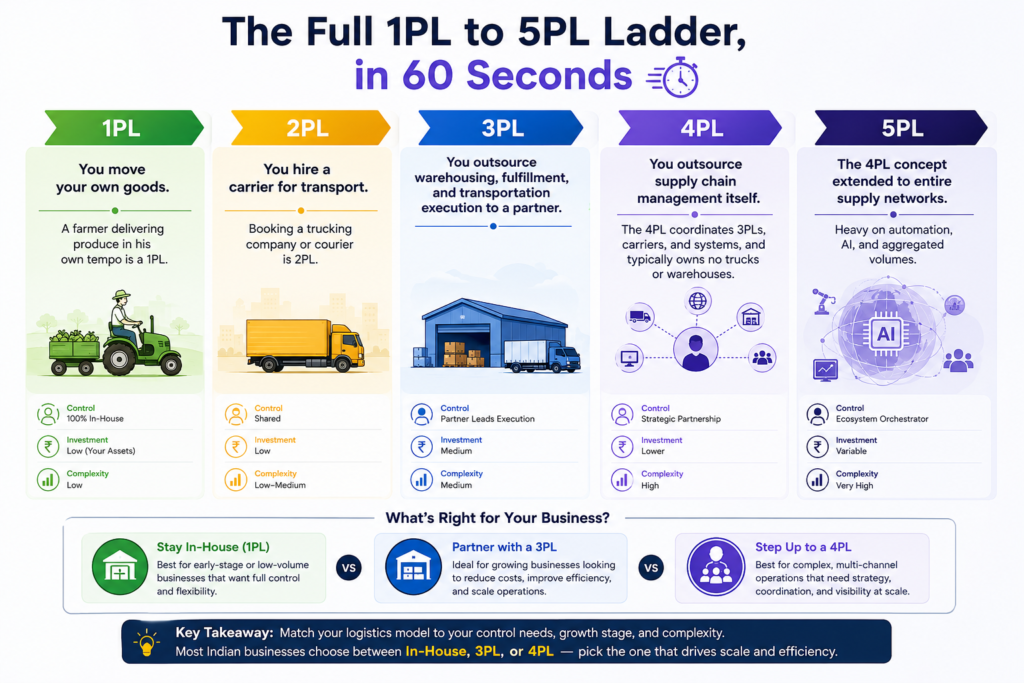
For most Indian businesses, the real choice sits between three options: staying in-house, partnering with a 3PL, or stepping up to a 4PL. So let’s weigh each one properly.
In-House Logistics: Full Control, Full Responsibility
There is a reason many companies start here. When volumes are small and products are simple, running your own storeroom and dispatch desk feels natural. And in some cases, staying in-house makes complete sense even at scale.
Where In-House Logistics Wins
- Total control. Every process, every SLA, every hire is yours to shape. For businesses with unusual handling needs or strict quality protocols, that control is valuable.
- Direct customer feedback loop. Your own dispatch team hears about problems immediately, without a partner in between.
- Potentially lower long-run cost at steady, high volumes. If your demand is stable and your facility runs near capacity year-round, owning the operation can beat paying a provider’s margin.
Where It Hurts
- Capital gets locked up. Warehouse leases, racking, material handling equipment, a WMS, and a trained team demand serious upfront investment. That is money not going into product or marketing.
- Scaling is slow and lumpy. Growing from one warehouse to three means months of hiring, leasing, and setup. Seasonal spikes are worse; you staff for peak and pay for it all year.
- Expertise is expensive. Freight negotiation, compliance, warehouse engineering, and logistics technology are full-time specialisations. Building that bench in-house is costly, and losing one key manager can wobble the whole operation.
Here is a simple gut check. If your team is spending more energy running logistics than improving your product, or if fulfillment breaks every festive season, you have probably outgrown your logistics setup.
What Is a 3PL, and What Do You Actually Get?
A third-party logistics provider takes over the physical execution of your supply chain. In practice, a good 3PL delivers four things:
- Warehousing and storage, often across multiple locations, so your inventory sits closer to your customers.
- Fulfillment operations: receiving, putaway, picking, packing, kitting, and dispatch.
- Transportation management, including carrier contracts, freight consolidation, LTL services, and last-mile coordination.
- Value-added services such as labelling, quality checks, returns processing, and reverse logistics.
The Case for a 3PL
The economics are the headline. A 3PL spreads warehouse, technology, and labour costs across many clients, so you pay for what you use instead of building everything yourself. Capex becomes opex. According to DHL, that shift is the single biggest reason mid-sized businesses outsource.
Scalability comes next. Festive surge? New region? A capable 3PL absorbs volume swings that would break an in-house setup. This flexibility is exactly what a fast-growing fashion brand needed in our 3PL solution for a leading apparel and fashion retailer.
Then there is focus. Every hour your leadership does not spend on freight rates is an hour spent on product, customers, and growth. That reallocation of attention, more than any line-item saving, is where outsourcing pays off. We explored this shift in from cost reduction to value creation.
The Trade-Offs
Honesty time. Outsourcing means sharing control. If your 3PL has a bad week, your customers experience it as your bad week. Communication gaps, misaligned SLAs, or a partner who treats you as a small account can all sting.
The fix is not avoiding 3PLs; it is choosing well and contracting well. Our guide on selecting the right 3PL for outsourcing your logistics walks through the evaluation criteria that matter.
What Is a 4PL, and Who Really Needs One?
Now for the layer above. A fourth-party logistics provider does not primarily run warehouses or trucks. Instead, it designs, manages, and optimises your entire supply chain, coordinating multiple 3PLs, carriers, customs agents, and technology platforms on your behalf.
The classic analogy: if 3PLs are the musicians, the 4PL is the conductor.
What a 4PL Brings to the Table
- A single point of contact. One partner accountable for the whole chain, instead of you juggling five vendor relationships.
- Control tower visibility. Integrated dashboards across warehouses, carriers, and borders, so you see the entire network in one place.
- Strategic optimisation. Network design, mode selection, inventory placement, and procurement leverage across providers.
- Neutrality. Because most 4PLs are asset-light, they can pick the best 3PL for each task instead of pushing their own facilities.
As Maersk’s guide to logistics models puts it, a 4PL manages the supply chain end to end while 3PLs execute within it.
The Trade-Offs
A 4PL adds a management layer, and that layer has a price. For businesses with straightforward supply chains, the extra orchestration can be overkill. You also step one level further away from daily operations, which demands deep trust and airtight governance. In contrast to a 3PL relationship, unwinding a 4PL engagement is harder because the provider holds your supply chain’s institutional knowledge.
Who genuinely benefits? Enterprises running complex, multi-region networks: think a manufacturer sourcing from three countries, selling through distributors, marketplaces, and D2C, with in-plant logistics, just-in-time distribution, cold chain, and regular exports in the mix. If that sounds like your operation, a 4PL conversation is worth having. If you run one product line out of two warehouses, it probably is not. Yet.
3PL vs 4PL vs In-House: Side-by-Side Comparison
Here is the whole decision on one table:
| Factor | In-House | 3PL | 4PL |
|---|---|---|---|
| Who executes | Your team | Provider’s team | Provider’s network of 3PLs |
| Who manages strategy | You | You | The 4PL, with you |
| Assets | You own/lease all | Provider owns/operates | Typically asset-light |
| Upfront investment | High (capex) | Low (pay-per-use) | Low, plus management fee |
| Scalability | Slow, expensive | High | Very high |
| Control over operations | Complete | Shared | Delegated |
| Technology | You build/buy | Provider’s WMS/TMS | Integrated control tower |
| Best for | Stable volumes, special handling | Growing businesses, seasonal demand | Large, complex, multi-region chains |
| Biggest risk | Locked capital, slow scaling | Partner dependency | Distance from operations |
Screenshot that table. It settles most boardroom debates faster than an hour of discussion.
Is Amazon a 3PL or a 4PL?
This question comes up constantly, so let’s clear it up. Fulfillment by Amazon (FBA) is a 3PL service: Amazon stores your inventory, packs orders, and delivers them using its own network. It executes.
However, Amazon is not managing your entire supply chain, negotiating with other providers on your behalf, or redesigning your network. That orchestration role belongs to a 4PL. So FBA sellers using a separate warehouse for offline channels, plus their own import pipeline, still have nobody playing conductor. That gap is exactly where many scaling brands feel the pain.
The Cost Question: Which Model Is Cheaper in India?
Ah, the question every CFO asks first. The honest answer: it depends on volume stability, not just volume size.
India’s logistics costs have long hovered near 13 to 14% of GDP by popular estimates (though the real meaning behind that number deserves scrutiny), roughly double the share in developed markets. Whichever model trims your slice of that pie wins.
A rough framework:
- In-house wins when demand is stable, utilisation stays high year-round, and your handling needs are so specific that providers would charge a premium anyway.
- 3PL wins when demand fluctuates, you are expanding to new regions, or your volumes cannot yet justify dedicated infrastructure. You convert fixed costs into variable costs and skip the capex entirely.
- 4PL wins when your spend is already large and fragmented across many providers, and coordination overhead, not warehouse rent, is your biggest leak. The 4PL’s procurement leverage and network optimisation typically recover more than its fee.
One more Indian nuance: if you import goods or serve global markets, models like FTWZ warehousing can defer duties and cut costs dramatically. Our comparison of bonded warehouse vs FTWZ covers when each makes sense, and why FTWZ may be the best route for entering the India market. Add customs clearance and freight forwarding into the same partner relationship, and the coordination savings compound further.
A Quick Worked Example
Let’s make the cost logic concrete. Imagine a consumer durables brand shipping 15,000 orders a month from a leased 25,000 sq ft warehouse in NCR.
In-house, the maths typically stacks up like this: warehouse lease and utilities, a 20-person team with supervisors, racking and equipment amortisation, a WMS licence, plus freight contracts negotiated at modest volumes. Divide the total by 15,000 orders and the real cost per order is usually far higher than anyone in the boardroom assumed. Then add the hidden line items: pilferage, errors, and the ops manager’s weekends.
The same operation inside a multi-client shared warehousing facility shares rent, labour, equipment, and technology across several brands. The brand pays per order or per unit stored, freight rides on the 3PL’s consolidated volumes, and the festive spike is absorbed by flexing shared manpower. Costs rise and fall with sales instead of sitting fixed through lean months.
Is the 3PL route always cheaper on paper? Not necessarily in a peak month. Across a full year of seasonal swings, however, the variable model usually wins, and it wins bigger when you add back the leadership time it frees up.
What About a Lead Logistics Provider (LLP)?
You will also hear the term LLP thrown around in 3PL vs 4PL discussions. A lead logistics provider is essentially a 4PL role played by a company that also has 3PL roots: one partner takes the lead on managing your whole logistics network, including other providers, while possibly executing part of the work itself.
For many Indian businesses, this hybrid is the practical sweet spot. You get orchestration and a single point of accountability, plus a partner with real operating experience on the ground rather than a pure consultant. When evaluating providers, ask whether they can grow with you from execution into an LLP role, so you are not forced to switch partners as complexity increases.
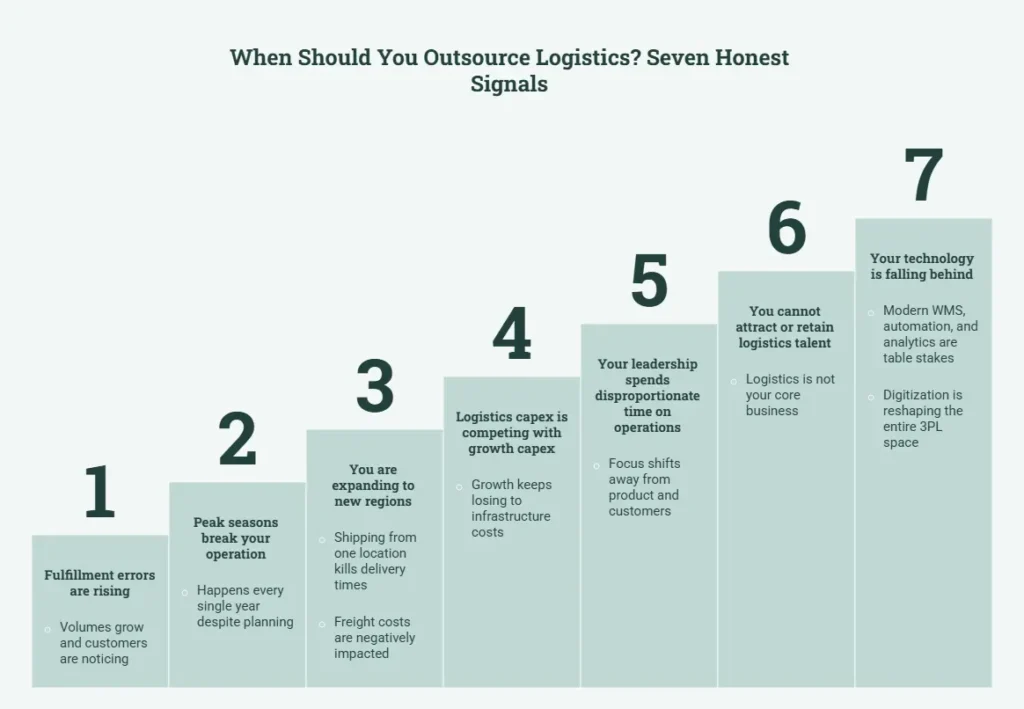
When Should You Outsource Logistics? Seven Honest Signals
Not sure where you stand? These triggers usually mean it is time to move from in-house to a 3PL:
- Fulfillment errors are rising as volumes grow, and customers are noticing.
- Peak seasons break your operation every single year, despite planning.
- You are expanding to new regions and shipping everything from one location is killing delivery times and freight costs.
- Logistics capex is competing with growth capex, and growth keeps losing.
- Your leadership spends disproportionate time on operations instead of product and customers.
- You cannot attract or retain logistics talent because it is not your core business.
- Your technology is falling behind. Modern WMS, automation, and analytics are table stakes now, and digitization is reshaping the entire 3PL space.
And the upgrade trigger from 3PL to 4PL? When you find yourself managing four or more logistics vendors, reconciling their reports manually, and nobody in your company can see the supply chain end to end. Coordination cost is the tell.
How to Choose: A Simple Decision Framework
Therefore, instead of asking “which model is best,” ask these four questions in order:
- Is logistics a competitive differentiator or a supporting function for us?
If your entire value proposition is delivery experience, keep more control. For most businesses, logistics supports the core rather than being the core, which favours outsourcing.
- How predictable is our demand?
Stable and high: in-house can work. Growing or seasonal: 3PL. Complex and multi-market: 4PL territory.
- What can we afford to lock up in capex?
Warehouses, equipment, and systems are multi-year commitments. If flexibility matters more than ownership, rent the capability.
- Do we have the management bandwidth?
An in-house operation needs leaders. A 3PL needs a strong ops manager to govern the partnership. A 4PL needs an empowered supply chain head who can steer strategy. Match the model to the bench you actually have.
Notice something? The answer often changes with growth stage. Plenty of businesses run in-house until product-market fit, move to a 3PL through their scaling years, and consider 4PL orchestration once complexity multiplies. There is no shame in changing models; there is only cost in changing too late.
A real-world example: a leading power back-up manufacturer came to us juggling exactly this dilemma, and the 3PL case study shows how outsourced warehousing and distribution freed their team to focus on manufacturing. On the global side, our logistics solution for a UK fashion retailer shows the same principle across borders.
The India Angle: Why This Decision Is Bigger Right Now
Timing matters, and the timing is unusual. India’s logistics market was valued around USD 228 billion in 2024 and is projected to approach USD 429 billion by 2033. GST unified the market and made hub-based warehouse networks viable. Infrastructure corridors are compressing transit times. Meanwhile, customer expectations set by quick commerce keep rising, pushing every supply chain toward being more customer-focused.
What does that mean for your decision? Three things:
- The gap between professionally run logistics and improvised logistics is widening. Specialised sectors like cold chain logistics in India show how quickly capability requirements are rising.
- 3PL and 4PL capability in India has matured sharply, so the outsourcing option is far stronger than it was even five years ago.
- Businesses that lock into rigid, self-built infrastructure today may find themselves outflanked by competitors who stayed flexible.
In short, the cost of choosing wrong has gone up, and so has the payoff for choosing well.
Making the Switch: How to Transition From In-House to a 3PL Smoothly
Decided to outsource? The transition matters as much as the choice. A rushed handover creates the very service dips you were trying to escape. Four rules keep it clean:
- Run a structured selection, not a rate-card beauty parade. Share real order profiles, SKU counts, and seasonality data with shortlisted providers so quotes reflect reality.
- Pilot before you migrate. Move one region, channel, or product line first. Prove the SLAs, then scale the partnership.
- Migrate data early. SKU masters, dimensions, batch rules, and historical demand should be in the 3PL’s WMS and tested weeks before go-live.
- Keep a governance rhythm. Weekly ops calls for the first quarter, monthly KPI reviews after, and a clear escalation matrix. Partnerships drift without cadence.
Handled this way, most businesses complete the shift within a quarter, and the operations team’s first reaction is usually relief.
Common Mistakes to Avoid (Whichever Model You Pick)
- Comparing a 3PL quote against incomplete in-house costs. Count rent, salaries, equipment depreciation, software, errors, and management time, not just rent.
- Outsourcing chaos. A broken process handed to a 3PL is still broken. Clean your data and processes first, or choose a partner who will fix them with you.
- Choosing on price alone. The cheapest provider with weak SLAs costs more within a year. Evaluate capability, technology, and cultural fit.
- Skipping the governance layer. Every outsourcing relationship needs defined KPIs, review cadences, and escalation paths from day one.
- Treating the decision as permanent. Revisit your model every 18 to 24 months. Your business changes; your logistics model should keep up.
Conclusion: Match the Model to Your Growth Stage
Let’s bring it home. In-house logistics gives you control but consumes capital and scales slowly. A 3PL gives you execution muscle, flexibility, and expertise while you keep strategic control. A 4PL takes over orchestration itself, which makes sense once your supply chain spans many partners, regions, and channels.
The 3PL vs 4PL vs in-house question has no universal winner. The right answer depends on your demand stability, capital priorities, complexity, and management bandwidth. Ask the four framework questions, be honest about the signals, and re-examine the choice as you grow.
Ready to figure out where your business fits? Genex Logistics has spent over a decade running 3PL and integrated supply chain operations across India and beyond, from apparel and retail to power and manufacturing. Browse our case studies to see the models in action, then talk to our team for a no-pressure assessment of your current logistics model and what a smarter setup could save you. Get in touch with Genex Logistics today.
Frequently Asked Questions
A 3PL (third-party logistics provider) executes logistics operations: warehousing, order fulfillment, transportation, and returns, usually using its own facilities and teams. A 4PL (fourth-party logistics provider) manages the entire supply chain strategically, coordinating multiple 3PLs, carriers, and technology platforms as your single point of contact. Put simply, a 3PL does the work while a 4PL directs the work, typically without owning warehouses or trucks itself.
The terms describe increasing levels of logistics outsourcing. 1PL means you move your own goods. 2PL means hiring a carrier for transport. 3PL means outsourcing warehousing and fulfillment execution. 4PL means outsourcing supply chain management and orchestration across providers. 5PL extends this to managing entire supply networks with heavy automation and data analytics.
Only in specific conditions: stable year-round demand, high facility utilisation, and enough scale to justify dedicated infrastructure and specialist staff. For growing or seasonal businesses, a 3PL is usually cheaper overall because it converts fixed capex into variable, pay-per-use costs and shares warehouse, technology, and labour expenses across many clients. Always compare the 3PL quote against your complete in-house cost, including salaries, software, errors, and management time.
The clearest signal is coordination overload: you manage four or more logistics vendors, reconcile their reports manually, and lack end-to-end supply chain visibility. Multi-region networks, multiple sales channels, frequent imports or exports, and cold chain or compliance-heavy operations also strengthen the case for a 4PL’s control tower approach and lead logistics provider role.
Evaluate warehouse network coverage, industry experience, technology stack (WMS, TMS, real-time visibility), scalability during peak seasons, value-added services like reverse logistics and kitting, financial stability, and cultural fit. Ask for case studies in your sector and clearly defined SLAs with review mechanisms. If you import or plan an India market entry, also check whether the provider offers FTWZ or bonded warehousing options, which can defer duties and improve cash flow.

Kapil Pathak is a Senior Digital Marketing Executive with over six years of experience specializing in the logistics and supply chain industry. His expertise spans digital strategy, search engine optimization (SEO), search engine marketing (SEM), and multi-channel campaign management. He has a proven track record of developing initiatives that increase brand visibility, generate qualified leads, and drive growth for D2C & B2B technology companies.