A decade ago, temperature-controlled distribution was a niche service used by a handful of pharmaceutical and seafood exporters. Today it is the backbone of India’s fastest-growing consumer categories, quick-commerce groceries, fresh dairy, packaged foods, vaccines, and high-value biologics. As consumer expectations shift toward fresh, safe, and rapidly delivered products, cold chain logistics in India has moved from a competitive advantage to an operational necessity.
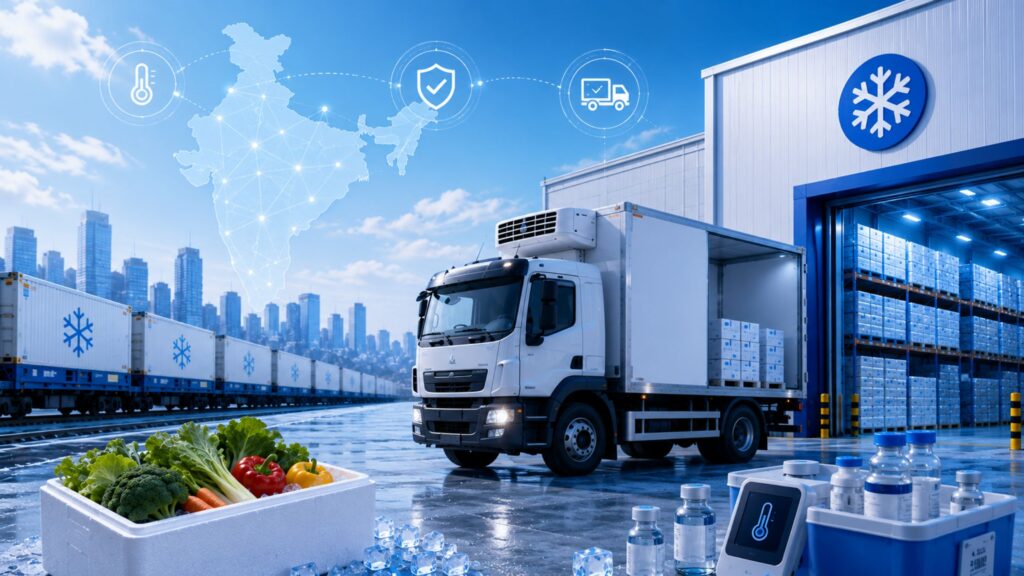
Yet the sector sits at a difficult crossroads. India’s cold chain market has crossed USD 12–25 billion (estimates vary by research firm and scope) and is projected to grow at a double-digit CAGR through the early 2030s. At the same time, the country still loses a significant share of its perishable produce to inadequate infrastructure, and businesses face rising energy costs, fragmented networks, and a tightening compliance environment.
This guide breaks down what cold chain logistics involves, the real challenges Indian businesses face, the compliance standards you cannot ignore, and the opportunities, including why a growing number of brands are choosing to outsource cold chain operations to a specialised 3PL partner.
What Is Cold Chain Logistics?
Cold chain logistics is a temperature-controlled supply chain that maintains a specific temperature range for perishable and temperature-sensitive goods, without interruption, from the point of origin to final delivery. Unlike standard “dry” logistics, a cold chain operates within strict biological, chemical, and physical parameters, and a single break in the thermal window can spoil an entire shipment.
A functioning cold chain rests on four core pillars:
- Refrigerated warehousing (cold storage): Temperature-controlled warehouse and storage facilities including pack houses, cold warehouses, ripening chambers, and pre-cooling units positioned at strategic points in the network.
- Refrigerated transportation (reefer fleets): Reefer trucks, refrigerated rail containers, and multimodal units with active refrigeration to protect goods from external temperature swings.
- Thermal packaging: Insulated containers, gel packs, and phase-change materials that hold temperature during handling and last-mile delivery.
- End-to-end telematics: IoT sensors, data loggers, and GPS tracking that provide continuous, auditable visibility into temperature, humidity, and location.
Common temperature bands include 2°C to 8°C for most pharmaceuticals and dairy, 15°C to 25°C for controlled-room-temperature medicines, and -18°C and below for frozen foods and certain biologics.
Why Cold Chain Logistics Matters in India
India is one of the world’s largest producers of fruits, vegetables, milk, and marine products, but production advantage means little without the infrastructure to preserve and move it. Cold chain logistics matters for four reasons:
Reducing food wastage. A large share of India’s horticultural output is lost after harvest due to inadequate cold storage and handling. Effective cold chains keep produce fresh from farm to shelf, protecting both value and food security.
Supporting pharma and vaccine distribution. India is a global pharmaceutical manufacturing hub. Vaccines, biologics, and many medicines require unbroken temperature control through specialised pharma and healthcare logistics, and the stakes are measured in patient safety, not just spoilage.
Boosting farmer income and exports. Cold storage lets producers hold stock and reach distant or international markets without quality loss, improving price realisation and opening seafood, dairy, and processed-food export opportunities.
Powering organised retail and e-commerce. Supermarkets, online grocery, and quick-commerce platforms depend entirely on reliable cold storage and refrigerated last-mile delivery to meet customer expectations for fresh and frozen goods, part of the broader shift toward a customer-focussed supply chain.
Key Challenges in Cold Chain Logistics in India
For all its growth, the sector is bottlenecked by structural problems that any business operating a cold chain must plan around.
Infrastructure gaps. Cold storage capacity remains insufficient and unevenly distributed. Much of it is concentrated in specific regional belts and skewed toward a few commodities, leaving large gaps in production zones and consumption centres alike.
High operational costs. Cold chain is asset- and energy-heavy. Electricity alone can account for a substantial share of operating expenses, on top of refrigeration maintenance, diesel for reefer fleets, and equipment upgrades. These costs weigh heavily on smaller operators, and they feed into the reason logistics costs run close to 13% of India’s GDP, well above global benchmarks.
Unreliable power supply. Cold storage depends on continuous electricity. In regions with an inconsistent grid, businesses fall back on diesel generators, driving costs higher and adding emissions.
Fragmented supply chains. India’s logistics ecosystem involves many independent stakeholders, producers, transporters, warehouse operators, and retailers. Poor coordination between them creates delays, handling gaps, and thermal breaks.
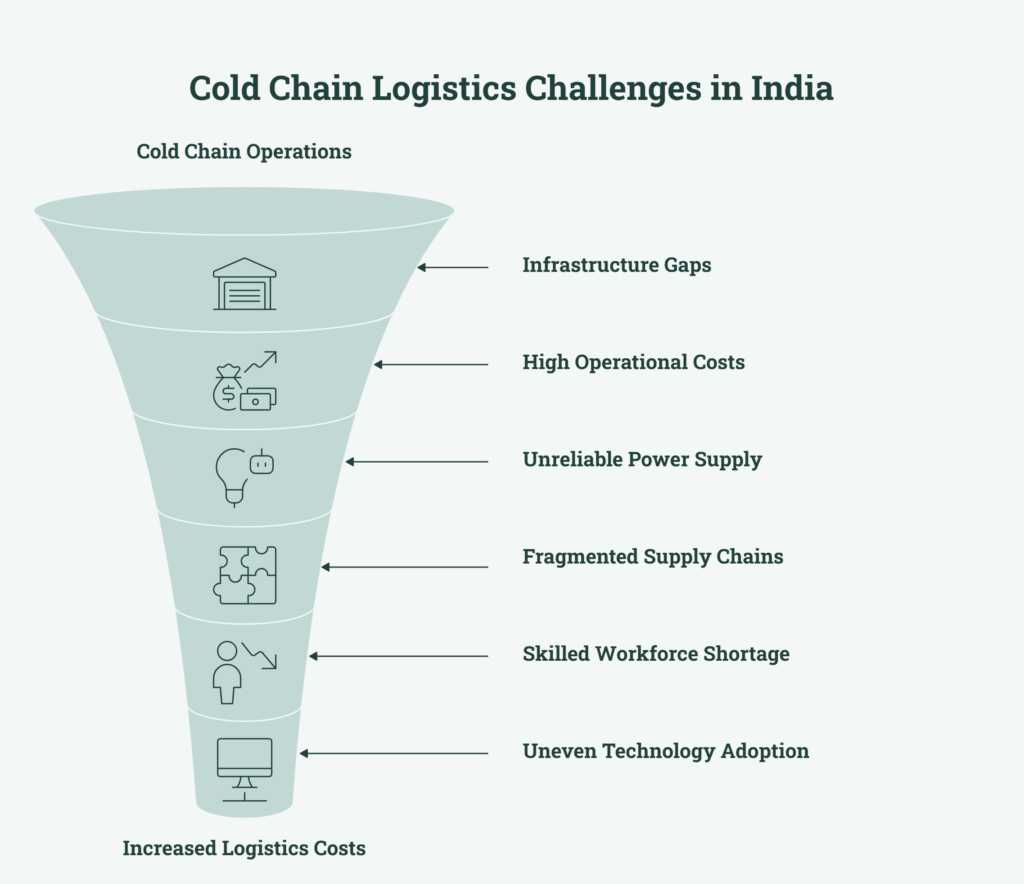
Skilled workforce shortage. Cold chain operations need specialised skills in refrigeration engineering, temperature monitoring, quality assurance, and compliance, capabilities in short supply across the country.
Uneven technology adoption. IoT monitoring, automation, and analytics are available, but high implementation costs and limited technical expertise mean adoption is patchy, especially among smaller firms.
Regulatory complexity. Companies handling food, beverages, and medicines must meet multiple safety and quality standards, and requirements can vary across states, adding cost and complexity to any pan-India network.
Environmental pressure. Cold chains are energy-intensive and increasingly face pressure to cut emissions, improve efficiency, and adopt sustainable refrigeration.
Compliance: The Standards You Cannot Ignore
Compliance is where many cold chains quietly fail, and where a serious operator distinguishes itself. Regulators and customers alike now expect documented, auditable proof that the thermal window was never broken. The standards below matter most in India.
FSSAI (Food Safety and Standards Authority of India). Any business storing or transporting food products must comply with FSSAI norms covering hygiene, temperature control, and traceability. Increasingly, buyers prefer logistics partners who hold FSSAI registration alongside food-safety management certifications.
WHO Good Distribution Practices (GDP). For pharmaceuticals, GDP compliance is the benchmark. It requires validated transport lanes, temperature mapping of storage and vehicles, continuous data logging (often at 15-minute intervals), chain-of-custody documentation, and trained personnel. GDP-compliant transport typically supports distinct bands for 2°C–8°C, 15°C–25°C, and -18°C cargo.
ISO 22000 and HACCP. These food-safety management and hazard-analysis frameworks are widely expected of cold storage and food-logistics providers, giving customers confidence that risks are systematically identified and controlled.
Additional certifications. Depending on the cargo and lanes, providers may also hold AEO (Authorised Economic Operator), MPEDA (for marine exports), EIA, and other sector-specific accreditations.
The practical takeaway: compliance is no longer a checkbox. Validated temperature mapping, digital logging, audit trails, and trained drivers are becoming table stakes, and a compliance failure can mean rejected shipments, regulatory penalties, and lost contracts.
Understanding Cold Chain Costs in India
Cold chain is significantly more expensive than dry logistics, and understanding the cost structure is essential to planning a profitable operation. The main cost drivers are:
- Energy: Refrigeration is the single largest recurring expense, often the largest share of operational cost, and it is highly sensitive to grid reliability and fuel prices.
- Fleet and fuel: Reefer units consume diesel both to move and to cool, making transport costs materially higher per kilometre than ambient freight.
- Infrastructure and maintenance: Cold storage carries high capital costs and ongoing maintenance for refrigeration systems, backup power, and monitoring equipment.
- Compliance and monitoring: Sensors, data-logging systems, audits, mapping, and trained staff all add cost, but reduce the far larger cost of spoilage and rejected loads.
- Wastage risk: Every thermal break carries the risk of losing high-value cargo, so the “cost” of a weak cold chain is often hidden in write-offs rather than line items.
Because these costs are largely fixed and utilisation-dependent, achieving scale and high asset utilisation is the single biggest lever for bringing per-unit cost down, a key reason many brands outsource rather than build in-house (more on that below). Handled well, cold chain is also where logistics shifts from cost reduction to genuine value creation.
Opportunities Driving the Indian Cold Chain Market
The same pressures creating challenges are also creating substantial opportunity for businesses that get cold chain right.
Food processing boom. India’s food and beverage processing sector continues to expand, with rising demand for packaged, frozen, and ready-to-cook products pulling investment into cold chain infrastructure across the value chain.
Pharma and vaccine growth. Expanding domestic production of vaccines, biosimilars, and specialty medicines is driving demand for advanced, GDP-compliant cold chain solutions.
Quick-commerce and e-grocery. Online grocery and 10-minute delivery models depend on dense networks of cold storage and refrigerated last-mile delivery, a natural fit for e-commerce logistics and one of the fastest-growing cold chain segments in urban India.
Government support. Programmes such as the Pradhan Mantri Kisan SAMPADA Yojana, the PM Gati Shakti National Master Plan, NABARD-backed cold storage projects, and the broader National Logistics Policy are channelling investment and improving connectivity to reduce wastage and strengthen the network.
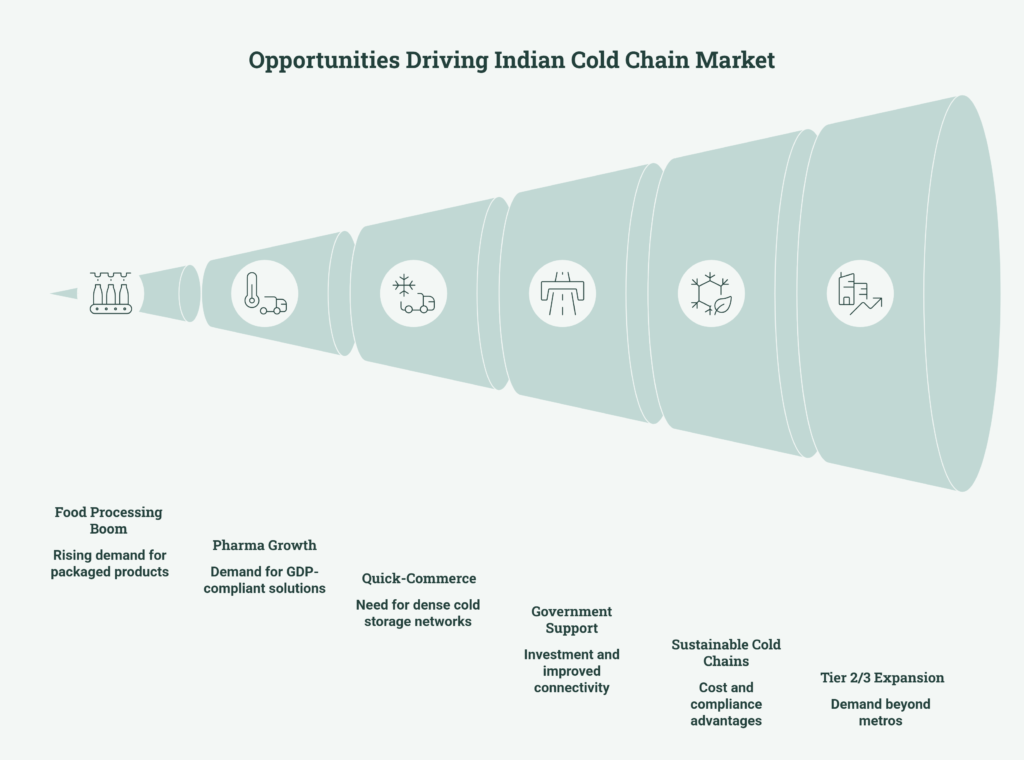
Sustainable cold chains. Solar-powered cold storage, energy-efficient refrigeration, and cleaner reefer fleets are emerging as both a cost and compliance advantage, and a way to meet growing ESG expectations. It is a live question of how the logistics of the future balances speed against the environment.
Tier 2 and Tier 3 expansion. Rising incomes and changing consumption in smaller cities are extending demand for fresh and frozen products well beyond the metros, opening new geographies for cold chain investment.
Export potential. Better cold chain infrastructure helps Indian seafood, produce, dairy, and processed foods meet international quality standards and grow in global markets, where instruments like a Free Trade Warehousing Zone (FTWZ) can further streamline cross-border trade.
The Role of Technology
Technology is closing many of the sector’s oldest gaps, reflecting the wider impact of digitization in the 3PL space. IoT sensors deliver real-time monitoring of temperature, humidity, and equipment performance, flagging deviations before they become losses. AI-driven demand forecasting sharpens inventory planning and cuts waste, while route-optimisation analytics reduce delivery times and fuel costs. Blockchain is beginning to add tamper-proof traceability across the chain, and warehouse automation is improving accuracy and throughput in cold storage. For any modern cold chain, digital visibility is no longer optional; it is the mechanism that turns compliance from a promise into proof.
Why Partner With a 3PL for Cold Chain Logistics
Building a compliant, technology-enabled cold chain in-house means heavy capital investment in reefer fleets and cold storage, specialised talent that is hard to hire, and the ongoing burden of certifications and audits, all before achieving the scale that makes the economics work. This is why a growing number of food, pharma, and D2C brands outsource cold chain operations to a specialised third-party logistics (3PL) partner. If your business has outgrown its current logistics setup, it is worth knowing how to select the right 3PL for outsourcing.
A capable cold chain 3PL delivers advantages that are difficult to replicate alone:
- Ready infrastructure and scale. Established cold storage and reefer networks mean you avoid large upfront capital outlay and benefit from the high asset utilisation that keeps per-unit costs down.
- Built-in compliance. A serious 3PL already operates FSSAI-registered, GDP-compliant, ISO/HACCP-certified facilities with validated temperature mapping and audit-ready documentation.
- End-to-end visibility. Integrated IoT monitoring and real-time dashboards give you continuous, auditable proof of temperature integrity across storage and transit.
- Flexibility. Seasonal capacity, multi-temperature handling, value-added services, and Tier 2/3 reach can be scaled up or down without you carrying idle assets.
- Focus. Your team stays focused on product, brand, and demand while the logistics partner absorbs the operational and regulatory complexity.
For businesses scaling into new categories or geographies, the right 3PL turns cold chain from a capital-heavy risk into a variable, compliant, and scalable service, the foundation of 3PL and contract logistics done right.
Ready to strengthen your cold chain? Genex Logistics provides integrated, compliant, and technology-enabled cold chain and 3PL solutions across India. Talk to our team to design a temperature-controlled supply chain built for your products.
Frequently Asked Questions
It is the process of storing and transporting temperature-sensitive products, like food, medicines, and vaccines, under continuous, controlled temperature conditions so their quality and safety are preserved from origin to final delivery.
It reduces post-harvest food wastage, supports safe distribution of pharmaceuticals and vaccines, improves farmer incomes and exports, and enables the fresh and frozen deliveries that modern retail and quick-commerce depend on.
The biggest challenges are infrastructure gaps and uneven distribution, high energy and operating costs, unreliable power supply, fragmented supply chains, a shortage of skilled workers, uneven technology adoption, and regulatory complexity.
Key standards include FSSAI norms for food, WHO Good Distribution Practices (GDP) for pharmaceuticals, and ISO 22000 / HACCP food-safety certifications, along with sector-specific accreditations such as AEO and MPEDA depending on the cargo.
Food and beverage, pharmaceuticals and healthcare, dairy, fisheries and seafood, agriculture and horticulture, frozen foods, and online grocery and quick-commerce platforms.
For most brands, yes, outsourcing to a compliant 3PL avoids heavy capital investment, provides ready infrastructure and certifications, delivers real-time visibility, and scales flexibly, letting the business focus on its core products

Kapil Pathak is a Senior Digital Marketing Executive with over six years of experience specializing in the logistics and supply chain industry. His expertise spans digital strategy, search engine optimization (SEO), search engine marketing (SEM), and multi-channel campaign management. He has a proven track record of developing initiatives that increase brand visibility, generate qualified leads, and drive growth for D2C & B2B technology companies.