Ten minutes. That is how long a customer in Gurgaon or Indiranagar now expects to wait for milk, a phone charger, or a birthday candle. And while the delivery rider gets all the attention, the real story sits behind an unmarked shutter a few streets away.
Quick commerce warehousing is quietly forcing the biggest redesign of Indian warehouses in a generation. The mega fulfillment center on the highway has not disappeared, but it now has hundreds of tiny, fast-moving cousins inside the city. For brands, and for the 3PL partners who serve them, the rules of warehouse design, location, and operations have changed.
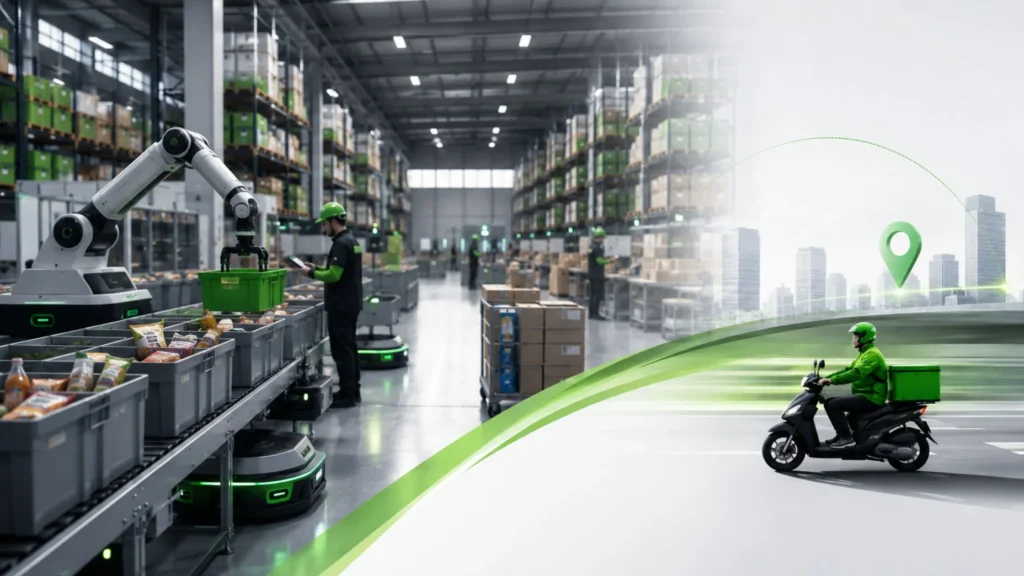
In this guide, we will break down what quick commerce actually is, how a dark store warehouse works, how it differs from a regular fulfillment center, and what the mother hub and spoke model means for 3PL warehousing design in India. We will also cover what all of this means for your brand if your products are selling (or should be selling) on Blinkit, Zepto, or Swiggy Instamart.
Let us start at the beginning.
What Is Quick Commerce, and How Big Is It in India?
Quick commerce, often shortened to q-commerce, is the delivery of everyday products in 10 to 30 minutes. Think groceries, snacks, personal care, medicines, electronics accessories, and increasingly apparel and toys.
The difference from regular e-commerce is not just speed. It is a completely different supply chain. Traditional e-commerce ships from large warehouses outside the city and takes one to three days. Quick commerce stocks a curated range of products inside the city, within two to three kilometres of your doorstep, so an order can be picked, packed, and handed to a rider within two or three minutes of you tapping “place order.”
The scale in India is hard to ignore. The quick commerce market in India stands at roughly USD 3.65 billion in 2026 and is projected to more than double by 2031. Blinkit alone operated more than 1,800 dark stores by mid-2026, up from under 800 a year earlier. Zepto and Swiggy Instamart each run over a thousand. Flipkart Minutes, BigBasket’s BB Now, and Amazon Now are expanding fast behind them.
Every one of those numbers is a warehouse. A small, dense, oddly shaped warehouse, but a warehouse all the same. Which brings us to the format at the centre of it all.
Dark Store Warehouse: The New Format Reshaping Urban Warehousing in India
What is a dark store in quick commerce?
A dark store is a small warehouse, usually 2,500 to 5,000 sq ft, that looks like a retail store on the inside but is closed to shoppers. No billing counters, no trolleys, no browsing. Only pickers, shelves, and a dispatch counter. Orders come in through the app, staff pick items from planogrammed shelves, and riders collect packed bags at the door.
The name comes from that simple fact: the store is “dark” to the public. It exists only to fulfil online orders, which is why the industry also calls these micro fulfillment centers or hyperlocal fulfillment nodes.
How big is a dark store in India?
Most dark stores in India fall between 2,500 and 5,000 sq ft, though newer large-format stores stocking 10,000 or more SKUs can stretch beyond that. Compare that with a typical 3PL fulfillment center of 50,000 to 200,000 sq ft, and you see the design challenge immediately. A dark store has to do serious throughput in a space smaller than many showrooms.
Three design choices make that possible:
- Curated assortment. A dark store carries roughly 2,000 to 4,000 fast-moving SKUs, chosen by hyperlocal demand data for that exact neighbourhood. A store near a student area stocks differently from one near family housing.
- High-density racking and tight slotting. Every shelf position is planned. Fast movers sit at waist height near the packing counter. Slow movers go up high or get delisted quickly.
- Short, fixed pick paths. Layouts are designed so a picker can complete an average order in 60 to 90 seconds of walking, not minutes.
Add a cold storage corner for dairy and frozen items, and you have a multi-temperature micro warehouse squeezed into the footprint of a large flat. Dark stores are even reshaping urban real estate demand, as operators compete for ground-floor spaces in dense residential pockets.
Quick Commerce vs E-commerce Warehousing: What Actually Changed?
It is tempting to treat a dark store as just a smaller warehouse. That would be a mistake. Almost every design assumption flips when your delivery promise drops from days to minutes.
Here is the side-by-side view:
| Design factor | Traditional e-commerce fulfillment center | Quick commerce dark store |
|---|---|---|
| Location | Outskirts, near highways, cheap land | Inside the city, 2 to 3 km from customers |
| Size | 50,000 to 200,000+ sq ft | 2,500 to 5,000 sq ft |
| SKU range | 50,000 to lakhs of SKUs | 2,000 to 4,000 curated SKUs |
| Inventory depth | Weeks of stock | 1 to 2 days of stock |
| Replenishment | Weekly or bi-weekly inbound | Daily, often nightly, from a mother hub |
| Order-to-dispatch time | 4 to 24 hours | 2 to 3 minutes |
| Picking method | Batch and wave picking across long aisles | Zone picking on short, fixed paths |
| Key metric | Cost per order, storage utilisation | Orders per hour, dispatch latency |
| Cold chain | Separate temperature-controlled zones | Compact multi-temperature corners in-store |
Notice the pattern? A traditional fulfillment center is designed around storage efficiency. A dark store is designed around speed of retrieval. Storage is almost an afterthought; the store holds only a day or two of inventory because space is too expensive to waste on stock that is not selling today.
That single shift, from storing goods to turning goods, drives everything else in quick commerce warehouse design. It also creates a new problem: if every dark store holds just one or two days of stock, something has to feed those stores relentlessly. Enter the mother hub.
The Mother Hub and Spoke Model: How 3PL Networks Are Being Redrawn
Here is the part most articles skip, and it is where 3PL warehousing design is changing the most.
A network of 50 dark stores in a city cannot each receive deliveries from 200 different brands every day. The trucks alone would choke the streets. Instead, quick commerce runs on a mother hub and spoke model:
- The mother warehouse (mother hub) is a conventional large warehouse on the city’s edge, often 50,000 sq ft or more. It receives bulk inbound from brands and 3PL partners, holds one to two weeks of city-level stock, and performs quality checks, labelling, and kitting.
- Spoke dark stores receive nightly or twice-daily replenishment from the mother hub, based on what each neighbourhood sold that day and what demand forecasting predicts for tomorrow.
- The replenishment window is brutal. Most inbound to dark stores happens between 11 pm and 6 am, so shelves are full before the morning rush. Put-away cycle time is measured in minutes per cage, not hours per truck.
Why does this matter for warehouse design? Because the mother hub is not a standard fulfillment center either. It is designed for case picking and store-wise sortation, not individual customer orders. Its dock design, staging lanes, and WMS logic revolve around building store-specific consignments at speed, closer to retail distribution than to e-commerce fulfillment.
For 3PL providers, this is a structural shift. The classic Indian 3PL network, built around a few large regional warehouses after GST, now needs a third layer: city-level hubs feeding hyperlocal nodes. Some 3PLs are going further and operating dark store networks themselves for platforms and D2C brands, because platforms are finding it expensive to own every piece of the infrastructure.
If you are wondering whether your current logistics network can handle this, our guide on the signs your business has outgrown its logistics setup is a useful gut check.
Inside Dark Store Design: SKUs, Slotting, and Throughput
Let us zoom into the store itself, because this is where quick commerce warehousing gets genuinely clever.
SKU curation is the first design decision
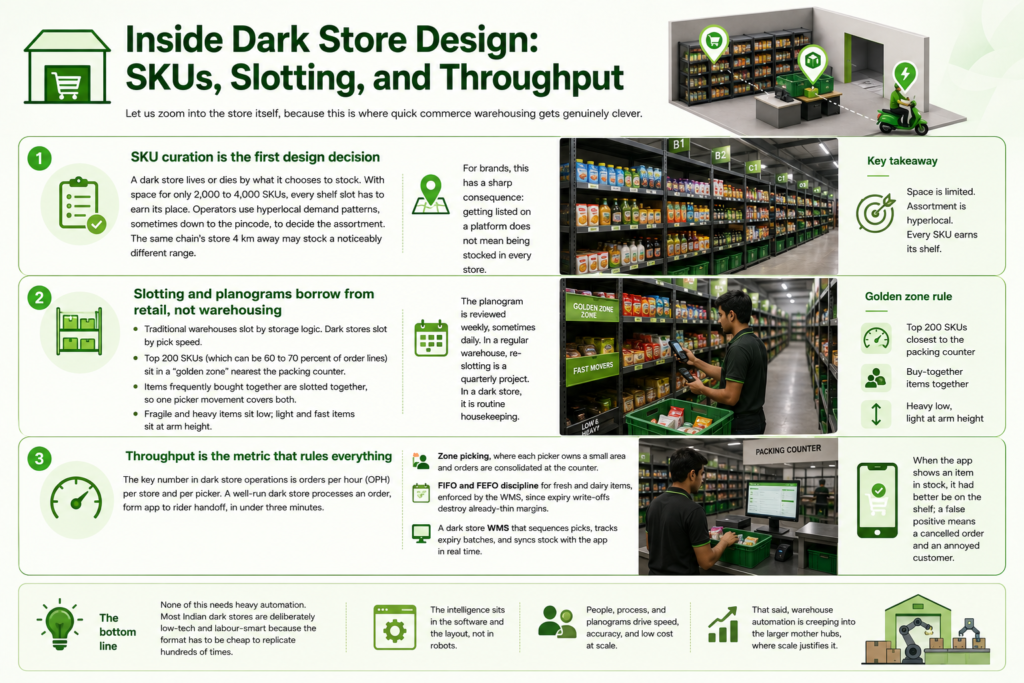
A dark store lives or dies by what it chooses to stock. With space for only 2,000 to 4,000 SKUs, every shelf slot has to earn its place. Operators use hyperlocal demand patterns, sometimes down to the pincode, to decide the assortment. The same chain’s store 4 km away may stock a noticeably different range.
For brands, this has a sharp consequence: getting listed on a platform does not mean being stocked in every store. Your product competes for shelf space daily, based on its sell-through in that micro-market.
Slotting and planograms borrow from retail, not warehousing
Traditional warehouses slot by storage logic. Dark stores slot by pick speed:
- Top 200 SKUs (which can be 60 to 70 percent of order lines) sit in a “golden zone” nearest the packing counter.
- Items frequently bought together are slotted together, so one picker movement covers both.
- Fragile and heavy items sit low; light and fast items sit at arm height.
The planogram is reviewed weekly, sometimes daily. In a regular warehouse, re-slotting is a quarterly project. In a dark store, it is routine housekeeping.
Throughput is the metric that rules everything
The key number in dark store operations is orders per hour (OPH) per store and per picker. A well-run dark store processes an order, from app to rider handoff, in under three minutes. That requires:
- Zone picking, where each picker owns a small area and orders are consolidated at the counter.
- FIFO and FEFO discipline for fresh and dairy items, enforced by the WMS, since expiry write-offs destroy already-thin margins.
- A dark store WMS that sequences picks, tracks expiry batches, and syncs stock with the app in real time. When the app shows an item in stock, it had better be on the shelf; a false positive means a cancelled order and an annoyed customer.
None of this needs heavy automation. Most Indian dark stores are deliberately low-tech and labour-smart because the format has to be cheap to replicate hundreds of times. The intelligence sits in the software and the layout, not in robots. That said, warehouse automation is creeping into the larger mother hubs, where scale justifies it.
3PL for Quick Commerce: What This Means for Your Brand
So far we have looked at this from the platform’s side. Now the more practical question: if you are a brand selling on Blinkit, Zepto, Swiggy Instamart, or Flipkart Minutes, what does quick commerce warehousing demand from you?
Quite a lot, as it turns out. Quick commerce is unforgiving to sellers who treat it like just another marketplace channel.
The compliance bar is higher than e-commerce
Platforms run tight inbound operations at their mother hubs. That means:
- Appointment-based inbound. Miss your PO delivery slot and your stock may be rejected or rescheduled days later, while your products show “out of stock” to customers.
- Strict fill-rate expectations. Consistently under-delivering against POs hurts your visibility on the platform.
- Batch, expiry, and labelling compliance. Especially for food, beverages, and personal care, incorrect batch documentation gets consignments turned away at the dock.
Your inventory has to sit closer to the action
A single national warehouse cannot serve quick commerce well. POs from platforms are city-specific and frequent, with short lead times. Brands increasingly need stock positioned in the same cities as the platforms’ mother hubs, ready to fulfil a PO within 24 to 48 hours.
This is exactly where a 3PL and contract logistics partner earns its keep. Instead of leasing your own space in six cities, you use shared warehousing close to platform hubs, with kitting and packing services to meet each platform’s labelling and case-pack rules.
A capable quick commerce 3PL partner typically handles:
- City-level stock positioning aligned to platform PO patterns
- Appointment scheduling and PO compliance for Blinkit, Zepto, and Instamart inbound
- Platform-specific packaging, labelling, and kitting
- Daily or alternate-day replenishment readiness with real-time stock visibility
- Returns and rejected-consignment handling, the unglamorous cousin of reverse logistics that quick commerce quietly generates
If you are still weighing whether to build this muscle in-house or outsource it, our comparison of 3PL vs 4PL vs in-house logistics walks through that decision in detail. And for the broader picture of how outsourcing lifts performance, see our guide on how 3PL solutions optimise supply chains for Indian businesses.
D2C brands: quick commerce is a shelf, not a channel
One mindset shift helps D2C founders more than any tactic. E-commerce is a catalogue; quick commerce is a shelf. Shelves are finite, local, and ruthless about sell-through. Winning means picking your hero SKUs, keeping fill rates high in your priority cities, and letting data, not sentiment, decide which products stay in the assortment.
The Hard Parts: Unit Economics, Real Estate, and Compliance
It would be dishonest to write about quick commerce warehousing without the difficult bits. Three challenges shape every design decision in this space.
Unit economics are thin. Small baskets, free or cheap delivery, and expensive urban real estate make profitability a grind. Several platforms have reported widening losses even as revenue grows. The pressure lands on the warehouse: every rupee of rent, every wasted shelf slot, and every expired unit matters. This is why dark stores hold so little inventory and why replenishment precision is treated as a survival skill.
Urban real estate is scarce and pricey. Ground-floor, road-facing spaces of 3,000 sq ft in dense neighbourhoods are exactly what restaurants, clinics, and retail chains also want. Dark store operators compete for them, which pushes rents up and forces creative choices: basements, first floors with goods lifts, and shared multi-brand micro hubs.
Compliance is multiplying. FSSAI requirements for food storage, weights and measures rules, local shop-and-establishment norms, and growing scrutiny of gig-worker conditions all touch dark store operations. Multi-city networks need compliance handled systematically, not store by store. It is a similar story to what we described in our cold chain logistics guide: the operators who treat compliance as a design input, not an afterthought, are the ones who scale.
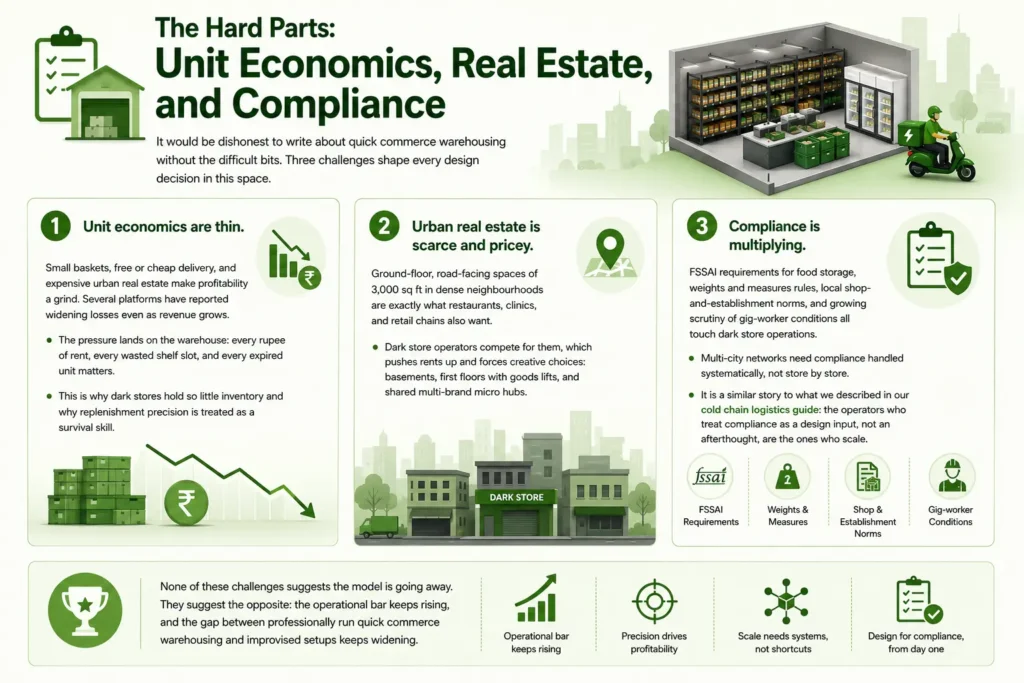
None of these challenges suggests the model is going away. They suggest the opposite: the operational bar keeps rising, and the gap between professionally run quick commerce warehousing and improvised setups keeps widening.
Where Quick Commerce Warehousing Goes Next
Three shifts are worth watching between now and 2028.
First, larger-format dark stores. Platforms are testing 8,000 to 10,000 sq ft stores carrying 10,000+ SKUs, blurring the line between a dark store and a small fulfillment center. Expect hybrid designs with a fast zone for 10-minute items and a slower zone for scheduled delivery.
Second, 3PL-operated dark store networks. As platforms chase profitability, more of them will hand parts of the infrastructure to logistics partners who can spread costs across clients, the same logic that built the 3PL industry in the first place.
Third, tier 2 expansion. Quick commerce is moving into Lucknow, Jaipur, Coimbatore, and beyond. Smaller cities mean smaller order densities, which will demand even sharper warehouse network design: fewer, smarter nodes rather than blanket coverage.
The Bottom Line
Quick commerce has not replaced traditional warehousing in India. It has added a new, demanding layer on top of it: hyperlocal, high-turn, design-obsessed micro warehouses fed by city-level mother hubs. For platforms, the warehouse is now the product. For brands, quick commerce success is won or lost in inbound compliance, city-level stock positioning, and fill rates long before the rider picks up the bag.
If your brand is scaling on Blinkit, Zepto, or Swiggy Instamart and your warehousing is struggling to keep pace, Genex Logistics can help. With PAN-India 3PL and contract logistics operations, shared warehousing near major consumption centres, and kitting, labelling, and distribution services built for platform compliance, we help brands turn quick commerce from a firefight into a channel that compounds. Talk to our team for a no-pressure review of your quick commerce readiness.
Frequently Asked Questions
A dark store is a small warehouse, typically 2,500 to 5,000 sq ft, set up like a retail store but closed to the public. It stocks 2,000 to 4,000 fast-moving SKUs curated for its neighbourhood and exists only to pick, pack, and dispatch online orders, usually within two to three minutes. Dark stores are the core infrastructure behind 10-minute delivery in India.
E-commerce warehousing uses large fulfillment centers outside cities, holds weeks of inventory across lakhs of SKUs, and optimises for storage cost. Quick commerce warehousing uses small dark stores inside cities, holds one to two days of stock across a curated assortment, and optimises for orders per hour and dispatch speed. Replenishment also differs: dark stores are restocked daily from a city mother hub, usually overnight.
It is a two-layer warehouse network. A large mother warehouse on the city’s edge receives bulk stock from brands, then sends nightly store-wise replenishment to dozens of spoke dark stores across the city. The mother hub is designed for case picking and store sortation, while dark stores are designed for rapid single-order picking. Together they make 10-minute delivery possible without each store needing its own supplier deliveries.
Yes, and increasingly so. Platforms use 3PLs for mother hub operations, city-level stock positioning, transportation, and in some cases fully operated dark store networks. Brands selling on Blinkit, Zepto, and Swiggy Instamart also use 3PL partners for warehousing near platform hubs, appointment-based PO inbound, platform-compliant labelling and kitting, and returns handling.
Brands are onboarded as sellers or vendors, after which platforms issue city-specific purchase orders based on demand. Success depends on operational discipline: delivering POs within appointment slots, maintaining high fill rates, meeting batch and expiry labelling norms, and holding inventory close to platform mother hubs. Many brands use a 3PL for quick commerce to manage this multi-city compliance without building their own warehouse networ

Kapil Pathak is a Senior Digital Marketing Executive with over six years of experience specializing in the logistics and supply chain industry. His expertise spans digital strategy, search engine optimization (SEO), search engine marketing (SEM), and multi-channel campaign management. He has a proven track record of developing initiatives that increase brand visibility, generate qualified leads, and drive growth for D2C & B2B technology companies.