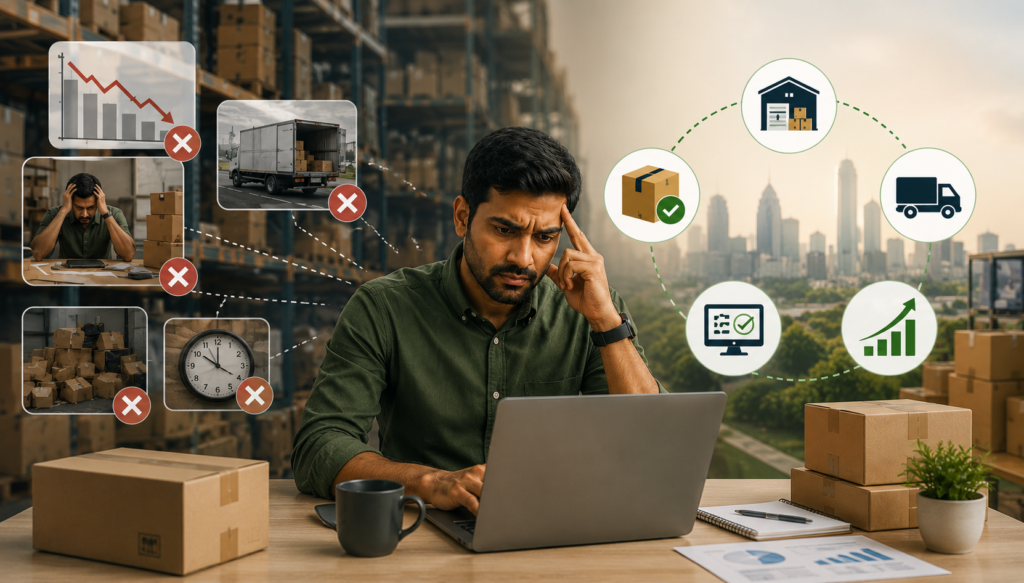
Every business founder loves the moment when orders start flooding in. But here is the thing nobody warns you about early enough: growth has a logistics shadow. And if you do not deal with it proactively, that shadow grows fast.
Maybe your warehouse team is struggling to keep pace. Maybe customers are calling about delayed shipments more than before. Maybe your freight costs are climbing every quarter with no clear reason why.
According to a Deloitte study, 79% of companies with high-performing supply chains achieve above-average revenue growth compared to peers. The inverse is equally true: logistics bottlenecks are among the most direct suppressors of business growth, and often the first clear sign a business has outgrown its logistics setup.
This article walks you through the ten clearest signs you have outgrown your logistics setup, and what your options are when you get there.
Sign #1: Your Warehouse Is Constantly Running Out of Space
If your team is regularly building makeshift overflow areas, using hallways for inventory, or blocking picking aisles with pallets, that is not a storage problem. That is a logistics scalability problem.
A useful benchmark: warehouses running above 85% capacity utilization are considered operationally at risk (Peerless Research Group). That buffer exists to absorb incoming stock, enable efficient picking, and handle demand surges without chaos.
Common warning signs to watch:
- Pallets blocking aisles or fire exits
- Seasonal stock arriving with no planned home
- Fast and slow-moving SKUs stored together, slowing down picking
- New product lines getting delayed at the receiving dock
More square footage alone will not fix this. You need better slotting, racking infrastructure, or a warehouse and storage partner who already has the capacity built and optimized. If you are unsure how efficiently your current space is being used, this cube space utilization quiz is a useful starting point.
Sign #2: Fulfillment Delays Are Becoming the Norm
Every business has the occasional late shipment. Carrier delays happen. But if the same customer is calling about the same problem twice, you are dealing with a systemic issue — not bad luck.
Research from McKinsey shows that companies with superior supply chain capabilities enjoy 30% lower operational costs and 15% less inventory carrying cost than their peers. Chronic fulfillment delays erode exactly these advantages.
At scale, fulfillment delays usually trace back to:
- Poor warehouse layout creating bottlenecks in picking and packing
- Understaffed packing stations during peak order periods
- Reactive dispatch planning — processing orders as they arrive, not by delivery priority
- No transportation management capability to route shipments efficiently
If your team is spending more time managing complaints than improving processes, your operations have likely crossed the threshold where 3PL and contract logistics support would make a measurable difference.
Sign #3: Inventory Accuracy Is Getting Worse
Walk into almost any warehouse that is growing faster than its systems, and you will find the same problem: what the system says is in stock and what is actually on the shelf are two different things.
According to Gartner, inventory accuracy at warehouses without a WMS sits between 65–75%. A properly implemented warehouse management system typically raises that to 99%+. That gap represents real money — in oversells, dead stock, emergency reorders, and customer refunds.
Poor inventory accuracy shows up as:
- Overselling — taking orders for items not actually available
- Dead stock locking up capital while fast-movers run short
- Shrinkage that cannot be traced because receiving is not systematically logged
- Manual stock counts taking days and going stale before they are finished
Read more about how 3PL and supply chain optimization can address inventory challenges at scale, and how technology-led operations bring accuracy to near-perfect levels.
Sign #4: Logistics Costs Are Rising Without a Clear Reason
Growing businesses expect logistics costs to increase with volume. But there is a meaningful difference between costs scaling proportionally and costs growing faster than revenue.
India’s logistics cost as a percentage of GDP has long been a structural challenge. As covered in Genex’s analysis of logistics costs as a share of GDP, inefficiencies compound quickly — and companies that do not optimize their logistics operations end up absorbing costs that well-run businesses avoid.
Common culprits behind rising per-unit logistics costs:
- Freight not being consolidated or routed efficiently
- High return processing costs from picking and packing errors
- Overtime becoming a permanent line item as capacity maxes out
- Premium courier rates from reactive, last-minute bookings
- Duplicate handling caused by poor warehouse slotting
If your operations team cannot explain clearly why freight costs rose 30% last quarter, that absence of insight is itself the problem.
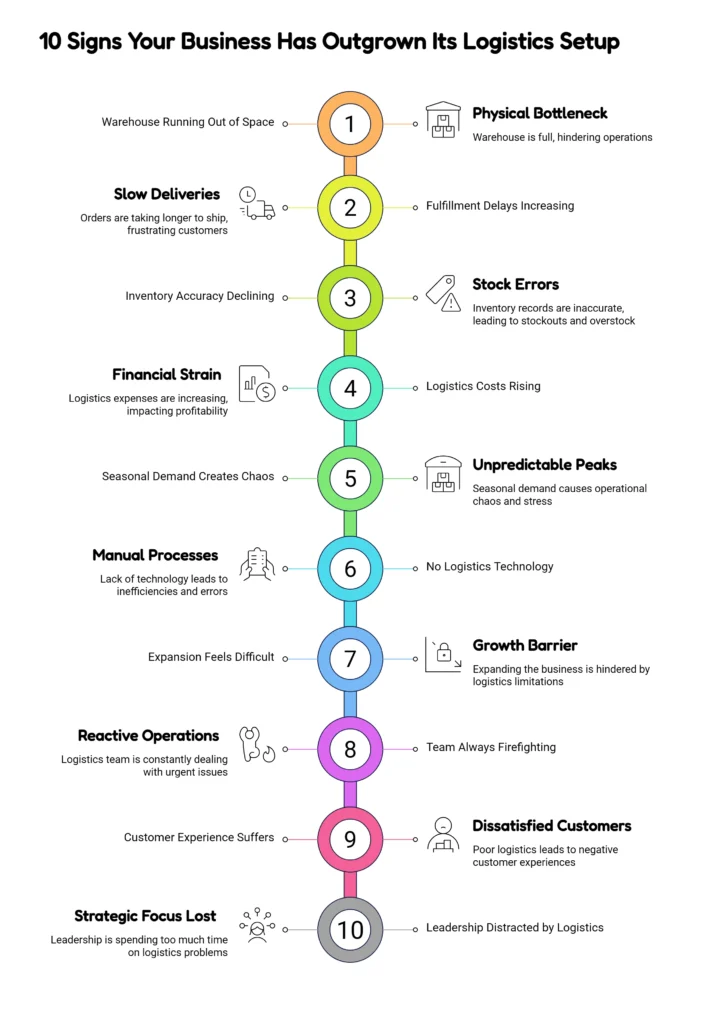
Sign #5: Seasonal Demand Spikes Create Operational Chaos
The Indian festive season — Diwali, end-of-year sales, Big Billion Days — can create demand surges of 3x to 5x normal volume for many categories. If handling this surge requires months of painful preparation and still results in chaos, your capacity planning is not where it needs to be.
Seasonal spikes expose specific structural weaknesses:
- Staffing flexibility — can you scale labor up quickly, then back down without permanent overhead?
- Space elasticity — can you absorb peak stock without crippling your regular operations?
- Carrier relationships — do you have pre-negotiated capacity, or are you scrambling at premium rates when every competitor is too?
Experienced 3PL operators have built their entire model around managing these peaks. Shared warehousing and pallet services are one practical option — paying only for the space and handling you actually use, which is particularly valuable when demand is seasonal or variable.
Sign #6: You Have No Real Logistics Technology
Running a growing logistics operation in 2025 without proper technology is a structural disadvantage — not just an inconvenience. Digitization in logistics has moved from a nice-to-have to a competitive necessity.
As explored in the impact of digitization in the 3PL space, businesses that adopt logistics technology consistently outperform those running on manual processes — in accuracy, speed, and cost control.
Technology gaps that signal your setup has hit its ceiling:
- No real-time inventory visibility across storage locations
- Stock management happening on spreadsheets or WhatsApp groups
- No WMS tracking putaway, pick paths, or accuracy rates
- No carrier performance data to hold partners accountable
- No dashboard showing cost per order fulfilled or on-time dispatch rates
Without data, you cannot improve. Without automation, you cannot scale. The good news: you do not have to build all this technology yourself. Modern 3PL partnerships include WMS platforms integrated with your e-commerce or ERP stack — without requiring enterprise-grade capital investment.
Sign #7: Expanding to New Markets Feels Logistically Impossible
Here is a quick test: if tomorrow you decided to start serving customers in Tier 2 cities in Maharashtra or Rajasthan, how quickly could your current logistics setup support that?
If the answer is “not without a significant project,” that is a logistics scalability constraint, and one that is directly limiting your revenue potential. It is also a clear sign you have outgrown your logistics setup.
Market expansion requires fulfillment points positioned for delivery speed and cost efficiency, carrier networks covering target geographies, reliable reverse logistics for returns from new markets, and road express capability for time-sensitive deliveries across Tier 2 and Tier 3 destinations.
When logistics infrastructure is thin, every new market feels like building from scratch. When it is robust and pre-networked, new geographies become a configuration change.
Sign #8: Your Team Is Always in Firefighting Mode
Talk to the operations manager of a business that has outgrown its logistics setup, and you will hear a common theme: there is no time to plan because there is too much to react to.
Firefighting mode in logistics looks like order management over WhatsApp, no time for root cause analysis, and leadership making logistics decisions on the fly rather than based on data.
When operations are in permanent crisis mode, two things happen. Your best operations people burn out — and they are hard to replace. And you can never get ahead of problems because you are always behind them. This is the point where external logistics expertise stops being a cost and starts being a release valve.
Sign #9: Customer Experience Is Taking a Hit
Your customers do not see your warehouse. They do not know your carrier partners. But they feel every delay, every wrong item in the box, and every difficult return.
According to a PwC customer experience study, 73% of consumers say delivery experience is a key driver of brand loyalty. The inverse is equally powerful — one bad delivery experience frequently ends the customer relationship permanently.
In the Indian D2C and e-commerce space, logistics is a key competitive differentiator. If your marketplace ratings are declining or your customer service team is spending significant time on fulfillment complaints, your logistics setup is directly damaging your brand equity.
Sign #10: Leadership Is Spending Too Much Time on Logistics
How many hours per week does your leadership team spend on logistics problems?
If the answer is “a lot,” that time is coming at the direct expense of strategy, product development, and sales. When founders and senior managers are regularly pulled into resolving carrier issues, warehouse conflicts, or inventory emergencies, logistics has become a strategic distraction rather than a business enabler.
This is one of the most compelling arguments for outsourcing. Not to lose control — but to gain bandwidth. Choosing the right 3PL partner converts logistics from a constant management burden into a contracted, SLA-driven function that you monitor through dashboards rather than manage through daily firefighting.
In-House Logistics vs. 3PL: A Direct Comparison
| Factor | In-House Logistics | 3PL Partner |
| Capital requirement | High (lease, staff, technology, equipment) | Low — variable, pay-per-use model |
| Scalability | Slow; each step needs fresh investment | Immediate — infrastructure already built |
| Technology (WMS) | Build or buy separately at significant cost | Included in the partnership |
| Seasonal flexibility | Limited by fixed headcount and space | High — flex staffing and overflow space |
| Geographic reach | Restricted to own facility network | Multi-city, pre-established across India |
| Freight rates | Individual carrier negotiations | Consolidated volumes = better rates |
| Management bandwidth | Significant internal time and attention | Minimal — SLA-driven accountability |
| Best suited for | Logistics as genuine competitive advantage | Product, brand, or technology-led businesses |
What to Do When You Have Outgrown Your Logistics Setup
Once you realise you have outgrown your logistics setup, you broadly have three paths forward:
Option 1: Invest Internally
Lease more space, hire staff, implement a WMS, build carrier relationships from scratch. Maximum control, but significant capital outlay and time. Makes sense when logistics is a genuine competitive differentiator for your business.
Option 2: Partner With a 3PL
Outsource warehousing and fulfillment operations. You get immediate access to infrastructure, technology, and expertise without the capex. This is typically the right move for businesses focused on product, brand, or technology, where logistics is a necessary function but not the differentiator. Genex operates dedicated 3PL facilities in Farrukhnagar, Bhiwandi, and Bengaluru purpose-built for scalable fulfillment across India.
Option 3: Adopt a 4PL or WMS Platform
If you are running multiple warehouses or working with more than one logistics partner, a 4PL model gives you unified visibility and control across your entire network. This is increasingly common for mid-market businesses that want the flexibility of multiple fulfillment partners with the oversight of a single platform.
The wrong answer — and the most expensive one is doing nothing while the signs are already clear.
Conclusion
Businesses that handle logistics scaling well are the ones that recognise the warning signs early and act before problems become crises. Warehouse capacity issues, fulfillment delays, inventory inaccuracies, and rising costs do not improve on their own. They compound — and faster as volume grows.
If you are nodding at three or more of the signs on this list, you have likely outgrown your logistics setup, and it is time to have a serious conversation about it. At Genex Logistics, we work with growing businesses across D2C, FMCG, manufacturing, and e-commerce to diagnose exactly these challenges and build fulfillment models that actually scale, from our 3PL warehousing facilities in Farrukhnagar, Bhiwandi, and Bengaluru to technology-enabled distribution across India.
Get in touch with the Genex team today — and find out what a more scalable logistics setup could look like for your business.
Frequently Asked Questions
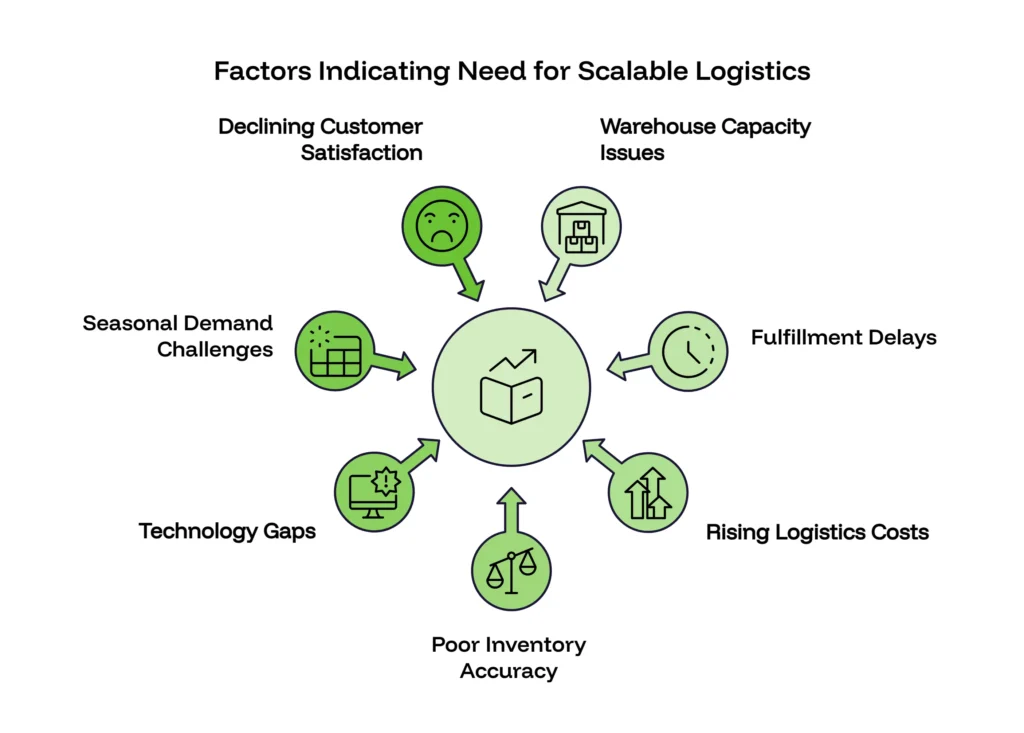
The most common signs include warehouse capacity issues, fulfillment delays, rising logistics costs, poor inventory accuracy, technology gaps, seasonal demand challenges, and declining customer satisfaction — all pointing to the need for a more scalable logistics model.
A company should seriously consider outsourcing when warehouse utilization consistently exceeds 85%, cost per order is rising without volume justification, fulfillment delays are recurring, or leadership is spending significant time managing logistics problems instead of growing the business. Any three of these signs together is a strong signal.
Warehouse capacity constraints occur when available storage, labor, or equipment can no longer efficiently handle incoming and outgoing inventory volume. Signs include blocked picking aisles, overflow storage outside designated areas, and receiving backlogs. Operationally, the risk threshold is around 85% space utilization.
Logistics bottlenecks directly suppress revenue by causing fulfillment delays, inventory inaccuracies, and poor customer experience. McKinsey research shows companies with supply chain weaknesses carry 15-20% higher operational costs than best-in-class peers — compressing margins precisely when growth requires investment.
Logistics scalability is the ability of your warehousing, fulfillment, and transportation operations to grow proportionally with your business — without proportional increases in cost or management complexity. Without it, every new market, product line, or demand spike becomes a crisis rather than an opportunity.
For most mid-sized businesses, 3PL outsourcing converts high fixed logistics costs — rent, staff, equipment, technology — into variable costs that scale with actual volume. Combined with better freight rates through consolidated carrier relationships, total logistics cost typically decreases 15-25% compared to an equivalent in-house operation at the same volume.

Kapil Pathak is a Senior Digital Marketing Executive with over six years of experience specializing in the logistics and supply chain industry. His expertise spans digital strategy, search engine optimization (SEO), search engine marketing (SEM), and multi-channel campaign management. He has a proven track record of developing initiatives that increase brand visibility, generate qualified leads, and drive growth for D2C & B2B technology companies.