Warehousing is no longer a back-office decision in India. With the country’s warehousing market projected to reach nearly USD 35 billion by 2027, and logistics costs under constant boardroom scrutiny, the model you choose for storage and fulfilment directly shapes your unit economics, delivery speed, and ability to scale.
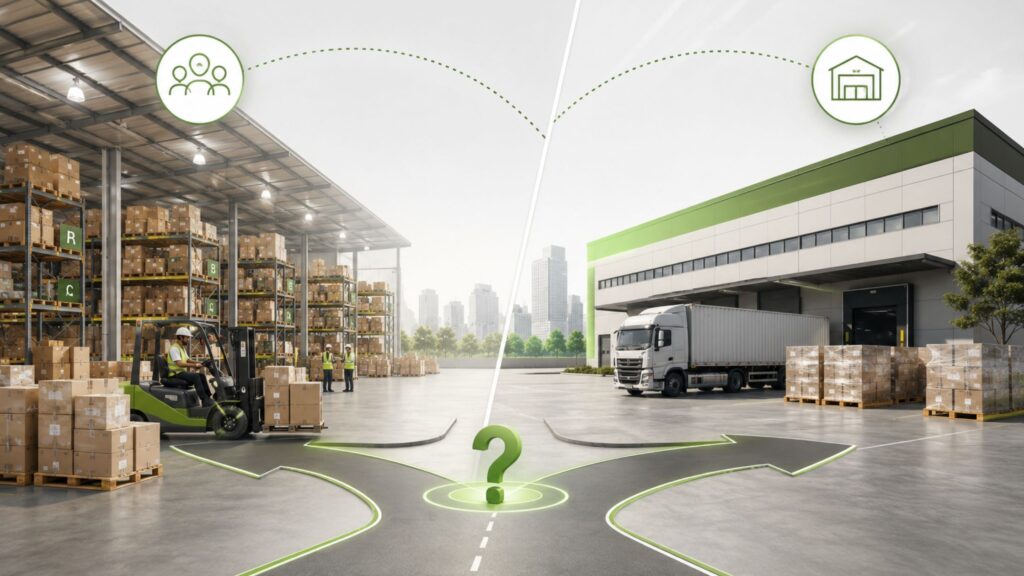
For most businesses, that choice comes down to two options: shared warehousing (also called multi-client or multi-user warehousing) or dedicated warehousing. Both are typically delivered through a third-party logistics (3PL) partner, but they sit at opposite ends of the cost-versus-control spectrum.
This guide breaks down both models in the Indian context real cost benchmarks in rupees, operational trade-offs, and a practical decision framework so you can pick the model that fits your stage of growth rather than the one that simply looks cheaper on paper.
What Is Shared Warehousing?
Shared warehousing is a multi-client model in which a 3PL provider operates a single facility for several businesses at once. Each client’s inventory is stored, tracked, and billed separately, but the infrastructure space, racking, material handling equipment (MHE), warehouse management system (WMS), security, and labour is shared across all clients.
You pay only for the space and resources you actually consume, typically billed per pallet position, per square foot, or per order processed. This converts warehousing from a fixed cost (CapEx-heavy) into a variable cost (pay-per-use OpEx) which is exactly why shared warehousing has become the default entry point for D2C brands, e-commerce sellers, and companies testing new markets in India.
Typical characteristics of a shared warehouse in India:
- Multi-client Grade A or Grade B facility operated by a 3PL
- Billing per pallet (₹100–₹300 per pallet per month, depending on city and service level) or per sq ft consumed
- Shared labour pool, MHE, and WMS with client-wise inventory segregation
- Value-added services (kitting, labelling, quality checks, returns processing) available on demand
- Short commitment periods often monthly or quarterly, rarely beyond a year
What Is Dedicated Warehousing?
Dedicated warehousing reserves an entire facility its space, team, equipment, and processes exclusively for one client. The facility may be leased directly by your company or, more commonly in India, operated by a 3PL on a dedicated contract (contract warehousing), often as a build-to-suit (BTS) development.
Because nothing is shared, you get full control: custom racking layouts, your own SOPs, dedicated trained manpower, specialised infrastructure (temperature control, hazmat compliance, high-value cages), and complete visibility into every process. The trade-off is commitment dedicated contracts in India typically run 3–9 years, and you pay for the entire facility whether it is 60% full or 95% full.
Typical characteristics of a dedicated warehouse in India:
- Single-client facility, usually 50,000 sq ft and above
- Rentals of ₹18–₹60 per sq ft per month in metro markets (Mumbai, Delhi NCR, Bengaluru), ₹10–₹30 in Tier 2 cities plus operating costs
- Long-term lease or contract commitment (3+ years)
- Custom layout, dedicated team, client-specific WMS configuration and SLAs
- Suited to high, stable volumes and specialised handling requirements
Shared vs Dedicated Warehousing: Quick Comparison
| Parameter | Shared (Multi-Client) Warehousing | Dedicated Warehousing |
|---|---|---|
| Cost model | Variable (pay-per-use OpEx) | Fixed (full facility cost, CapEx or long lease) |
| Upfront investment | Minimal | High |
| Commitment | Monthly to yearly | Typically 3–9 years |
| Scalability | Scale up/down on demand; ideal for seasonal peaks | Fixed capacity; scaling requires new space |
| Control & customisation | Limited processes standardised across clients | Complete layout, SOPs, team, technology |
| Location flexibility | Easy multi-city presence via 3PL network | Concentrated in one or few locations |
| Speed to launch | Days to weeks (plug and play) | 3–12 months (fit-out or BTS) |
| Best suited for | Startups, D2C, seasonal businesses, market entry | Large stable volumes, specialised handling, brand-critical operations |
| Cost at low volume | Lower pay for what you use | Higher unused space still costs money |
| Cost at high volume | Can exceed dedicated at scale | Lower per unit at consistently high utilisation |
The Cost Equation: What You Actually Pay in India
The honest answer to “which is cheaper?” is: it depends on your volume and its variability.
Shared warehousing costs. You typically pay ₹100–₹300 per pallet per month, plus per-order handling charges (inward, pick-pack, outward) and optional VAS fees. A D2C brand storing 200 pallets in a shared NCR facility might spend ₹3–5 lakh per month all-in, with the ability to drop to 120 pallets in lean months and pay proportionately less.
Dedicated warehousing costs. A 50,000 sq ft Grade A facility in an NCR logistics hub at ₹25 per sq ft costs ₹12.5 lakh per month in rent alone before manpower (typically the largest operating cost), MHE, WMS licensing, utilities, security, and compliance. Whether you ship 50,000 orders or 20,000 that month, the cost is the same.
The crossover point. As volumes grow and stabilise, shared warehousing’s per-unit charges begin to exceed what an efficiently run dedicated facility would cost. Most 3PLs see this crossover when a client consistently occupies 25,000–40,000+ sq ft equivalent with predictable throughput. Below that, shared almost always wins; above it, dedicated deserves serious evaluation.
There is one more cost dimension India-specific businesses should weigh: GST-era network consolidation. Since GST removed the need for state-wise depots, many companies have consolidated into fewer, larger regional warehouses a shift that favours dedicated facilities for the core network and shared facilities for spokes and new-market testing.
Advantages and Limitations of Shared Warehousing
Advantages:
- Lower cost of entry. No CapEx, no long lease. Overheads security, maintenance, utilities, management are distributed across multiple clients.
- Elastic capacity. Indian demand is famously seasonal: festive-season (Diwali, BBD-style sale events) volumes can be 3–4x baseline. Shared facilities absorb these swings without penalty.
- Faster market entry. Launching in a new region takes weeks, not months. A 3PL’s multi-city shared network gives you pan-India reach without pan-India leases.
- Built-in expertise and technology. You inherit the 3PL’s WMS, trained manpower, and process maturity from day one.
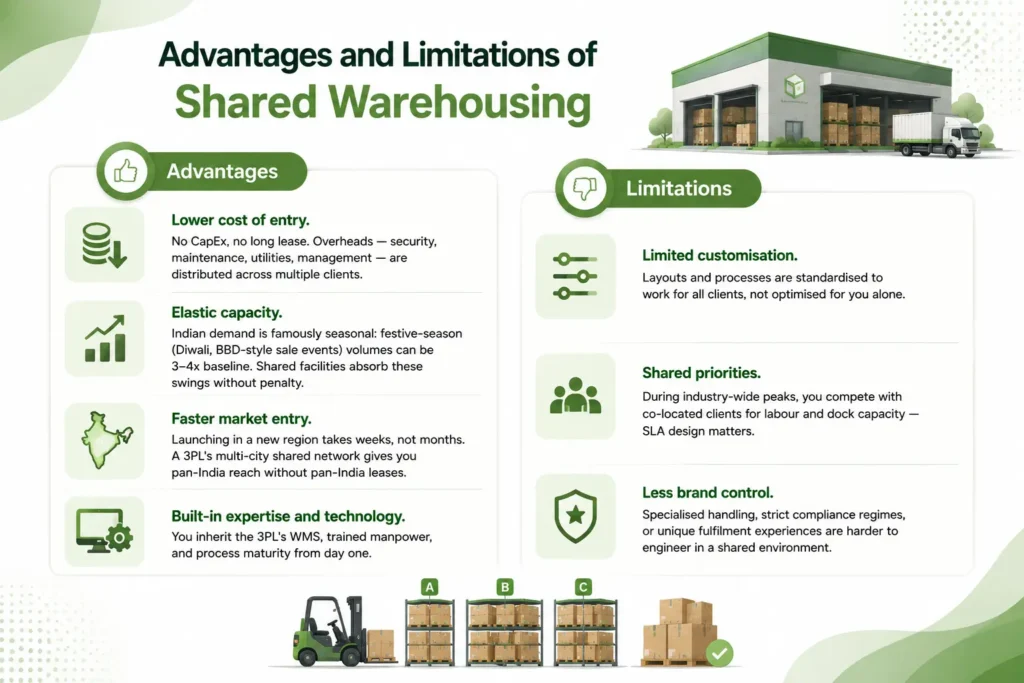
Limitations:
- Limited customisation. Layouts and processes are standardised to work for all clients, not optimised for you alone.
- Shared priorities. During industry-wide peaks, you compete with co-located clients for labour and dock capacity SLA design matters.
- Less brand control. Specialised handling, strict compliance regimes, or unique fulfilment experiences are harder to engineer in a shared environment.
Advantages and Limitations of Dedicated Warehousing
Advantages:
- Full control and visibility. Your SOPs, your quality standards, your team, your data end to end.
- Customisation. Racking designed for your SKU profile, automation where it pays back, temperature zones, high-security cages, line-side sequencing for manufacturing.
- Lower per-unit cost at scale. With high, stable utilisation, dedicated facilities beat shared rates on per-unit economics.
- Deeper integration. The facility becomes an extension of your supply chain integrated with your ERP, your transport network, and your service promises.
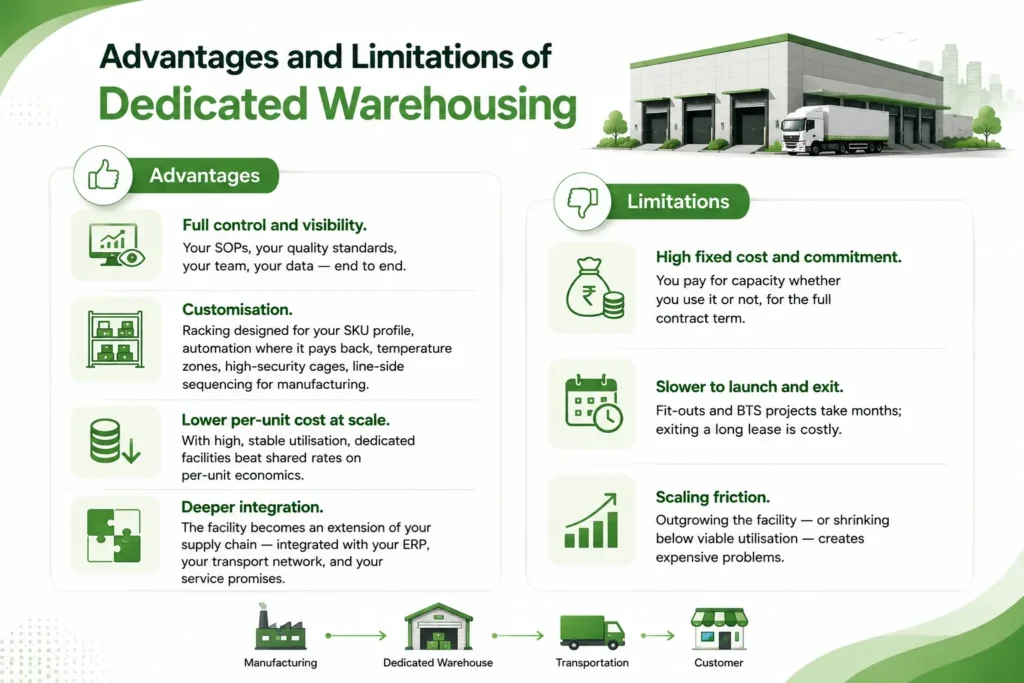
Limitations:
- High fixed cost and commitment. You pay for capacity whether you use it or not, for the full contract term.
- Slower to launch and exit. Fit-outs and BTS projects take months; exiting a long lease is costly.
- Scaling friction. Outgrowing the facility or shrinking below viable utilisation creates expensive problems.
Which Model Fits Your Business? A Decision Framework
Choose shared (multi-client) warehousing if:
- You are a startup, D2C brand, or SME with volumes below roughly 25,000 sq ft equivalent
- Your demand is seasonal or unpredictable
- You are entering a new city, region, or the India market itself
- You want to convert fixed logistics costs into variable costs
- Speed to launch matters more than process customisation
Choose dedicated warehousing if:
- You have large, stable, predictable volumes (typically 40,000+ sq ft, sustained)
- Your products need specialised handling cold chain, hazmat, high-value, oversized
- Warehousing processes are core to your brand promise (same-day dispatch, custom packaging, strict quality gates)
- You need deep systems integration and complete data control
- You can commit to a 3+ year horizon with confidence
Consider a hybrid model if you’re in between. This is the option most comparison guides skip, yet it is how many mature supply chains in India actually run: a dedicated mother warehouse for core, stable volume, plus shared facilities as regional spokes, seasonal overflow, and new-market test beds. Hybrid networks let you enjoy dedicated economics where volume justifies it and shared flexibility everywhere else. A capable 3PL can operate both under one contract, one WMS view, and one performance dashboard.
Real-World Scenarios
A D2C fashion brand scaling nationally starts with shared facilities in NCR and Bengaluru, pays per order, and survives its first two festive seasons without a single lease. At 1,200 orders a day sustained, it moves core inventory into a dedicated 60,000 sq ft facility while keeping shared spokes in the East and South.
An FMCG company post-GST consolidation collapses 22 state depots into 4 dedicated regional distribution centres, using shared warehouses in 6 secondary markets where volumes don’t justify dedicated space.
An electronics importer testing India enters via a shared bonded warehouse or FTWZ route first, deferring duties and committing to nothing then graduates to dedicated space once demand is proven. (Genex operates its own FTWZ facilities.)
Frequently Asked Questions
In shared warehousing, multiple businesses use one facility and split its costs, paying only for the space and services they consume. In dedicated warehousing, the entire facility, team, and infrastructure serve a single client, offering full control in exchange for higher cost and longer commitment.
At low or fluctuating volumes, yes you avoid fixed costs and pay per use. At high, stable volumes, dedicated warehousing usually delivers lower per-unit costs. The crossover typically occurs around 25,000–40,000 sq ft of sustained space usage.
A multi-client (or multi-user) warehouse is another name for a shared warehouse: a 3PL-operated facility where several clients share infrastructure, equipment, and labour while maintaining fully segregated inventory and separate billing.
Limited customisation, standardised processes, potential competition for labour and dock capacity during industry-wide peaks, and less control over specialised handling or brand-specific fulfilment experiences.
When volumes become large and predictable enough that per-unit shared charges exceed the cost of running a dedicated facility at high utilisation — and when customisation, compliance, or integration needs outgrow what a shared environment can offer. See our guide on the signs you’ve outgrown your logistics setup.
Warehouse rentals range roughly from ₹18–₹60 per sq ft per month in metro markets and ₹10–₹30 in Tier 2 cities, depending on grade and location. In shared facilities, pallet storage typically costs ₹100–₹300 per pallet per month plus handling charges.
Most e-commerce and D2C brands start with shared warehousing for its elasticity through sale events and festive peaks, then adopt hybrid or dedicated models as volumes stabilise. Quick-commerce-oriented brands add dark-store-style nodes on top — see our take on quick commerce warehousing.
No. A dedicated warehouse can be run by a 3PL exclusively for you (contract warehousing) you get the control of in-house operations without building the capability yourself. For a fuller comparison, read 3PL vs 4PL vs in-house logistics.
The Bottom Line
Shared warehousing buys you flexibility, speed, and a variable cost base. Dedicated warehousing buys you control, customisation, and better economics at scale. Neither is universally “better” the right answer follows your volume, its predictability, and how central warehousing is to your customer promise. And for a growing number of businesses in India, the real answer is a deliberately designed hybrid of both.
Genex Logistics operates shared, dedicated, and hybrid warehousing and storage solutions across India backed by integrated transportation, FTWZ capabilities, and supply chain consulting. If you’re weighing the two models, talk to our team for a network and cost assessment tailored to your volume

Kapil Pathak is a Senior Digital Marketing Executive with over six years of experience specializing in the logistics and supply chain industry. His expertise spans digital strategy, search engine optimization (SEO), search engine marketing (SEM), and multi-channel campaign management. He has a proven track record of developing initiatives that increase brand visibility, generate qualified leads, and drive growth for D2C & B2B technology companies.