You have signed with a 3PL in Bhiwandi. The racks are ready, the first truck is booked, and your team is excited about two-day delivery to Mumbai.
Then your CA calls. “Have we added the warehouse to our GST registration yet?”
Silence.
This happens more often than you would think. Brands spend weeks comparing 3PL rates and SLAs, but GST paperwork gets treated as an afterthought. Unfortunately, the tax department does not see it that way. If your stock sits at an address that is not on your GST certificate, your goods, your input tax credit and your e-way bills can all run into trouble.
In this guide, we will walk through everything you need to know about GST registration for a 3PL warehouse. Specifically, we will cover:
- When a 3PL warehouse counts as a “place of business” under GST
- The difference between PPOB, APOB and VPOB
- How to add a warehouse to your GST registration, step by step
- Whether to use a tax invoice or a delivery challan for stock transfers
- Who generates the e-way bill, and what changed in 2026
- Common mistakes, plus a simple onboarding checklist
Let’s get into it.
Why GST Becomes a Warehouse Question the Moment You Outsource
When you run your own warehouse, the address is usually already on your GST certificate. Nobody thinks twice about it.
Outsourcing changes that. Your goods now sit in a building you do not own, often in a city or state where you have no office. However, GST law cares about where your goods are, not who owns the roof above them.
Think of your GST registration as a map you have given to the tax department. Every location where you store, receive or dispatch goods should appear on that map. A 3PL warehouse missing from the map is like a branch office nobody told head office about.
This matters even more as you grow. Once you spread stock across Delhi NCR, Mumbai and Bengaluru, you are effectively running a multi-warehouse inventory operation. Each node needs to be visible, both in your system and in your GST records.
Is a 3PL Warehouse a “Place of Business” Under GST?
In most cases, yes.
Section 2(85) of the CGST Act defines “place of business” broadly. It includes a warehouse, godown or any place where you store goods or carry on business. Ownership is not the test. Use is.
So if your goods are stored at a 3PL facility and shipped to customers from there, that facility is your place of business. It does not matter that the 3PL holds the lease.
When you generally need a separate GST registration in another state
GST registration is state-wise. Your Delhi GSTIN does not cover a warehouse in Haryana or Maharashtra.
CBIC has addressed this exact situation. It clarified that a business must take a separate GST registration in the second state when it uses a third-party warehouse or cold storage there to make taxable supplies to customers.
In plain terms, you will usually need a new state registration if:
- Your stock sits in a 3PL warehouse in a state where you are not registered, and
- Orders are invoiced and dispatched to customers from that warehouse
This is the most common setup for D2C brands, marketplace sellers and B2B distributors using a 3PL.
When you might not
There are grey areas. For example, if a warehouse only holds stock briefly and every sale is invoiced from your home state, the position can differ. Some advance rulings have looked at specific facts and reached different answers.
However, these are edge cases. If you are unsure, get a written opinion from your CA before goods move. It is far cheaper than fixing a problem after a vehicle is stopped on the highway.
PPOB, APOB and VPOB: Clearing Up the Alphabet Soup
These three terms confuse almost everyone at first. Here is the simple version.
| Term | Full form | What it means | Typical example |
|---|---|---|---|
| PPOB | Principal Place of Business | Your main registered address in a state | Head office in Delhi |
| APOB | Additional Place of Business | Any extra location in the same state, added under the same GSTIN | Your 3PL warehouse in Gurugram |
| VPOB | Virtual Place of Business | A service address used as the PPOB when you have no office in that state | A shared office address in Bengaluru |
A few things are worth remembering:
- One GSTIN per state. You can have several APOBs under it, but they must all be in that state.
- Every warehouse in that state is an APOB. If you use two 3PL sites in Maharashtra, both go on the Maharashtra GSTIN.
- VPOB solves the “no office” problem. Many brands use a VPOB to get the state GSTIN first. They then add the 3PL warehouse as an APOB.
If you already sell through Amazon FBA or Flipkart FBF, this will feel familiar. Marketplaces ask you to add each fulfilment centre as an APOB before you can send stock. A 3PL works the same way. If you are weighing Amazon FBA against your own WMS-run warehouse, the GST steps are nearly identical.
How to Add a 3PL Warehouse as an Additional Place of Business
The good news? Adding an APOB is mostly paperwork. It just needs to be done before your first inbound truck arrives.
Documents you will need
Collect these early. Missing documents are the number one reason APOB applications get delayed.
From your 3PL:
- No Objection Certificate (NOC) or consent letter allowing you to use the address
- Proof of the 3PL’s right to the premises (rent agreement or ownership document)
- Latest electricity bill or property tax receipt for the address
- Your warehousing or service agreement with the 3PL
From your side:
- Existing GSTIN and login credentials
- Authorisation letter or board resolution for the signatory
- Photographs of the premises, if your state officer asks for them
A good 3PL will have a ready NOC template. If yours hesitates, treat it as a warning sign about how they handle compliance in general.
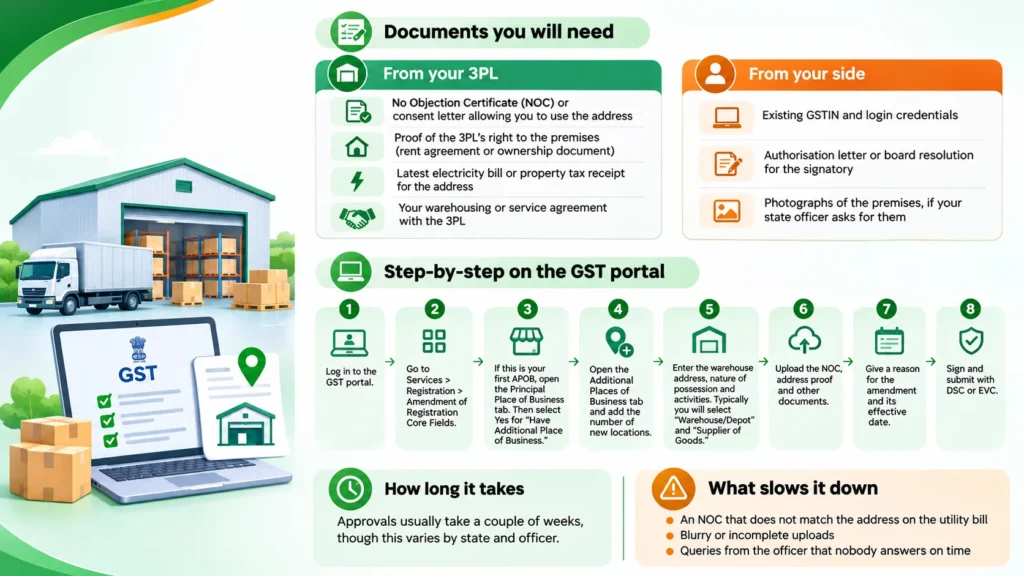
Step-by-step on the GST portal
- Log in to the GST portal with your credentials.
- Go to Services > Registration > Amendment of Registration Core Fields.
- If this is your first APOB, open the Principal Place of Business tab. Then select Yes for “Have Additional Place of Business.”
- Open the Additional Places of Business tab and add the number of new locations.
- Enter the warehouse address, nature of possession and activities. Typically you will select “Warehouse/Depot” and “Supplier of Goods.”
- Upload the NOC, address proof and other documents.
- Give a reason for the amendment and its effective date.
- Sign and submit with DSC or EVC.
After the officer approves it, your updated registration certificate (Form REG-06) will list the new address.
How long it takes, and what slows it down
Approvals usually take a couple of weeks, though this varies by state and officer. Delays mostly come from:
- An NOC that does not match the address on the utility bill
- Blurry or incomplete uploads
- Queries from the officer that nobody answers on time
Tip: Build this into your onboarding timeline. Start the APOB process at least three to four weeks before go-live, alongside system setup and SOP sign-off.
Stock Transfers Under GST: Tax Invoice or Delivery Challan?
Once the warehouse is registered, the next question is how to move stock into it. This is where many finance teams get stuck.
The answer depends on one thing: are the two locations under the same GSTIN or different GSTINs?
| Movement | Same or different GSTIN? | Document | GST charged? |
|---|---|---|---|
| Factory in Noida to 3PL in Ghaziabad (both UP) | Same GSTIN | Delivery challan | No |
| Head office warehouse in Delhi to 3PL in Gurugram | Different GSTINs (Delhi vs Haryana) | Tax invoice | Yes, IGST |
| 3PL in Bhiwandi to 3PL in Pune (both Maharashtra) | Same GSTIN | Delivery challan | No |
| 3PL in Bengaluru back to factory in Chennai | Different GSTINs | Tax invoice | Yes, IGST |
Why the difference? Under GST, two registrations of the same company are treated as “distinct persons.” So a transfer between them counts as a supply, even with no payment. Schedule I of the CGST Act makes this clear.
Within one GSTIN, however, you are just moving goods from one room of your house to another. There is no supply, so a delivery challan under Rule 55 is enough.
What about valuation and input tax credit?
For interstate stock transfers, the value is generally based on open market value under Rule 28. There is a practical shortcut, though. If the receiving branch can claim full input tax credit, the value on the invoice is usually accepted.
In practice, this means the IGST you pay in one state comes back as credit in the other. It is cash-flow neutral if handled well. But it does tie up working capital for a few weeks, so plan for it.
E-Way Bill for Stock Transfer: Who Generates It and When
Now for the part that causes the most roadside headaches.
An e-way bill is an electronic document that tracks goods in transit. It is required for both sales and non-sales movements, including stock transfers.
Threshold basics
- For interstate movement, an e-way bill is generally needed when the consignment value crosses Rs 50,000.
- For intrastate movement, the threshold and exemptions vary by state. Most states follow Rs 50,000, but some have their own rules.
- Part B (vehicle details) is not needed for short intrastate hops under 50 km to or from a transporter.
Always check the current rule for each state you operate in. Thresholds are revised from time to time.
Brand or 3PL: who presses the button?
Legally, the consignor (the person sending goods) or the consignee can generate the e-way bill. If neither does, the transporter must.
In practice, here is how it usually splits:
- Inbound to the 3PL: The brand generates it, because the brand is sending the goods.
- Outbound from the 3PL to customers: The e-way bill is generated against the brand’s invoice, using the warehouse APOB as the dispatch address. Many 3PLs do this on the brand’s behalf through an API or delegated access.
- Returns: Often missed. Returned goods moving back to the warehouse may also need an e-way bill.
The key is to put this in writing. Your SLA should say exactly who generates e-way bills for each flow, using which GSTIN and which system. A strong 3PL warehouse management setup will build this into dispatch SOPs, not leave it to whoever is on shift.
Watch the address. E-way bills dispatched from a warehouse must show an address that matches your registration. If the 3PL site is not on your certificate, the mismatch can be flagged in transit.
What Changed in 2026: Ship-To GSTIN and E-Way Bill Closure
If you last reviewed your e-way bill process a year ago, it is time for another look.
GSTN announced two key changes to the e-way bill system this year. They were first planned for 15 June 2026 and were then moved to 1 August 2026 to give businesses time to update their ERP systems.
1. Ship-To GSTIN is now mandatory in bill-to/ship-to cases
A bill-to/ship-to transaction is one where the invoice goes to one party, but the goods go somewhere else. For example, a retailer is billed at its Delhi office, but delivery goes to its Mumbai warehouse.
You now have to report the GSTIN of the ship-to location in these cases. If the consignee or warehouse is unregistered, you enter “URP” instead.
Why does this matter for 3PL users? Because 3PL flows are full of bill-to/ship-to cases. B2B orders delivered to a distributor’s warehouse, marketplace replenishments and dealer shipments all fall into this bucket.
2. A new e-way bill closure facility
You can now voluntarily close an e-way bill once delivery is complete. Previously, used or unused e-way bills could sit open in the system until they expired.
Closing them keeps your records clean. It also makes reconciliation easier at month-end.
What to do now
- Update customer, warehouse and consignee GSTIN records in your ERP and WMS
- Confirm your 3PL’s dispatch system captures Ship-To GSTIN correctly
- Agree on who closes e-way bills after delivery
This is a good example of why WMS-ERP integration matters. If addresses and GSTINs live in two disconnected systems, errors creep in fast.
Monthly Reconciliation: What Your 3PL Should Hand You
GST compliance is not a one-time setup. It is a monthly habit.
At minimum, your 3PL should share these every month:
- Inward register: Every inbound consignment, matched to goods received notes (GRNs) and e-way bills
- Outward register: Every dispatch, matched to invoices and e-way bill numbers
- Stock statement: Opening stock, receipts, dispatches, returns and closing stock by SKU
- Damage and shrinkage report: Anything written off, with reasons
- Open e-way bill list: Anything not yet closed or cancelled
Your finance team then matches these against GSTR-1 and your books. Gaps here are usually the first thing a GST audit picks up.
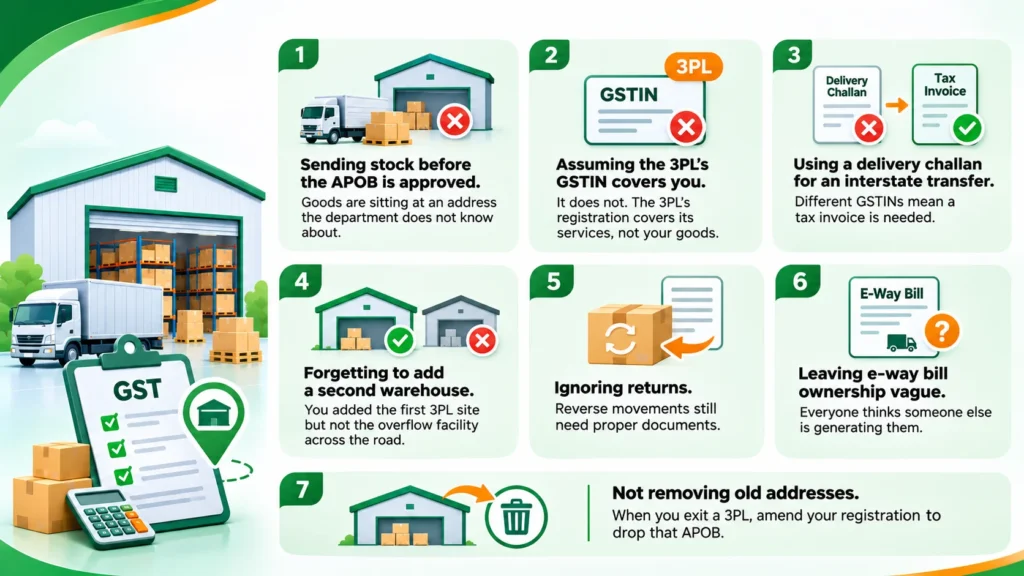
7 Common GST Mistakes Brands Make With 3PL Warehousing
We see these again and again. Most are easy to avoid once you know about them.
- Sending stock before the APOB is approved. Goods are sitting at an address the department does not know about.
- Assuming the 3PL’s GSTIN covers you. It does not. The 3PL’s registration covers its services, not your goods.
- Using a delivery challan for an interstate transfer. Different GSTINs mean a tax invoice is needed.
- Forgetting to add a second warehouse. You added the first 3PL site but not the overflow facility across the road.
- Ignoring returns. Reverse movements still need proper documents.
- Leaving e-way bill ownership vague. Everyone thinks someone else is generating them.
- Not removing old addresses. When you exit a 3PL, amend your registration to drop that APOB.
Quick commerce brands face an extra twist. With stock spread across many small sites, keeping every location on your GST certificate takes real discipline. Our guide on dark store WMS for quick commerce covers how to track that kind of network.
A Simple GST Compliance Checklist for 3PL Onboarding
Use this before your first inbound truck:
- Confirm whether the warehouse is in a state where you already have a GSTIN
- If not, apply for a new state registration (using a VPOB if needed)
- Collect the NOC, address proof and agreement from your 3PL
- File the APOB amendment and track approval
- Decide on tax invoice vs delivery challan for each stock flow
- Write e-way bill responsibilities into the SLA
- Update Ship-To GSTIN records in your ERP and WMS
- Agree on the monthly reconciliation pack
- Test one small consignment end to end before full go-live
If you are also rolling out new software at the same time, pair this list with a WMS implementation checklist. Compliance and system setup should move together, not one after the other.
Conclusion: Get the Paperwork Right Before the Pallets Move
Outsourcing your warehousing should make life easier. GST is one area where a little planning up front saves a lot of pain later.
Here is a quick recap:
- A 3PL warehouse is usually your place of business under GST, even though you do not own it.
- If it is in a new state, you generally need a separate GST registration there.
- Every warehouse in a state must be added as an APOB on that state’s GSTIN.
- Use a delivery challan within one GSTIN and a tax invoice between GSTINs.
- Agree on e-way bill ownership in writing, and update for the 2026 Ship-To GSTIN rule.
- Reconcile with your 3PL every month.
At Genex Logistics, GST readiness is part of how we onboard every client. We provide the NOC and address documents you need for APOB registration. We also align e-way bill workflows with your team and share a clean monthly reconciliation pack, so compliance does not slow down your launch.
Planning to move stock into a new city or state? Talk to the Genex team about compliant, multi-location warehousing that is ready from day one.
Frequently Asked Questions
Usually, yes. If your goods are stored in a 3PL warehouse in a state where you are not registered, and you supply customers from there, that warehouse is your place of business. You will generally need a new GSTIN in that state, with the warehouse added as a principal or additional place of business.
You typically need a No Objection Certificate (NOC) or consent letter from the 3PL, proof of the 3PL’s right to the premises, a recent electricity bill or property tax receipt, and your warehousing agreement. Some officers also ask for photographs of the site. Once approved, the address appears on your updated REG-06 certificate.
It depends on the GSTIN. If both locations are under the same GSTIN (same state), you move goods on a delivery challan with no GST. If they are under different GSTINs (different states), the law treats them as distinct persons. You then raise a tax invoice and charge IGST, which the receiving branch can usually claim back as input tax credit.
The consignor or consignee can generate it, and the transporter must do so if neither does. In practice, the brand handles inbound e-way bills, while outbound e-way bills are often generated by the 3PL on the brand’s behalf, using the brand’s GSTIN and the warehouse APOB as the dispatch address. Always write this split into your SLA.
PPOB (principal place of business) is your main registered address in a state. APOB (additional place of business) is any extra location, like a 3PL warehouse, added under the same state GSTIN. VPOB (virtual place of business) is a service address some brands use as their PPOB when they have no office in that state, so they can get registered and then add the warehouse as an APOB.

Kapil Pathak is a Senior Digital Marketing Executive with over six years of experience specializing in the logistics and supply chain industry. His expertise spans digital strategy, search engine optimization (SEO), search engine marketing (SEM), and multi-channel campaign management. He has a proven track record of developing initiatives that increase brand visibility, generate qualified leads, and drive growth for D2C & B2B technology companies.