Pick the wrong warehouse location, and you pay for it every day. Each parcel travels a little farther. Each truck waits a little longer. Each festive rush hurts a little more.
Rent is easy to compare, so many teams start there. But rent is rarely the biggest cost. Freight, delivery time and tax setup often matter more.
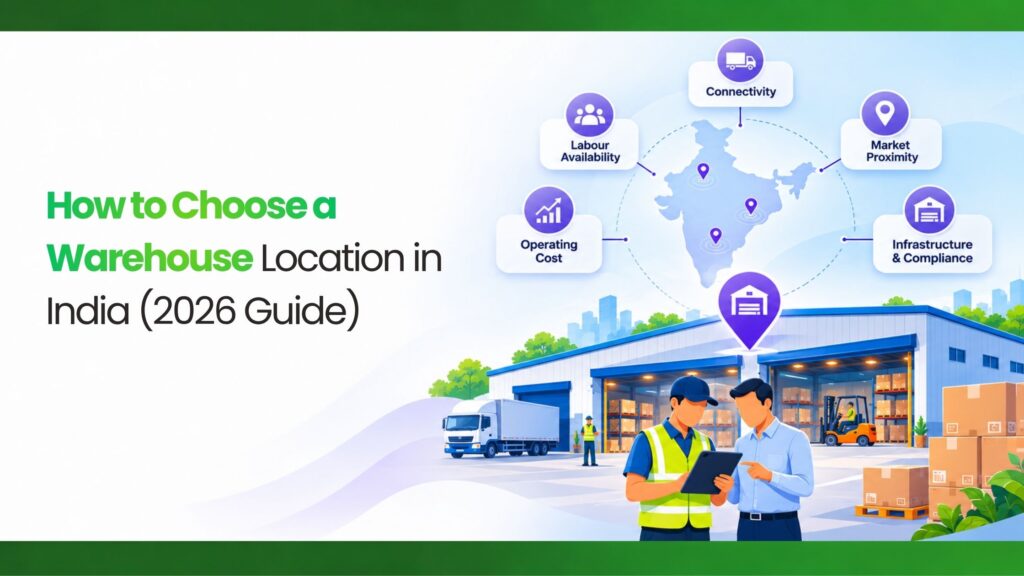
So how do you choose a warehouse location in India without relying on gut feeling? This guide gives you a simple decision framework. It works for D2C brands, manufacturers, importers and distributors.
Here is what we will cover:
- Why location shapes cost, speed and compliance
- The factors that matter most
- Single warehouse vs hub-and-spoke vs multi-city networks
- A look at India’s main warehousing clusters
- A scoring matrix and two worked examples
- Common mistakes and quick answers to FAQs
Why Warehouse Location Matters More Than Rent
Think of a warehouse like a tea stall. The chai can be perfect. But if the stall sits on a lane nobody walks down, you will struggle.
A warehouse works the same way. Even a great facility loses money if it sits far from your customers, suppliers or ports.
Location drives three big things:
- Freight cost. Longer distances and higher courier zones raise the cost of every parcel or truckload.
- Delivery speed. The closer your stock, the faster you can promise delivery.
- Compliance. Each state has its own tax registration and rules.
The stakes are also rising. Colliers reports that India’s Grade A warehouse stock has nearly doubled since 2021, to about 300 million sq ft. It expects rents in most key clusters to rise 5-10% a year.
Good space is getting pricier. So a wrong call costs more than it used to.
Map Your Demand and Flows First
Don’t open a property portal yet. Start with your own data.
Pull the last 6 to 12 months of orders or dispatches. Then answer four questions:
- Which pincodes or cities get most of your orders?
- Where do your goods come from: a factory, a port or many suppliers?
- What delivery promise do customers expect: same day, 2 days or 5 days?
- How uneven is demand across the year?
Next, try the center of gravity method. It sounds fancy, but the idea is simple. Plot your customers and suppliers on a map. Give more weight to places with more volume. The weighted middle point is a good starting zone for a single warehouse.
Also set a rough budget early. Our guide to warehousing cost in India shows typical rent and 3PL rates, so you can rule out unrealistic options fast.
The Key Factors in Warehouse Site Selection in India
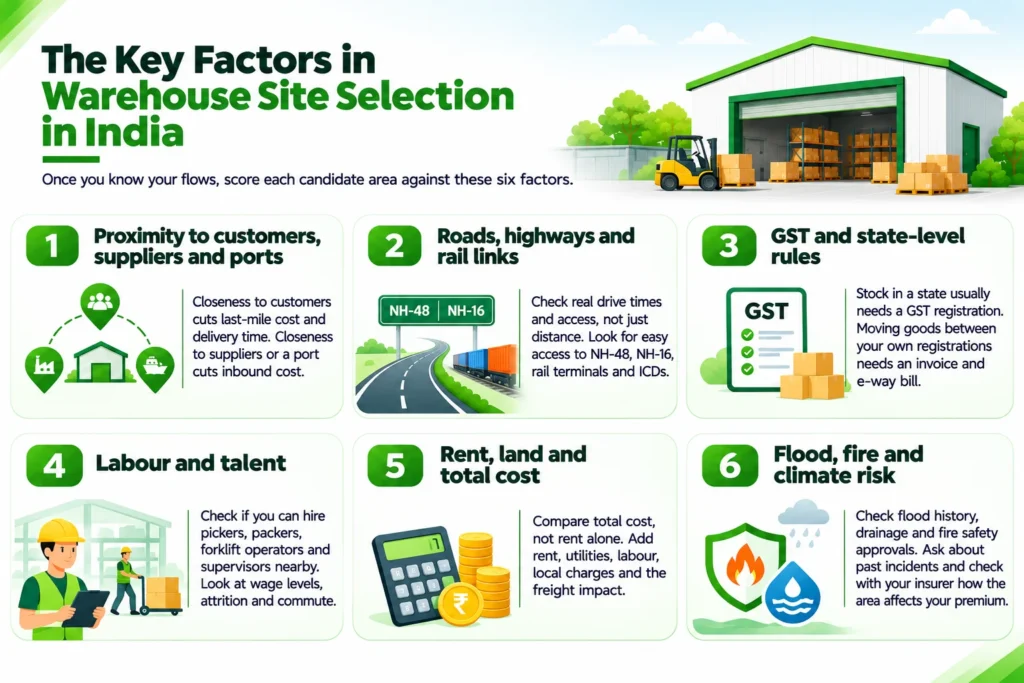
Once you know your flows, score each candidate area against these six factors.
1. Proximity to customers, suppliers and ports
Closeness to customers cuts last-mile cost and delivery time. Closeness to suppliers or a port cuts inbound cost.
Which one wins? It depends on your model. D2C brands lean towards customers. Importers and exporters lean towards ports such as JNPT, Mundra or Chennai.
A good test: where does most of your freight bill come from, inbound or outbound?
2. Roads, highways and rail links
A site 20 km from a highway can still be a headache if the access road jams or floods. Check real drive times at peak hours, not just distance on a map.
Look for easy access to national highways such as NH-48 and NH-16. If you move containers, check nearby rail terminals and inland container depots (ICDs). Dedicated freight corridors help with long-haul bulk cargo.
3. GST and state-level rules
Since GST arrived, many firms have moved stock into fewer, larger warehouses. But GST still shapes your network.
Stock held in a state usually needs a registration in that state. Moving goods between your own registrations counts as a supply, so you need an invoice and an e-way bill.
Importing goods? Duty planning can also shape where you store them. See how a bonded warehouse compares with an FTWZ before you choose a site. Always confirm the details with your CA before signing a lease.
4. Labour and talent
Warehouses run on people. Check whether you can hire pickers, packers, forklift operators and supervisors nearby.
Look at wage levels, attrition and how far workers must travel. A cheap site with no workers is not cheap.
5. Rent, land and total cost
Compare total cost, not rent alone. Add rent, utilities, labour, local charges and the freight impact.
CRE Matrix’s recent Grade A deals show how wide the range can be. One Gurgaon deal was about ₹28 per sq ft a month, and a Bhiwandi deal was about ₹30. A Jhajjar deal was near ₹19.
A lower rent looks great until extra freight eats the saving.
6. Flood, fire and climate risk
Monsoon flooding can shut a site for days. Check flood history, drainage and fire safety approvals.
Ask the landlord about past incidents. Also ask your insurer how the area affects your premium.
Single Warehouse, Hub-and-Spoke or Multi-City Network?
Now the big question: how many locations do you need?
When one warehouse is enough
A single site works well when:
- Your volumes are modest.
- Customers sit mostly in one region.
- A delivery time of 3 to 5 days is fine.
- You sell bulky items that move slowly.
Pick a central, well-connected spot. Nagpur is often discussed for its central position. Just check carrier and 3PL options there before you commit.
How hub-and-spoke works
Picture a bicycle wheel. The hub is a large central warehouse with deep stock. The spokes are smaller regional warehouses that serve nearby customers.
The hub refills the spokes in bulk. That is cheaper than shipping every single parcel from one far-away point.
This model suits you if:
- You have a wide range of SKUs.
- Regional demand is uneven.
- You need 1 to 2 day delivery in big metros.
When a multi-city network pays off
Go multi-city when each region has steady volume and speed drives your sales. Fulfilment players such as Shiprocket Fulfillment and WareIQ promote spreading stock across many centres for this reason.
But there is a catch. More sites mean more stock spread out, more systems and more fixed cost. Don’t add a city just because it looks good on a slide.
Not ready to sign a lease in every region? Try shared warehousing first. It lets you test a new city with much less fixed cost.
A simple break-even check
Use this quick formula:
Monthly saving = orders from that region × freight saving per order
If the monthly saving is higher than the extra fixed cost, add the site. Fixed cost includes rent, staff, systems and extra safety stock. If it is lower, wait.
India’s Main Warehousing Clusters Compared (2026)
Indian warehousing grows in clusters, not in whole cities. Colliers expects a few high-activity clusters to drive 70-80% of Grade A demand.
Here is a quick snapshot:
| Cluster | Best for | Watch out for |
|---|---|---|
| Bhiwandi (MMR) | Western India, port-linked cargo, large 3PL operations | Congestion and rising rents |
| Pune (Chakan, Talegaon) | Auto, engineering, West and South-West markets | Rents rising with demand |
| NCR (Farukh Nagar, Gurgaon, Sonipat) | North India, e-commerce and B2B | State-wise tax and entry rules |
| Bengaluru-Hosur (Neelamangala, Hoskote, Hosur) | South India, consumer brands | Big differences in access between sites |
| Chennai (Oragadam, Sriperumbudur, NH-16) | Engineering, auto, port access | Tight vacancy and rising rents |
| Hyderabad | Pharma and South-Central India | Need for specialised, compliant space |
| Kolkata | East and North-East India | Check the supply of modern space |
A few numbers help put this in context:
- Bhiwandi is India’s largest cluster, with nearly 42 million sq ft of Grade A stock, according to Colliers.
- Colliers also notes that e-commerce leasing has gathered mainly in Farukh Nagar and Bhiwandi.
- Pune and the Mumbai region together took about 43% of national Grade A demand in the first half of 2026, per CRE Matrix.
- Within Bengaluru, Neelamangala alone took 44% of Grade A demand in the second quarter of 2026.
- In Chennai, rents rose 7% year on year to about ₹25.7 per sq ft a month in H1 2026, per Knight Frank’s H1 2026 warehousing report.
Why is Bhiwandi so popular? It sits close to JNPT and major expressways, and it serves a huge consumer market. That mix is hard to beat for Western India.
Emerging tier-2 hubs
Demand is spreading beyond the big metros. JLL says fourteen tier-2+ cities, including Jaipur, Chandigarh and Kochi, are emerging as warehousing markets, as reported by The Week. Together they hold about 112 million sq ft of stock.
Smaller cities often offer lower rents and less congestion. They can also help you reach a growing base of shoppers. Quick commerce is pushing stock closer to demand too, as our post on quick commerce warehousing explains.
But do your homework first. Check courier coverage, labour supply and whether a good 3PL partner operates nearby.
A Simple Warehouse Location Scoring Matrix
A scoring matrix turns a messy debate into a clear comparison. Here is how to build one:
- List your top 3 to 5 candidate locations.
- Pick 5 to 7 factors and give each a weight. The weights must add up to 100.
- Score each location from 1 (poor) to 5 (excellent) on each factor.
- Multiply each score by its weight, add them up and divide by 100.
Here is an illustrative example for a brand serving mainly Western and Southern India:
| Factor | Weight | Bhiwandi | Pune (Chakan) | Hosur |
|---|---|---|---|---|
| Customer proximity | 30 | 5 | 4 | 3 |
| Freight and port access | 20 | 5 | 4 | 3 |
| Total cost (rent + labour) | 20 | 2 | 3 | 4 |
| Tax and compliance fit | 10 | 4 | 4 | 4 |
| Labour availability | 10 | 4 | 4 | 4 |
| Climate and site risk | 10 | 3 | 4 | 4 |
| Weighted score | 100 | 4.0 | 3.8 | 3.5 |
These scores are only an example. Use your own data.
Notice how close the top two are. If you doubled the weight on cost, Pune could win. That is the point. The matrix shows you what really drives your choice.
Two Worked Examples
Example 1: A D2C brand shipping 5,000 orders a day
Suppose the orders split like this:
- North India: 32% (about 1,600 orders)
- West India: 28% (about 1,400 orders)
- South India: 27% (about 1,350 orders)
- East and others: 13% (about 650 orders)
Three regions each send more than 1,000 orders a day. That is a strong case for three nodes: NCR, Bhiwandi or Pune, and Bengaluru-Hosur.
Now run the break-even check. Assume local dispatch saves ₹15 to ₹25 per parcel versus a national zone. On 1,400 West India orders, that is ₹21,000 to ₹35,000 a day. Compare it with the added fixed cost of the site.
Serve the East from the nearest node for now. Add Kolkata when volumes grow.
Two practical tips. First, pick a partner whose network matches your regions. Our 3PL partner checklist shows what to ask. Second, plan for returns. They add cost that differs by region, so build reverse logistics into your model.
Example 2: A B2B manufacturer with dealers across the country
A manufacturer has one plant in Gujarat and 400 dealers. Dealers order in bulk but want stock within 3 days.
A hub-and-spoke setup fits well. Keep a main hub near the plant. Add regional distribution centres in NCR and the South. The hub refills them by full truckload, which keeps freight low.
If the company also imports parts, a site near a port or an ICD can cut inbound delays. Importers may also look at bonded or free trade warehousing options to defer duties.
Common Mistakes to Avoid
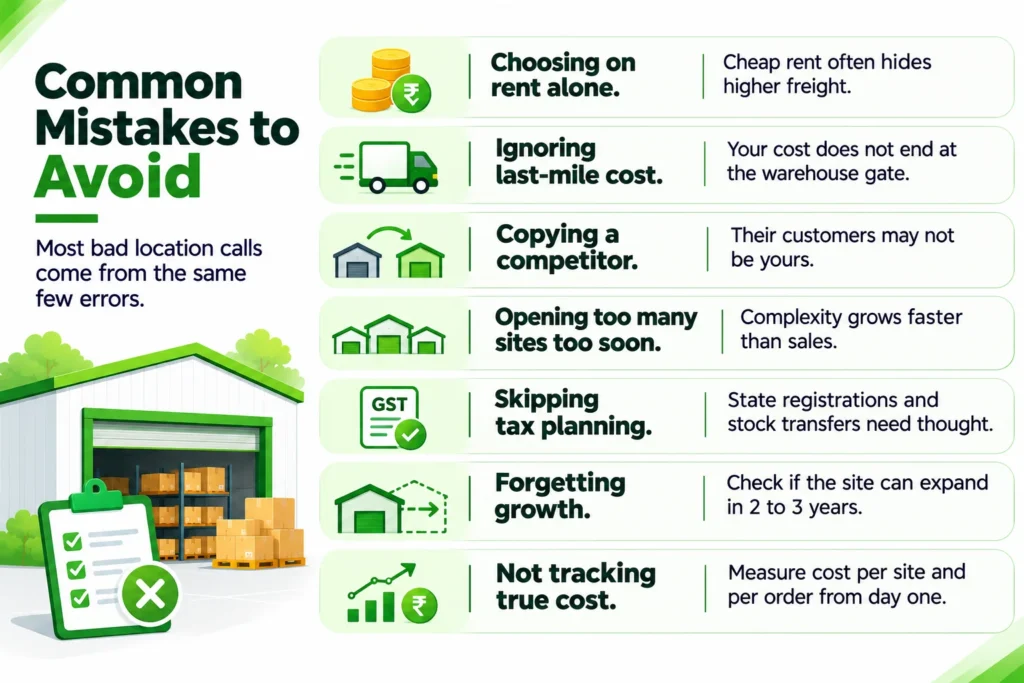
Most bad location calls come from the same few errors.
- Choosing on rent alone. Cheap rent often hides higher freight.
- Ignoring last-mile cost. Your cost does not end at the warehouse gate.
- Copying a competitor. Their customers may not be yours.
- Opening too many sites too soon. Complexity grows faster than sales.
- Skipping tax planning. State registrations and stock transfers need thought.
- Forgetting growth. Check if the site can expand in 2 to 3 years.
- Not tracking true cost. Measure cost per site and per order from day one.
How Genex Logistics Evaluates Location
We start with your data, not a property list.
First, we map your orders, suppliers and delivery promises. Then we test two or three network options. We compare total landed cost, not just rent.
We also check tax and compliance needs, including bonded or FTWZ requirements where they apply. Finally, we advise whether shared or dedicated space fits your stage.
The goal is simple. A network that fits your business today and still works after you grow. Our guide on how 3PL solutions optimize the supply chain in India explains the wider picture.
Conclusion
Choosing a warehouse location is not about finding the cheapest rent. It is about finding the best balance of freight, speed, tax and risk.
Here is a quick recap:
- Start with your demand and flow data.
- Use the center of gravity method to find a starting zone.
- Score sites on six factors, not rent alone.
- Match your network to your volume: single site, hub-and-spoke or multi-city.
- Run a break-even check before adding any new site.
- Test your shortlist with a weighted scoring matrix.
Not sure where to begin? Share your last 6 months of dispatch data with the Genex Logistics team. We will suggest two or three location options with a clear cost comparison. Contact us today to start your warehouse location study.
FAQs
There is no single best city. Bhiwandi near Mumbai is the largest cluster and works well for Western India and port cargo. NCR clusters such as Farukh Nagar serve the North. Bengaluru-Hosur and Chennai serve the South. The best choice depends on where your customers and suppliers are.
It depends on volume and delivery promise. A useful rule: add a new warehouse when a region sends enough steady orders that the freight saving beats the extra fixed cost. Many brands start with one site and move to two or three as they grow.
One central site is simpler and cheaper to run. It suits modest volumes and slower delivery promises. Several sites cut delivery time and freight but add cost and complexity. Use the center of gravity method and the break-even check to decide.
It is a network with one large central warehouse (the hub) and smaller regional warehouses (the spokes). The hub sends bulk stock to the spokes. The spokes then serve local customers faster and at a lower cost per parcel.
GST lets you hold stock in fewer places. Still, stock stored in a state usually needs a registration there. Transfers between your own registrations need an invoice and an e-way bill. Plan this with your CA before you pick locations.

Kapil Pathak is a Senior Digital Marketing Executive with over six years of experience specializing in the logistics and supply chain industry. His expertise spans digital strategy, search engine optimization (SEO), search engine marketing (SEM), and multi-channel campaign management. He has a proven track record of developing initiatives that increase brand visibility, generate qualified leads, and drive growth for D2C & B2B technology companies.