It’s the 28th of the month. Your marketplace account has three late-dispatch warnings, a modern trade buyer has flagged short supplies, and the warehouse says the stock count “should be fine.” You open the 3PL contract to see what they promised.
It says “best-in-class service.” Nothing else.
Sound familiar? Most 3PL relationships in India don’t fail because the warehouse is bad. They fail because the contract never said, in numbers, what “good” looks like. If service isn’t measurable, it isn’t really promised.
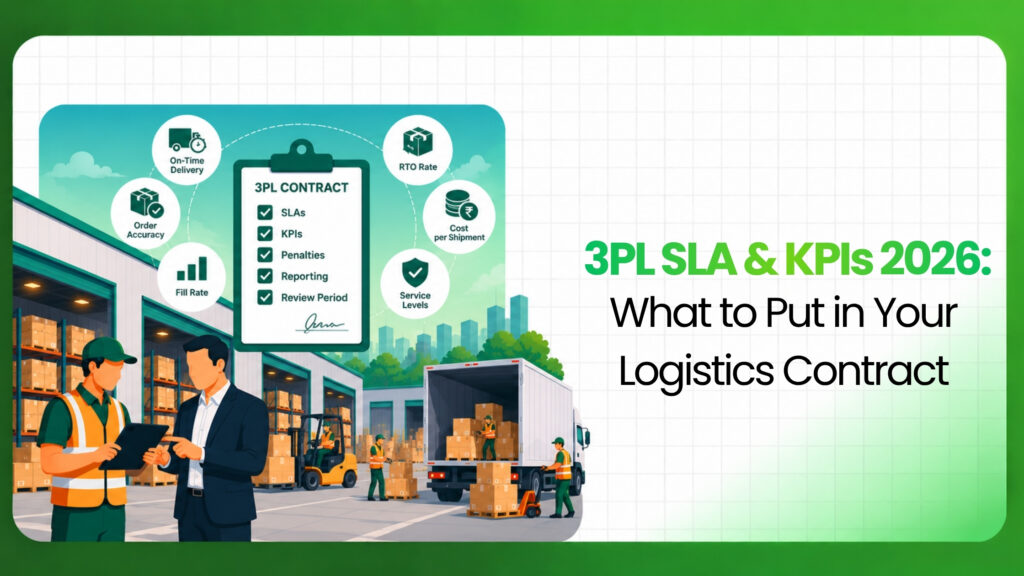
That’s the job of a 3PL SLA. It turns vague promises into targets you can track, review and enforce. The 3PL KPIs are the scorecard that tells you whether those targets are being met.
In this guide, you’ll learn:
- What a 3PL SLA is and how it differs from a KPI
- The clauses every 3PL contract should include
- Warehouse and transport KPIs with formulas and 2026 benchmarks
- How to set penalties, service credits and incentives that work
- The warning signs that your current SLA isn’t working
- A free 3PL SLA template you can copy into your next contract
Whether you’re outsourcing for the first time or renegotiating a deal that’s gone sour, this will help you write a contract that protects your business.
What Is a 3PL SLA?
A 3PL SLA, or 3PL service level agreement, is the part of your logistics contract that defines measurable service targets. It covers what the 3PL will deliver, how it will be measured, and what happens if targets are missed.
Think of it as the rulebook for the relationship. The commercial agreement covers rates and payment terms. The SLA covers performance.
A good logistics SLA answers five questions:
- What is being measured? (order accuracy, dispatch TAT, OTIF)
- How is it calculated? (the exact formula)
- What is the target? (99.5%, same day, within 24 hours)
- Where does the data come from? (usually the 3PL’s WMS)
- What happens if it’s missed? (service credits, a corrective plan, or exit)
SLA vs KPI: what’s the difference?
People often use these terms as if they mean the same thing. They don’t.
| SLA | KPI | |
|---|---|---|
| What it is | A promise written into the contract | A measurement tracked over time |
| Example | “98% of orders dispatched same day if received before 2 PM” | Dispatch TAT for October was 97.2% |
| Who owns it | Both parties sign it | The 3PL reports it, you verify it |
| If missed | Penalty, credit or corrective plan | A flag for discussion and improvement |
Here’s a simple way to remember it. The SLA is the speed limit. The KPI is the speedometer.
Also, not every KPI needs to become an SLA. You might track putaway time to understand your operation, but only attach penalties to the four to six metrics that hit your customers or your cash directly. A contract with 25 penalty clauses usually ends up enforcing none of them.
What Should a 3PL Contract Include? 9 Key Clauses
Before we get to KPIs, let’s look at the frame they sit in. A 3PL contract (or warehousing agreement, as it’s often called in India) usually has these key clauses. Skip any of them and you’ll feel it later.
- Scope of services. List every activity: receiving, storage, picking, packing, kitting, dispatch, returns, transport. Name the sites, channels and SKU count. Anything not listed becomes a “value-added service” with its own bill.
- Rate card. Storage per pallet or per sq ft, handling per unit or per order, and VAS charges. Our guide on warehousing cost in India explains how each model works.
- Minimum billing or minimum guarantee. Many 3PLs ask for a monthly minimum to cover fixed costs. Agree it in advance and link it to realistic volumes.
- Volume forecasts. Share expected order bands, including festive peaks. SLAs should apply within these bands, with a clear plan for spikes beyond them.
- Service levels and KPIs. The heart of the contract, covered in detail below.
- Liability for stock loss. Define the shrinkage tolerance (for example, 0.05% of throughput) and the value used for recovery. Cost price is standard. MRP is rarely accepted.
- Insurance. Who insures the stock in the warehouse and in transit? Get it in writing.
- Force majeure. Floods, strikes and lockdowns happen. Define what counts and how long SLAs are paused.
- Exit clause. Notice period, handover of stock and data, and what triggers an early exit, such as repeated SLA failures.
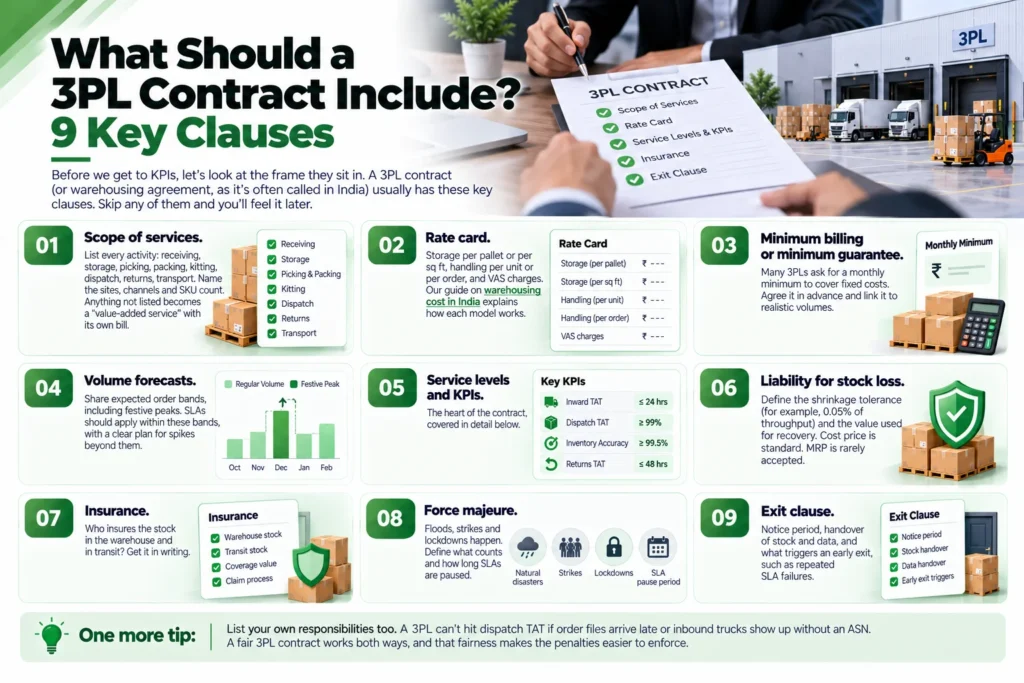
One more tip: list your own responsibilities too. A 3PL can’t hit dispatch TAT if order files arrive late or inbound trucks show up without an ASN. A fair 3PL contract works both ways, and that fairness makes the penalties easier to enforce.
3PL KPIs for the Warehouse: Formulas and 2026 Benchmarks
These warehouse KPIs decide whether the right product leaves on time and in good shape. The targets below are common starting points for a well-run Indian 3PL in 2026. Adjust them for your category, order profile and whether you use shared or dedicated warehousing.
| KPI | Formula | 2026 starting benchmark |
|---|---|---|
| GRN TAT | Time from vehicle reporting to GRN posted in WMS | Within 4 to 8 hours per truck |
| Receiving accuracy | Error-free GRNs ÷ total GRNs × 100 | 99.5% or higher |
| Dock-to-stock time | Time from unloading to stock available for picking | Within 24 hours |
| Inventory accuracy | Locations where system qty = physical qty ÷ locations counted × 100 | 99% or higher |
| Pick accuracy | Lines picked correctly ÷ total lines picked × 100 | 99.5% or higher |
| Order accuracy | Orders shipped without error ÷ total orders × 100 | 99.5% (99.9% for pharma, electronics) |
| Dispatch TAT | Orders dispatched within agreed time ÷ total orders × 100 | 98% same-day for orders before cut-off |
| Damage rate | Units damaged in 3PL custody ÷ units handled × 100 | Below 0.1% |
| FIFO/FEFO compliance | Orders picked by correct batch or expiry ÷ total orders × 100 | 100% for food, FMCG, pharma |
| Returns processing | Time from return received to restocked or written off | Within 48 to 72 hours |
What is GRN TAT in a warehouse?
GRN stands for Goods Receipt Note. It’s the record that confirms stock has arrived and been checked. GRN TAT is the time between a truck reporting at the dock and that GRN being posted in the system.
Why does it matter? Until the GRN is posted, the stock doesn’t exist for sales. A slow GRN means stock sitting on the dock while your website shows “out of stock.” During festive peaks, that delay costs real sales.
How is inventory accuracy calculated?
There are two ways, and the difference matters.
- By value: compare total system value to total physical value. Easy, but misleading. Overs in one bin cancel out shorts in another.
- By location: check each bin and count it correct only if the quantity matches exactly. Harder, but honest.
Always ask for location-level accuracy, backed by regular cycle counts rather than one big annual count.
Three rules for warehouse KPIs
- Define “error” upfront. Is a wrong SKU the same as a short shipment? Write it down. Most SLA disputes are about definitions, not performance.
- Fix the cut-off time. “Same-day dispatch” means nothing without one. A 2 PM cut-off and a 6 PM cut-off are very different promises.
- Use system timestamps. Every KPI should come from WMS data, not a spreadsheet filled in by hand.
Transport KPIs: OTD, OTIF and Lane-Wise TAT
If your 3PL also runs distribution, warehouse KPIs are only half the story. After all, a perfectly packed order that arrives three days late is still a failed order.
| KPI | Formula | What to watch |
|---|---|---|
| On-time delivery (OTD) | Deliveries within promised window ÷ total deliveries × 100 | Set the window per lane, not one number for India |
| OTIF | Deliveries on time and in full ÷ total deliveries × 100 | The metric big B2B and modern trade buyers judge you on |
| POD turnaround | PODs uploaded within agreed days ÷ total deliveries × 100 | Late PODs delay your invoicing and cash flow |
| Vehicle placement | Vehicles placed on time ÷ vehicles requested × 100 | Critical in peak season when trucks are scarce |
| Transit damage | Shipments with damage claims ÷ total shipments × 100 | Separate packaging faults from handling faults |
| E-way bill compliance | Shipments moved with a valid e-way bill ÷ total shipments × 100 | Should be 100%, since a missing bill can mean detention and fines |
What is OTIF in logistics?
OTIF means On Time, In Full. A delivery only counts if it arrives within the agreed window and with the full ordered quantity.
Here’s the OTIF formula:
OTIF % = (orders delivered on time and in full ÷ total orders) × 100
For example, say you shipped 1,000 orders last month. 960 arrived on time, but 25 of those were short. Your OTD is 96%, but your OTIF is only 93.5%.
Why does this matter so much in India? Large modern trade chains and quick commerce platforms increasingly hold suppliers to OTIF targets, often with deductions for misses. So if you sell to them, your 3PL’s OTIF directly affects your margins. Make sure the 3PL SLA at least matches what your buyers demand from you.
Why lane-wise TAT beats a national average
India isn’t one transit market. Delhi to Jaipur and Delhi to Guwahati can’t share the same target.
Instead, build a simple lane matrix: origin zone, destination zone and promised transit days. Then measure OTD against that matrix. It’s fairer to the 3PL and far more useful to you.
Quick commerce has its own clock
If you supply quick commerce dark stores, add a replenishment TAT KPI. Dark stores hold very little stock, so a late refill means empty shelves within hours. Agree a slot-based delivery window and a fill-rate target for each dispatch.
Also, make sure every interstate movement has a valid e-way bill. You can check rules and generate bills on the official e-Way Bill portal.
3PL Penalty Clauses, Service Credits and Incentives
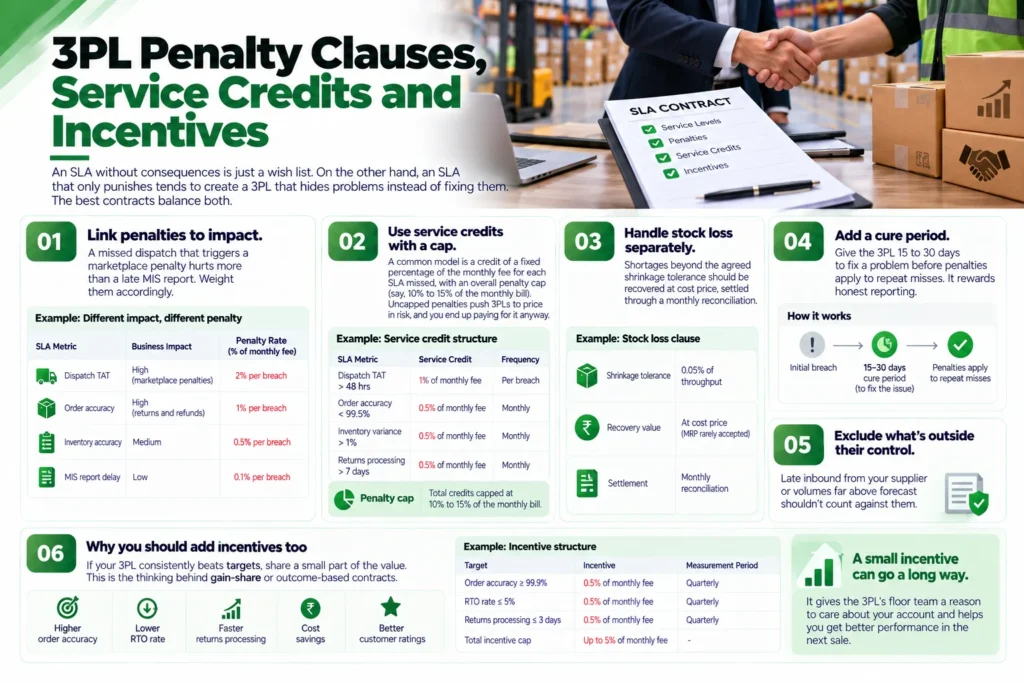
An SLA without consequences is just a wish list. On the other hand, an SLA that only punishes tends to create a 3PL that hides problems instead of fixing them. The best contracts balance both.
How to structure SLA penalties in logistics
- Link penalties to impact. A missed dispatch that triggers a marketplace penalty hurts more than a late MIS report. Weight them accordingly.
- Use service credits with a cap. A common model is a credit of a fixed percentage of the monthly fee for each SLA missed, with an overall penalty cap (say, 10% to 15% of the monthly bill). Uncapped penalties push 3PLs to price in risk, and you end up paying for it anyway.
- Handle stock loss separately. Shortages beyond the agreed shrinkage tolerance should be recovered at cost price, settled through a monthly reconciliation.
- Add a cure period. Give the 3PL 15 to 30 days to fix a problem before penalties apply to repeat misses. It rewards honest reporting.
- Exclude what’s outside their control. Late inbound from your supplier or volumes far above forecast shouldn’t count against them.
Why you should add incentives too
Here’s an idea many brands skip. If your 3PL consistently beats targets, share a small part of the value.
For example, a bonus for 99.9% order accuracy over a quarter, or for cutting returns processing time in half. This is the thinking behind gain-share or outcome-based contracts, a model more Indian brands are now asking about. The cost is small compared with what poor service costs you. More importantly, it gives the floor team a reason to care about your account.
Not sure whether a 3PL or a 4PL model suits this kind of contract? Our comparison of 3PL vs 4PL vs in-house logistics can help.
How to Measure 3PL Performance
You’ve set the targets. Now, how do you check them without drowning in spreadsheets?
Build a one-page 3PL scorecard
Your monthly 3PL scorecard should fit on a single page. One row per SLA, with the target, the actual, and a red, amber or green status.
| SLA | Target | October actual | Status |
|---|---|---|---|
| Order accuracy | 99.5% | 99.7% | Green |
| Dispatch TAT | 98% | 96.8% | Amber |
| Inventory accuracy | 99% | 98.2% | Red |
| OTIF | 95% | 95.4% | Green |
(Sample figures for illustration.)
If it takes a 30-slide deck to explain performance, something is probably being hidden.
Ask for a live WMS dashboard
In 2026, a monthly Excel MIS isn’t enough. Ask for read-only access to the 3PL’s WMS dashboard, or an API integration with your ERP. You should see real-time inventory visibility, open orders and dispatch status without sending an email.
As a bonus, live data also ends most arguments. When both sides see the same numbers, reviews focus on fixing problems rather than debating them.
Set a review rhythm
| Review | Who attends | What’s covered |
|---|---|---|
| Daily | Site supervisor, your ops coordinator | Daily stock report, pending orders, exceptions |
| Weekly | Account manager, your ops lead | KPI trends, open issues, upcoming volumes |
| Monthly | Account manager, finance, supply chain head | Scorecard, service credits, billing |
| Quarterly (QBR) | Leadership from both sides | Performance vs plan, improvements, contract changes |
Finally, agree an escalation matrix: who to call at each level, and how fast they must respond. When something breaks at 9 PM before a sale, you don’t want to be searching for phone numbers.
Signs Your 3PL SLA Isn’t Working
Maybe you already have a 3PL contract, but something feels off. Here are the warning signs to look for.
- Inventory mismatch every month. Your stock report and the 3PL’s never agree, and nobody can explain why.
- Late dispatch is “normal.” Orders received before the cut-off still go out the next day, and there’s always a reason.
- Order errors keep climbing. Wrong SKUs, short shipments and customer complaints are rising, but the 3PL’s own report says 99%.
- Reports arrive late or not at all. You chase the MIS every week instead of receiving it on schedule.
- Hidden charges show up on invoices. Extra handling, “special requests” or storage charges you never agreed to.
- Penalties are never applied. The SLA exists on paper, but no one has ever raised a service credit.
- Reviews feel like blame sessions. Each side brings its own numbers and the meeting ends without a fix.
If three or more of these sound familiar, your SLA probably needs work.
How to renegotiate a 3PL contract
Renegotiating doesn’t have to mean a fight. Follow these steps:
- Collect three months of data. Use your own order and complaint data, not just the 3PL’s reports.
- Pick the four to six metrics that hurt most. Focus there first.
- Agree definitions and a data source. This alone solves half of all disputes.
- Propose a 60- to 90-day improvement plan with clear targets and a joint weekly review.
- Add or tighten service credits and a cure period.
- Set an exit trigger. For example, three straight months below target on a critical SLA.
If the plan fails, it may be time to switch. Our 3PL partner checklist will help you evaluate the next one properly.
Free 3PL SLA Template You Can Copy
Here’s a simple 3PL SLA template to use as a starting point. Copy it into your contract annexure and adjust the targets to your business.
| Section | What to fill in | Example |
|---|---|---|
| Parties and term | Names, sites, start date, contract length | 2 years, Bhiwandi and Gurugram sites |
| Scope | Services, channels, SKU count | B2B, marketplace and D2C; 1,200 SKUs |
| Volume bands | Normal and peak order ranges | 2,000 to 5,000 orders a day; peak up to 8,000 |
| Cut-off time | When orders must arrive for same-day dispatch | 2 PM |
| Warehouse SLAs | GRN TAT, inventory accuracy, order accuracy, dispatch TAT | 6 hrs, 99%, 99.5%, 98% |
| Transport SLAs | OTD, OTIF, POD turnaround by lane | 95% OTD, 93% OTIF, e-POD in 48 hrs |
| Data source | System of record and client access | 3PL WMS with read-only dashboard |
| Reporting | Reports and timing | Daily stock report by 10 AM; monthly scorecard by 5th |
| Service credits | Credit per SLA miss and overall cap | 2% of monthly fee per miss; cap 10% |
| Shrinkage and liability | Tolerance and recovery value | 0.05% of throughput; recovered at cost |
| Client obligations | What you must provide | Order files by cut-off; ASN 24 hrs before inbound |
| Exclusions | What doesn’t count | Force majeure, volumes above peak band |
| Governance | Review meetings and escalation | Weekly ops call, monthly review, QBR |
| Exit | Notice and trigger | 90 days notice; 3 months below target on a critical SLA |
The examples are illustrative. Always have your legal team review the final warehouse service agreement.
Conclusion: Put It in Numbers, Then Put It in Writing
A strong 3PL relationship isn’t built on trust alone. It’s built on clear numbers that both sides agree to, check and review together.
Let’s recap the essentials:
- A 3PL SLA turns vague promises into measurable targets. KPIs are how you track them.
- Every 3PL contract needs clear scope, a rate card, liability terms, force majeure and an exit clause.
- Focus on four to six core SLAs, such as order accuracy, inventory accuracy, dispatch TAT and OTIF.
- Balance capped service credits with incentives, so the 3PL fixes problems instead of hiding them.
- Review performance with a one-page scorecard, a live WMS dashboard and a steady meeting rhythm.
At Genex Logistics, we build SLAs around each client’s order profile, channels and growth plans, not a one-size template. That applies to warehousing, distribution and in-plant logistics alike. Before go-live, we agree KPI definitions, data sources and the review rhythm, so both teams read the same scorecard from day one.
Planning to outsource, or stuck in a contract that isn’t working? Contact our team and we’ll help you map the 3PL SLAs and KPIs that fit your business.
Frequently Asked Questions
An SLA (service level agreement) in logistics is the part of a contract that sets measurable service targets, such as order accuracy, dispatch TAT and OTIF. It also defines how each target is measured and what happens if it’s missed.
The core 3PL KPIs are order accuracy, inventory accuracy, dispatch TAT, dock-to-stock time, GRN TAT and damage rate. If transport is included, add on-time delivery, OTIF and POD turnaround.
Most well-run warehouses target 99.5% or higher. High-value or regulated categories, like pharma and electronics, often push for 99.9%.
Most contracts use service credits, a set percentage of the monthly fee for each missed SLA, with an overall penalty cap. Stock loss beyond the agreed shrinkage tolerance is usually recovered separately at cost price.
Track operational KPIs daily or weekly, review the full scorecard monthly, and hold a quarterly business review (QBR) with leadership. Revisit the SLA targets themselves at least once a year.

Kapil Pathak is a Senior Digital Marketing Executive with over six years of experience specializing in the logistics and supply chain industry. His expertise spans digital strategy, search engine optimization (SEO), search engine marketing (SEM), and multi-channel campaign management. He has a proven track record of developing initiatives that increase brand visibility, generate qualified leads, and drive growth for D2C & B2B technology companies.