You asked three warehouse providers for a quote. One came back at ₹22 per sq ft. Another quoted ₹450 per pallet. The third sent a per-order rate with six line items underneath.
So which one is actually cheaper?
If you have ever tried to compare warehousing quotes in India, you know the feeling. Every provider prices differently, and the headline number rarely tells the full story. That makes it hard to budget, and even harder to know if you are overpaying.
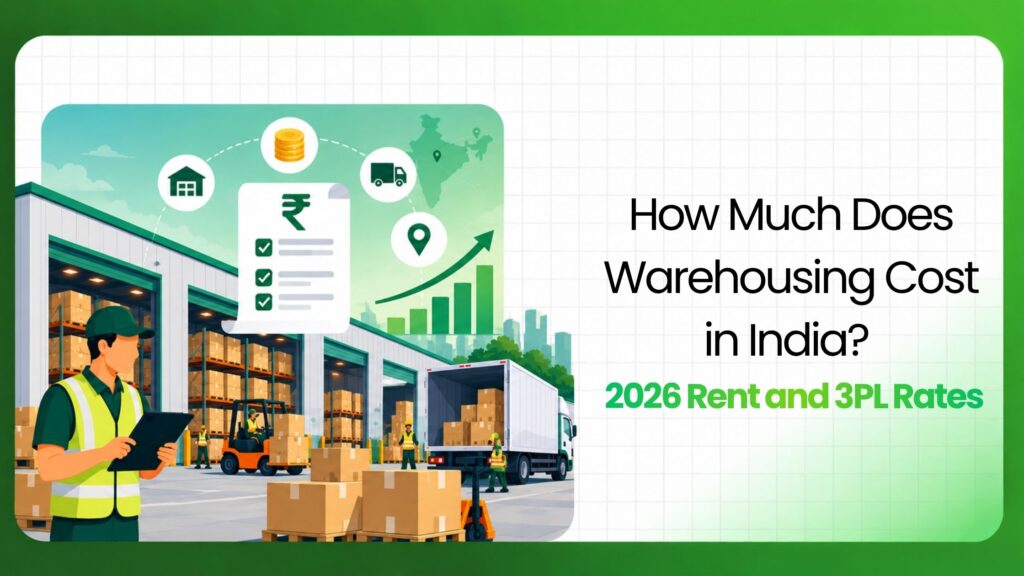
This guide clears that up. We will walk through:
- What warehousing really costs in India in 2026
- Warehouse rent per sq ft in major cities
- The cost components most businesses forget
- How 3PL companies price their services
- Hidden charges to watch for in contracts
- A worked example comparing in-house vs 3PL
- Practical ways to bring your bill down
By the end, you will be able to read any warehousing quote and know exactly what you are paying for.
How Much Does Warehousing Cost in India? The Quick Answer
In 2026, Grade A warehouse rent in India’s big markets averages ₹19 to ₹29 per sq ft per month. Ahmedabad sits at the lower end, while Pune is the most expensive.
But rent is only one piece. Once you add manpower, handling, technology and utilities, your total warehousing cost is often 1.5x to 2x the rent alone.
Here is a quick snapshot:
| Cost type | Typical range (2026) |
|---|---|
| Grade A rent, top 8 cities | ₹19–₹29 per sq ft per month |
| Tier-2 city rent | Usually lower than metro hubs |
| 3PL storage, per pallet | ₹300–₹700 per pallet per month |
| E-commerce fulfilment | ₹15–₹40 per order (pick, pack, label) |
| Rent escalation | Around 4–5% per year in most leases |
Rent figures are from the Knight Frank H1 2026 report. 3PL rates are indicative ranges and vary with volume, product type and location.
Why such a wide range? Because what you store, how fast it moves and where you need it all change the price. A pallet of slow-moving spare parts costs far less to manage than 2,000 small D2C orders a day.
Warehouse Rent per Sq Ft in India: City-Wise Rates for 2026
Where you set up matters more than most people expect. The same 50,000 sq ft can cost lakhs more per year depending on the city.
Here are the average Grade A rents for H1 2026, based on Knight Frank’s India Warehousing Market Report:
| City | Avg. rent (₹/sq ft/month) | YoY change |
|---|---|---|
| Pune | 28.7 | +6% |
| Mumbai (incl. Bhiwandi belt) | 26.0 | +5% |
| Kolkata | 26.0 | +4% |
| Chennai | 25.7 | +7% |
| Bengaluru | 24.0 | +6% |
| NCR | 22.6 | +5% |
| Hyderabad | 22.0 | +4% |
| Ahmedabad | 19.4 | +6% |
What these numbers tell you
- Rents are rising everywhere. Every major city saw 4–7% growth year on year. If you are signing a lease, lock in escalation terms early.
- Chennai is heating up fastest. At +7%, it is the quickest riser, driven by manufacturing and port-linked demand.
- NCR is still good value. Despite being India’s biggest leasing market, average rent sits below Mumbai and Pune.
- Micro-markets vary a lot. Within one city, rent can swing widely. In NCR, for example, Farukh Nagar and Kundli price very differently from older hubs closer to the city.
Is demand pushing prices up?
In short, yes. India leased about 36.8 million sq ft of warehousing in H1 2026, up 15% from a year earlier. Third-party logistics firms alone took 30% of that space.
When 3PLs are leasing this much, it tells you something. More businesses are choosing to outsource rather than run their own warehouses. We will look at why later in this article.
What about Tier-2 cities?
Cities like Lucknow, Indore, Coimbatore and Jaipur usually cost less per sq ft than the metros. They also put you closer to fast-growing consumer markets.
The catch? Grade A supply is thinner, so good space can be harder to find. A shared facility run by a 3PL is often the easiest way in.
What Makes Up Your Total Warehousing Cost?
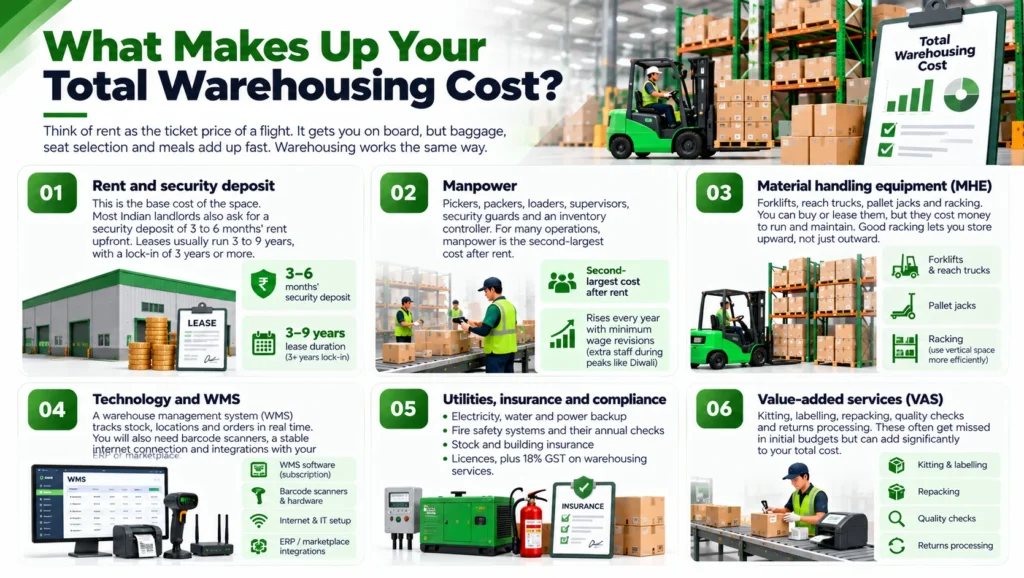
Think of rent as the ticket price of a flight. It gets you on board, but baggage, seat selection and meals add up fast. Warehousing works the same way.
Here are the main cost buckets you need to budget for.
1. Rent and security deposit
This is the base cost of the space. Most Indian landlords also ask for a security deposit of 3 to 6 months’ rent upfront. That cash stays locked in for the lease period.
Leases usually run 3 to 9 years, with a lock-in of 3 years or more.
2. Manpower
Pickers, packers, loaders, supervisors, security guards and an inventory controller. For many operations, manpower is the second-largest cost after rent.
It also rises every year with minimum wage revisions. And during peaks like Diwali, you need temporary staff on top.
3. Material handling equipment (MHE)
Forklifts, reach trucks, pallet jacks and racking. You can buy or lease them, but either way, they cost money to run and maintain.
Racking is worth special attention. Good racking lets you store upward, not just outward. If you are not sure how well you use your vertical space, try our cube space utilization quiz.
4. Technology and WMS
A warehouse management system (WMS) tracks stock, locations and orders in real time. You will also need barcode scanners, a stable internet connection and integrations with your ERP or marketplace.
Building this in-house is expensive. It is one reason many brands lean on a 3PL’s existing setup. We cover this in more detail in the impact of digitization in the 3PL space.
5. Utilities, insurance and compliance
- Electricity, water and power backup
- Fire safety systems and their annual checks
- Stock and building insurance
- Licences, plus 18% GST on warehousing services
6. Value-added services (VAS)
Kitting, labelling, repacking, quality checks and returns processing. These often get missed during budgeting and show up later as surprise line items.
How Do 3PL Companies Charge for Warehousing?
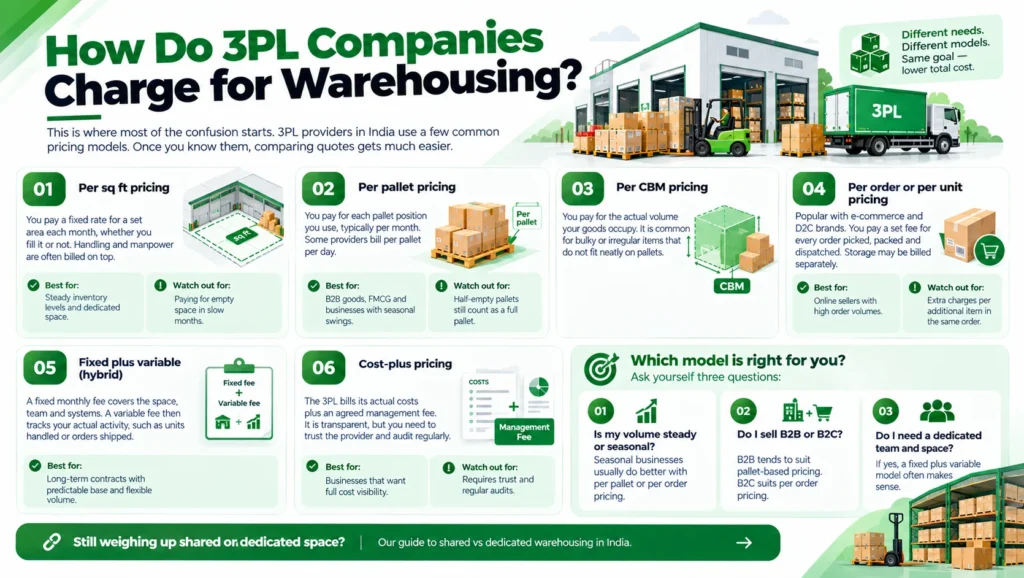
This is where most of the confusion starts. 3PL providers in India use a few common pricing models. Once you know them, comparing quotes gets much easier.
Per sq ft pricing
You pay a fixed rate for a set area each month, whether you fill it or not. Handling and manpower are often billed on top.
- Best for: steady inventory levels and dedicated space
- Watch out for: paying for empty space in slow months
Per pallet pricing
You pay for each pallet position you use, typically per month. Some providers bill per pallet per day.
- Best for: B2B goods, FMCG and businesses with seasonal swings
- Watch out for: half-empty pallets still count as a full pallet
Per CBM (cubic metre) pricing
You pay for the actual volume your goods occupy. It is common for bulky or irregular items that do not fit neatly on pallets.
Per order or per unit pricing
Popular with e-commerce and D2C brands. You pay a set fee for every order picked, packed and dispatched. Storage may be billed separately.
- Best for: online sellers with high order volumes
- Watch out for: extra charges per additional item in the same order
Fixed plus variable (hybrid)
A fixed monthly fee covers the space, team and systems. A variable fee then tracks your actual activity, such as units handled or orders shipped.
This model is common in long-term contracts. It gives both sides some predictability while still flexing with volume.
Cost-plus pricing
The 3PL bills its actual costs plus an agreed management fee. It is transparent, but you need to trust the provider and audit regularly.
Which model is right for you?
Ask yourself three questions:
- Is my volume steady or seasonal? Seasonal businesses usually do better with per pallet or per order pricing.
- Do I sell B2B or B2C? B2B tends to suit pallet-based pricing. B2C suits per order pricing.
- Do I need a dedicated team and space? If yes, a fixed plus variable model often makes sense.
Still weighing up shared or dedicated space? Our guide to shared vs dedicated warehousing in India breaks down the trade-offs.
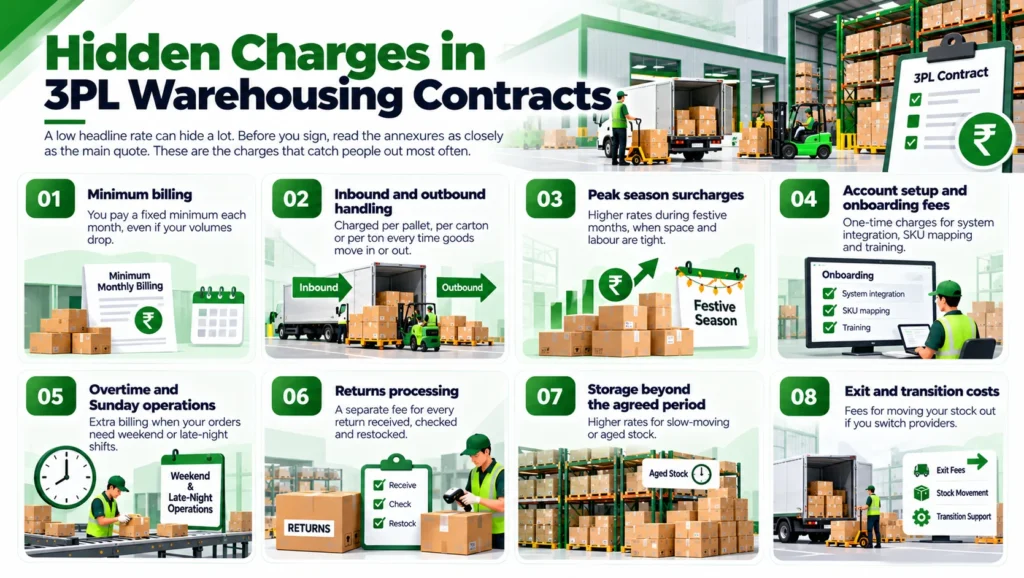
Hidden Charges in 3PL Warehousing Contracts
A low headline rate can hide a lot. Before you sign, read the annexures as closely as the main quote. These are the charges that catch people out most often.
- Minimum billing: You pay a fixed minimum each month, even if your volumes drop.
- Inbound and outbound handling: Charged per pallet, per carton or per ton every time goods move in or out.
- Peak season surcharges: Higher rates during festive months, when space and labour are tight.
- Account setup and onboarding fees: One-time charges for system integration, SKU mapping and training.
- Overtime and Sunday operations: Extra billing when your orders need weekend or late-night shifts.
- Returns processing: A separate fee for every return received, checked and restocked.
- Storage beyond the agreed period: Higher rates for slow-moving or aged stock.
- Exit and transition costs: Fees for moving your stock out if you switch providers.
How to protect yourself
Ask every provider for a full rate card, not just the storage rate. Then model your real monthly volume against each quote.
It also helps to ask a simple question: “What would my bill have been last October?” A peak month quickly shows which quote is truly cheaper.
For a full list of questions to ask before signing, see our checklist for choosing a 3PL logistics partner in India.
In-House Warehouse vs 3PL: Which Costs Less?
Numbers make this clearer than theory. Let’s take a simple example.
The business: A mid-size FMCG brand in NCR. It needs about 30,000 sq ft, but on average uses only 70% of that space. Volumes jump around Diwali and dip in the monsoon.
Option A: Run your own warehouse
| Cost item | Monthly cost (₹) |
|---|---|
| Rent: 30,000 sq ft × ₹22.6 | 6,78,000 |
| Manpower: 18 staff + 1 manager | 4,20,000 |
| Utilities and power backup | 1,00,000 |
| Security, insurance, maintenance | 80,000 |
| MHE lease (forklifts, pallet jacks) | 70,000 |
| WMS and IT | 40,000 |
| Total | 13,88,000 |
On top of that, you would pay a security deposit of around ₹40 lakh (six months’ rent) upfront. You also carry the risk of a 3-year lock-in.
Option B: Use a 3PL in a shared facility
| Cost item | Monthly cost (₹) |
|---|---|
| Storage: 1,200 pallets × ₹550 | 6,60,000 |
| Handling: 2,400 pallet movements × ₹150 | 3,60,000 |
| Value-added services (labelling, kitting) | 60,000 |
| WMS, manpower, MHE | Included |
| Total | 10,80,000 |
The result
In this example, the 3PL route saves about ₹3 lakh a month, or roughly 22%. Plus, ₹40 lakh of working capital stays in the business instead of sitting with a landlord.
These figures are illustrative. Your real numbers will depend on your product, order profile and location.
When in-house still makes sense
Outsourcing is not always the cheaper choice. Running your own warehouse can win when:
- Your volumes are very high and stable all year
- Your product needs highly specialised handling
- Warehousing is part of your core competitive edge
For a deeper comparison, read 3PL vs 4PL vs in-house logistics.
How to Reduce Warehousing Costs in India
You cannot control market rents. But you can control how well you use your space and how you buy services. Here are seven practical ways to trim your bill.
1. Use your vertical space
Most warehouses waste height. Adding taller racking or mezzanine floors lets you store more without paying for extra floor area. Even a small improvement in cube utilisation can delay a costly move to a bigger site.
2. Pay only for what you use
If your volumes swing through the year, fixed dedicated space means paying for air in slow months. Shared warehousing or per pallet pricing lets your cost rise and fall with your stock.
3. Plan ahead for peak season
Festive months bring surcharges, scarce labour and rushed decisions. Book space and staff early, and agree peak rates in the contract. Our festive season warehousing readiness guide covers what to sort out before Diwali.
4. Clear out slow-moving stock
Dead stock quietly eats space every month. Review ageing reports each quarter. Then liquidate, bundle or return items that have not moved in months.
5. Look beyond the metros
Tier-2 locations and city outskirts often cost less. Pair a regional hub with smaller forward stock points, and you can save on rent without slowing delivery.
6. Use FTWZ or bonded warehousing for imports
If you import goods, you can defer customs duty until the stock actually leaves the zone. That frees up working capital. Learn more in our comparison of bonded warehouses vs FTWZ.
7. Negotiate a smarter contract
- Ask for volume-based slabs that lower your rate as you grow
- Cap annual escalations in writing
- Reduce or remove minimum billing in your first year
- Set clear service level agreements (SLAs) with penalties for missed targets
Conclusion: Know Your Real Cost Before You Commit
Warehousing cost in India is about far more than the rent on a quote. Here is what to remember:
- Grade A rents average ₹19–₹29 per sq ft per month across the top cities, and they are rising 4–7% a year.
- Your total cost is often about double the rent once manpower, equipment, technology and utilities are added.
- 3PLs price in different ways, so compare quotes on your real monthly volumes, not headline rates.
- Hidden charges matter. Minimum billing, peak surcharges and handling fees can change the picture completely.
- Outsourcing often wins for variable volumes, and it keeps lakhs of working capital in your business.
The smartest move? Get a clear, all-in number before you sign anything.
Want to see what warehousing would cost for your business? Genex Logistics runs shared and dedicated facilities across India, with transparent rate cards and no surprise line items. Talk to our team for a custom quote built around your actual volumes.
Frequently Asked Questions
In H1 2026, average Grade A warehouse rent across India’s top cities ranged from about ₹19.4 per sq ft per month in Ahmedabad to ₹28.7 in Pune. Mumbai, Kolkata and Chennai sit around ₹26, while NCR and Hyderabad are closer to ₹22.
Most 3PLs charge roughly ₹300 to ₹700 per pallet per month for storage. Inbound and outbound handling is usually billed separately per pallet movement. The final rate depends on location, product type and how many pallets you commit to.
Pick, pack and dispatch typically costs ₹15 to ₹40 per order. Extra items, special packaging, kitting or returns processing add to that. High-volume sellers can usually negotiate lower slab rates.
Yes. Warehousing and storage services generally attract 18% GST, which applies to both rent and 3PL service fees. Registered businesses can usually claim input tax credit on it. Check specific cases, such as agricultural produce storage, with your tax advisor.
For most businesses with seasonal or growing volumes, yes. A 3PL spreads the cost of space, staff, equipment and WMS across many clients. You also avoid a large security deposit. Running your own facility can still be cheaper at very high and stable volumes.
Image alt text suggestions
- Featured image: warehousing cost in India 2026 Grade A warehouse interior with pallet racking
- City rent table graphic: warehouse rent per sq ft in India by city 2026
- Pricing models graphic: 3PL warehousing charges India per pallet per sq ft per order
- Hidden charges checklist: hidden charges in 3PL warehousing contract India
- Cost comparison chart: in-house warehouse vs 3PL cost comparison India

Kapil Pathak is a Senior Digital Marketing Executive with over six years of experience specializing in the logistics and supply chain industry. His expertise spans digital strategy, search engine optimization (SEO), search engine marketing (SEM), and multi-channel campaign management. He has a proven track record of developing initiatives that increase brand visibility, generate qualified leads, and drive growth for D2C & B2B technology companies.