Picking a logistics partner feels a lot like hiring for a critical role you can’t afford to get wrong. Except instead of one employee, you’re handing over your warehouses, your delivery promise, and honestly, your customer’s trust.
If you’ve ever typed “how to choose a 3PL partner in India” into Google at 11 PM after a shipment went missing, you already know the stakes. A good third-party logistics provider quietly makes your business run smoother. A bad one becomes a full-time headache you never signed up for.
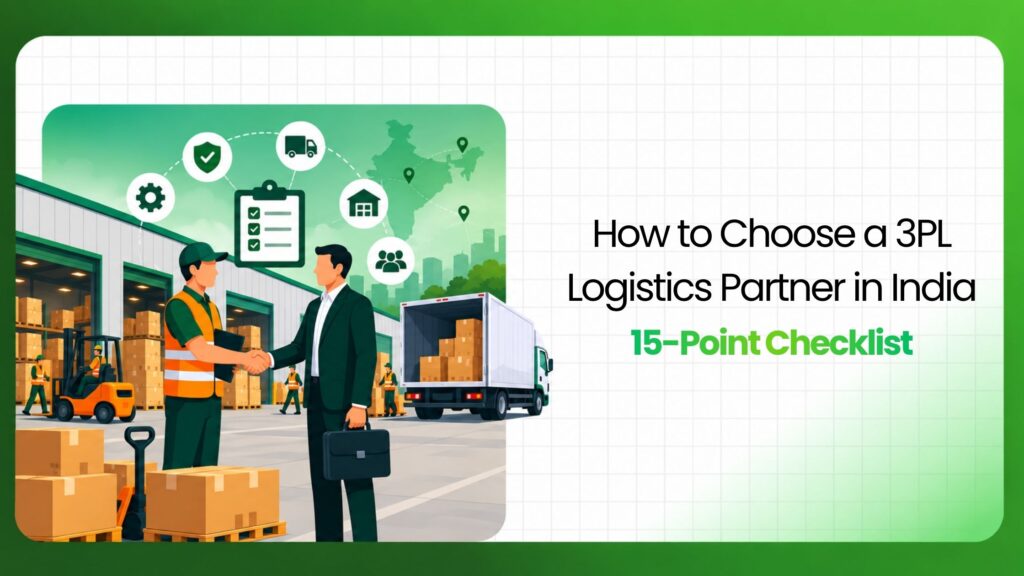
This guide breaks down exactly how to select a 3PL provider using a practical, 15-point checklist. Whether you’re an ecommerce brand shipping pan-India or a manufacturer needing contract logistics support, you’ll walk away knowing what to ask, what to ignore, and what should be a dealbreaker.
Let’s get into it.
What Is a 3PL Logistics Partner, Anyway?
A 3PL logistics partner is a company that manages some or all of your supply chain operations on your behalf. Think warehousing, transportation, inventory management, order fulfillment, and sometimes freight forwarding and customs clearance too.
Instead of building your own warehouses and hiring a fleet of drivers, you outsource that work to a third-party logistics provider in India who already has the infrastructure, technology, and expertise in place.
It’s a bit like renting a fully staffed kitchen instead of building one from scratch. You get the equipment and the chefs without the capital investment or the years it takes to figure out what actually works.
Why Choosing the Right 3PL Partner in India Matters More Than Ever
India’s logistics sector isn’t exactly standing still. According to IBEF industry estimates, the country’s third-party logistics market is growing at a rapid pace, driven by ecommerce expansion, GST-linked warehouse consolidation, and rising customer expectations for faster delivery.
That growth is great news, but it also means there are now dozens of providers competing for your business, all claiming to be the “best 3PL company in India.” Some of them genuinely are excellent. Others are overselling capabilities they don’t actually have.
Here’s the thing: a mismatched 3PL doesn’t just cost you money. It costs you stockouts, missed delivery windows, unhappy customers, and hours spent firefighting instead of growing your business.
That’s exactly why having a structured 3PL selection criteria in place, rather than picking based on the lowest quote, matters so much.
The 15-Point Checklist for Choosing a 3PL Partner in India
Before you even start evaluating vendors, get clear on your own requirements. What’s your order volume? Which cities do you need coverage in? Do you need cold storage, bonded warehousing, or just standard fulfillment? Write it down. This becomes your scorecard for everything below. If you’re still unsure whether you’re even asking the right questions, this piece on are you selecting the right 3PL for your business is a good gut-check before you go further.
Now, here’s what to actually look for when choosing a 3PL provider in India.
1. Industry Experience and Domain Expertise
Not all logistics is created equal. A provider that’s brilliant at moving FMCG products might struggle with pharma’s temperature-sensitive handling or automotive’s just-in-time delivery windows.
Ask potential partners: “Have you worked with businesses like mine before?” If they’ve handled your specific industry, whether that’s electronics, retail, automotive, or FMCG, they’ll already understand your pain points instead of learning on your dime.
2. Range of Services Offered
Some providers only do warehousing. Others only do transportation. The ones worth your time offer end-to-end support, including contract logistics, freight forwarding, and distribution under one roof.
Why does this matter? Because juggling five different vendors for one supply chain is exhausting, and it makes accountability nearly impossible when something goes wrong.
3. Pan-India Network and Warehouse Locations
If your customers are spread across India, a single-warehouse 3PL will eventually become a bottleneck. You’ll pay more in shipping zones and lose time on last-mile delivery.
Look for a pan-India logistics network with fulfillment centers positioned near your actual demand, not just wherever real estate happened to be cheap.
4. Technology Stack and Real-Time Visibility
In 2026, logistics without technology is like driving blindfolded. Ask about their Warehouse Management System (WMS) and Transportation Management System (TMS).
Can you track inventory in real time? Does their system integrate with your Shopify, WooCommerce, or ERP setup through APIs? A tech-enabled logistics provider should give you visibility, not radio silence until something goes wrong.
5. Scalability and Flexibility
Your business today isn’t your business during Diwali sale season. A good 3PL partner should flex with you, not force you into rigid contracts that punish growth or seasonal spikes.
Ask directly: “What happens if my order volume triples overnight?” Their answer tells you everything. If you’re already feeling the strain of outdated infrastructure, it might be worth reading whether you’ve outgrown your current logistics setup — and for a sense of what peak-season demand actually looks like, check out this breakdown of festive season warehousing readiness in India.
6. Pricing Structure and Hidden Costs
This one trips up a lot of businesses. A quote that looks cheap upfront can balloon once you factor in receiving fees, storage charges, picking fees, and penalty clauses.
Request a full breakdown of the 3PL pricing structure in India before signing anything. Transparent pricing, without hidden charges, should be non-negotiable.
7. Compliance, Safety, and Regulatory Adherence
India’s regulatory landscape isn’t simple. Your logistics partner needs to be fully compliant with GST requirements, transportation safety norms, and warehouse licensing rules.
A provider that cuts corners on compliance today will eventually cut corners on your shipments too. It’s just a matter of time.
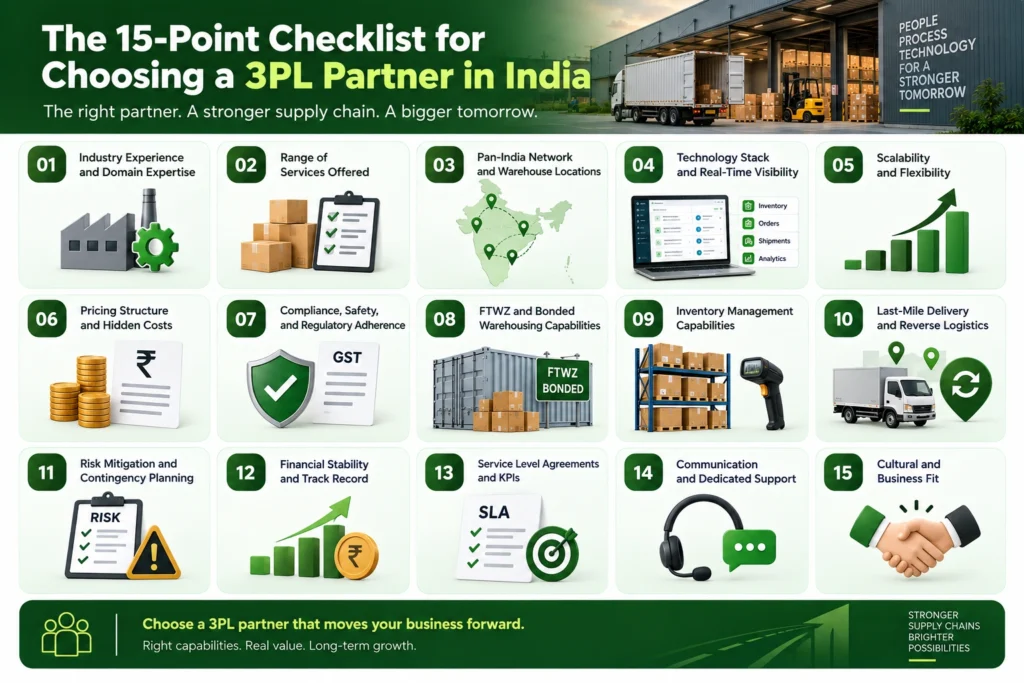
8. FTWZ and Bonded Warehousing Capabilities
If your business deals with imports, exports, or duty deferral, ask whether the provider offers FTWZ (Free Trade Warehousing Zone) and bonded warehousing services. These setups let you store goods without paying customs duty until they actually move into the domestic market, which can seriously improve your cash flow. Not sure which one fits your business? This comparison of bonded warehousing vs FTWZ breaks down the difference in plain terms.
9. Inventory Management Capabilities
Stockouts and overstocking both hurt your bottom line. A strong inventory management partner should offer accurate, real-time stock visibility, along with efficient order fulfillment, pick and pack processes, and cycle counts that actually match reality.
10. Last-Mile Delivery and Reverse Logistics
Delivery doesn’t end when the package leaves the warehouse. Ask how they handle last-mile delivery in tier 2 and tier 3 cities, and equally important, how they handle reverse logistics when customers return items.
Returns are unavoidable, especially in ecommerce. How smoothly your 3PL handles them says a lot about their operational maturity — and it’s a bigger opportunity than most brands realize. We’ve covered this in more depth in reverse logistics solutions for a missed opportunity in India.
11. Risk Mitigation and Contingency Planning
What happens during a flood, a strike, or a sudden fuel price spike? A dependable partner will have contingency plans already in place, not scramble to figure something out while your shipments sit stuck.
This is where risk mitigation and contingency planning genuinely separates the professionals from the amateurs.
12. Financial Stability and Track Record
It might feel awkward to ask a vendor about their financial health, but you should. A financially unstable 3PL can shut down operations abruptly, leaving your inventory and shipments in limbo.
Look at how long they’ve been operating, check client testimonials, and if possible, ask for references you can actually call.
13. Service Level Agreements and KPIs
A verbal promise isn’t a guarantee. Insist on a written service level agreement (SLA) that spells out delivery timelines, accuracy rates, and what happens if they fail to meet them.
Ask what key performance indicators (KPIs) they track and how often they’ll share that data with you. If they can’t answer this clearly, that’s a warning sign.
14. Communication and Dedicated Support
Logistics problems happen. It’s not a question of if, but when. What matters is how quickly and clearly your 3PL communicates when they do.
Do you get a dedicated account manager, or are you stuck in a generic support queue every time something goes wrong? This single factor often determines how painful (or painless) the relationship becomes.
15. Cultural and Business Fit
This last point gets overlooked constantly, but it matters. Does this provider actually understand your brand values and customer experience goals, or are you just another account number to them?
A 3PL that treats your business as a genuine partnership, not just a transaction, tends to go the extra mile when it counts.
3PL vs 4PL: Which One Does Your Business Actually Need?
Here’s a question that comes up a lot: what’s the actual difference between 3PL and 4PL?
A third-party logistics provider handles the physical execution of your supply chain, things like warehousing, transportation, and fulfillment. A fourth-party logistics (4PL) provider sits a level above that. They manage and coordinate your entire supply chain strategy, often overseeing multiple 3PL vendors on your behalf.
According to the Council of Supply Chain Management Professionals (CSCMP), the key distinction lies in ownership and scope. A 3PL executes; a 4PL orchestrates.
For most small and mid-sized businesses in India, a strong 3PL logistics partner is more than enough. You’d typically only need a 4PL if you’re managing a genuinely complex, multi-vendor global supply chain. If you’re still weighing your options, this comparison of 3PL vs 4PL vs in-house logistics lays out the trade-offs in detail.
Common Mistakes Businesses Make When Choosing a 3PL Partner
Even smart business owners fall into the same traps. Watch out for these:
- Choosing based on price alone. The cheapest option often has hidden costs buried in the fine print.
- Skipping the site visit. A warehouse that looks great in photos can look very different in person.
- Ignoring technology gaps. If they’re still using spreadsheets to track inventory, that’s your answer right there.
- Not asking for references. Past client experiences reveal far more than a sales pitch ever will.
- Overlooking contract flexibility. Locking into a rigid, long-term contract before you’ve tested the relationship is risky.
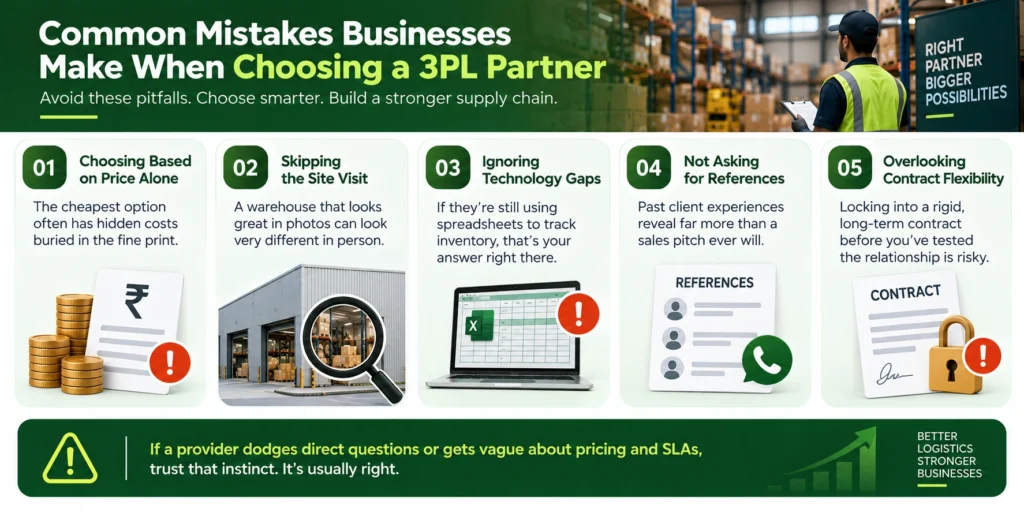
If a provider dodges direct questions or gets vague about pricing and SLAs, trust that instinct. It’s usually right.
How to Run a Simple 3PL RFP Process
You don’t need a 50-page document to evaluate vendors properly. A simple 3PL RFP checklist should cover:
- Your order volume and growth projections
- Required services (warehousing, transportation, freight forwarding, etc.)
- Geographic coverage needed
- Technology and integration requirements
- Budget range and pricing expectations
- Compliance and safety requirements
Send this to two or three shortlisted providers, compare their responses side by side, and don’t be afraid to negotiate contract rates once you know what a fair market price actually looks like.
Final Thoughts
Choosing a 3PL logistics partner in India isn’t a decision to rush. Run through this 15-point checklist, ask uncomfortable questions, and trust your gut when something feels off.
The right partner won’t just move your boxes from point A to point B. They’ll become an extension of your business, one that helps you scale without the operational chaos.
If you’re currently evaluating providers and want a partner with pan-India warehousing, FTWZ and bonded warehousing capabilities, tech-enabled visibility, and genuine industry expertise, take a look at our approach to 3PL and supply chain optimization to see if it’s the right fit for where your business is headed.
Frequently Asked Questions
A freight forwarder mainly arranges the movement of goods, especially across borders, handling shipping, customs documentation, and carrier coordination. A 3PL logistics partner typically offers a broader scope, including warehousing, inventory management, and domestic distribution, alongside freight services.
Costs vary widely depending on storage volume, order complexity, and value-added services like kitting or branded packaging. Most providers charge separately for receiving, storage, picking, and shipping, so always request an itemized breakdown before comparing quotes.
An FTWZ is a designated zone where businesses can store imported goods without paying customs duty until the goods actually leave the zone for domestic sale. It’s particularly useful for import-heavy businesses looking to improve cash flow and reduce duty-related costs.
Onboarding timelines depend on complexity, but most straightforward setups take anywhere from two to six weeks. This includes system integration, inventory transfer, staff training, and testing before going fully live.
At a minimum, expect reporting on order accuracy, on-time delivery rate, inventory accuracy, average fulfillment time, and return processing time. Regular KPI reporting keeps both sides accountable and helps catch issues before they snowball.

Kapil Pathak is a Senior Digital Marketing Executive with over six years of experience specializing in the logistics and supply chain industry. His expertise spans digital strategy, search engine optimization (SEO), search engine marketing (SEM), and multi-channel campaign management. He has a proven track record of developing initiatives that increase brand visibility, generate qualified leads, and drive growth for D2C & B2B technology companies.