Picture a busy factory floor for a second. Machines are humming, an assembly line is moving, and workers are fitting parts one after another. Now ask yourself a simple question: who makes sure the right part reaches the right workstation at the right moment? That quiet, behind-the-scenes work is exactly what in-plant logistics is all about.
Most people think logistics happens on highways and inside big warehouses. And a lot of it does. But some of the most important logistics work happens inside the factory gate, on the shop floor itself. If that internal flow breaks down, even the best production plan falls apart.
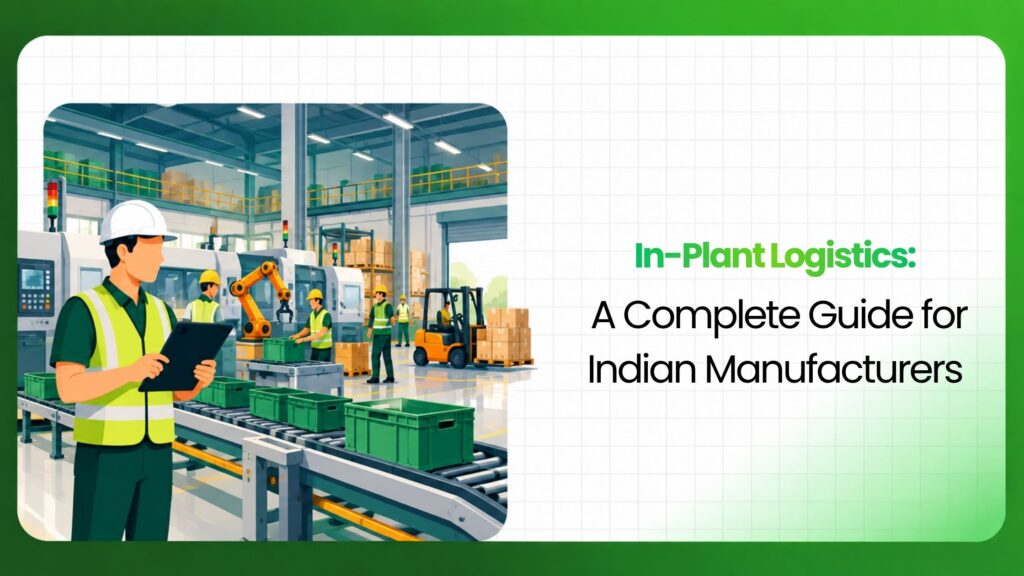
In this guide, we will walk through what in-plant logistics really means, what activities it covers, and how ideas like JIT and JIS keep an assembly line fed. We will also look at the benefits for Indian manufacturers, the industries that rely on it, and how to decide whether to run it yourself or hand it to a specialist. By the end, you will see why this “invisible” function often decides how smoothly a plant runs.
Let us get into it.
What Is In-Plant Logistics?
In-plant logistics is the management of material movement, storage, and handling within a manufacturing facility. In plain words, it is everything that happens to raw materials and parts from the moment they enter the plant until finished goods leave the dispatch dock.
Think of it as the circulatory system of a factory. Blood needs to reach every organ at the right time, in the right amount. In the same way, components need to reach every workstation on the line, exactly when production needs them. That is the job of in-plant logistics.
It covers the full internal journey:
- Receiving raw materials and components at the gate
- Storing them in an on-site stockroom or warehouse
- Picking, kitting, and staging parts for production
- Feeding those parts to the assembly line (line feeding)
- Moving sub-assemblies between stations
- Handling finished goods and preparing them for dispatch
Some people call this “intralogistics” or “internal logistics.” The label does not matter much. What matters is the goal: keep production running without a hitch, and do it at the lowest possible cost. Well-run in-plant logistics services act as the bridge between the warehouse and the shop floor.
In-Plant Logistics vs Warehousing: What Is the Difference?
This is a common point of confusion, so let us clear it up early.
Warehousing is mostly about storage. You bring goods in, keep them safe, track them, and ship them out when needed. It is a critical function, and a good warehouse and storage service forms the backbone of any supply chain.
In-plant logistics is about flow inside a production environment. It does not just store parts. It times their movement to match the rhythm of the assembly line. The clock matters. A part that arrives ten minutes late can stop the whole line.
Here is a simple way to remember it. Warehousing answers the question, “Where is my stock?” In-plant logistics answers a tougher question: “Is the right part at the right station at the right second?” The two work hand in hand, but they are not the same thing.
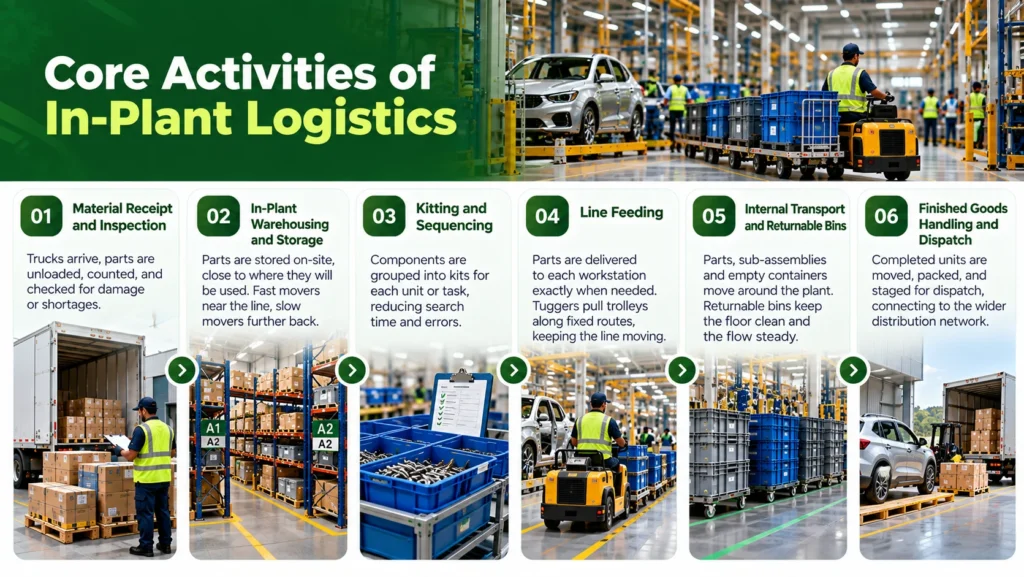
Core Activities of In-Plant Logistics
So what does the work actually look like day to day? In-plant logistics management pulls together several activities, all timed around the production schedule. Let us break them down.
Material Receipt and Inspection
Everything starts at the gate. Trucks arrive, and parts are unloaded, counted, and checked for damage or shortages. This step sets the tone. If wrong quantities slip through here, the error travels all the way to the line.
In-Plant Warehousing and Storage
Received parts are stored in an on-site area, often close to where they will be used. Fast-moving items sit near the line. Slow movers go further back. Smart layout planning here saves a huge amount of walking and driving later.
Kitting and Sequencing
Instead of sending loose parts to the line, teams often group them into “kits.” A kit holds all the components a worker needs for one unit or one task, packed together in a bin or trolley. Kitting cuts down search time and reduces errors, because the worker no longer hunts for parts across the shop floor.
Line Feeding
This is the heart of the operation. Production line feeding is the process of delivering parts to each workstation exactly when they are needed. Tuggers (small towing vehicles) pull trains of trolleys along fixed routes, dropping off full bins and picking up empty ones. When done well, the line never waits and never overflows.
Internal Transport and Returnable Bins
Parts, sub-assemblies, and empty containers move around the plant all day. Managing this traffic, including returnable bins and trolleys, keeps the floor clean and the flow steady. Empty bins have to cycle back to be refilled, or the whole system clogs up.
Finished Goods Handling and Dispatch
Once a unit rolls off the line, it needs to be moved, packed, and staged for dispatch. From here, it connects to the wider distribution network that carries it to customers. In-plant logistics closes the loop, from raw material in to finished product out.
JIT and JIS: The Engines Behind Line Feeding
You cannot talk about in-plant logistics for long without running into two three-letter terms: JIT and JIS. They sound technical, but the ideas are simple once you break them down.
What Is Just-in-Time (JIT)?
Just-in-Time (JIT) means parts arrive at the line close to the exact moment they are needed, not days or weeks early. The idea was made famous by Toyota’s production system, and it changed how the world thinks about manufacturing.
Why does this matter? Because stock that sits idle costs money. It ties up cash, eats floor space, and risks getting damaged or going out of date. JIT keeps inventory lean, so you carry only what you are about to use. You can read more about the roots of this approach in the Toyota Production System.
There is a catch, though. JIT only works if your inbound supply is reliable. If parts are late, the line stops, and a stopped line is expensive. So JIT and strong in-plant logistics go together like two sides of a coin.
What Is Just-in-Sequence (JIS)?
Just-in-Sequence (JIS) takes JIT one step further. Parts do not just arrive on time. They arrive in the exact order they will be fitted on the line.
Imagine a car plant building vehicles in different colours, one after another. With JIS, the seats or bumpers show up already sorted to match each car in the queue. The worker simply picks the next one. No sorting, no second-guessing.
JIT vs JIS at a Glance
| Feature | Just-in-Time (JIT) | Just-in-Sequence (JIS) |
|---|---|---|
| Core idea | Right part, right time | Right part, right time, right order |
| Sorting needed | Some sorting at the line | Almost none |
| Best suited to | Steady, high-volume lines | Mixed-model lines (many variants) |
| Complexity | Moderate | Higher |
For plants that build many variants, such as automotive, JIS can save a lot of handling time. However, it demands tight coordination and accurate data. That is where an experienced in-plant logistics team earns its keep.
Why In-Plant Logistics Matters for Indian Manufacturers
India’s manufacturing sector is growing fast, and the pressure on factories keeps rising. Buyers want products quicker. Margins are thin. Space in industrial zones is costly. In this setting, in-plant logistics is not a “nice to have.” It is a core lever for competitiveness.
Here is what strong in-plant logistics delivers.
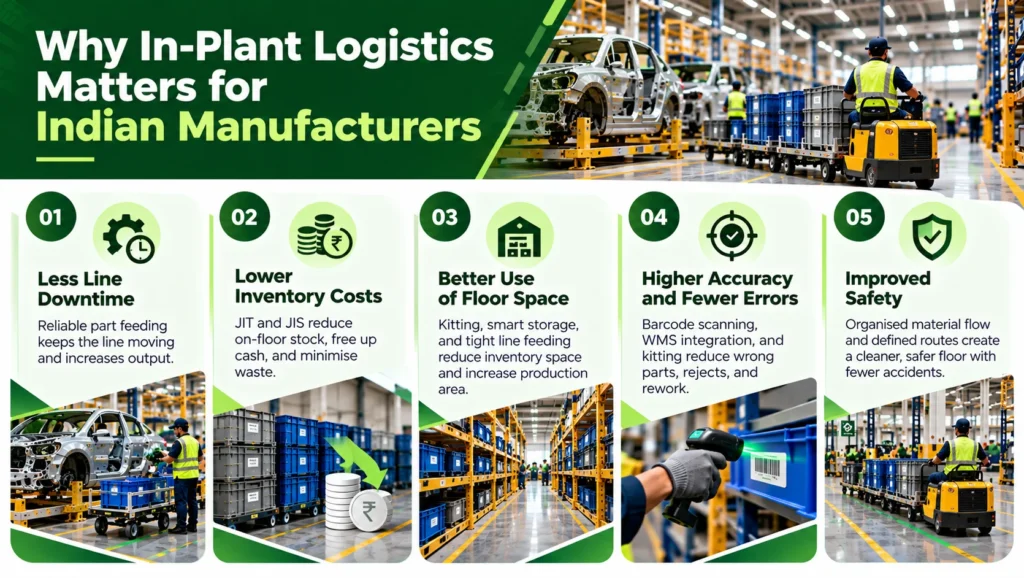
Less Line Downtime
A single stopped line can burn thousands of rupees a minute. By feeding parts reliably, in-plant logistics keeps the line moving. Uptime goes up, and so does output.
Lower Inventory Costs
With JIT and JIS, you hold less stock on the floor. That frees up cash and reduces waste. In a country where working capital is precious for many mid-size manufacturers, this is a real win. It reflects the wider shift from cost reduction to value creation that the best supply chains are chasing.
Better Use of Floor Space
Every square foot of a plant is expensive. Kitting, smart storage, and tight line feeding mean you need less space for inventory and more room for actual production.
Higher Accuracy and Fewer Errors
Barcode scanning, WMS integration, and kitting reduce the chance of the wrong part reaching the line. Fewer errors mean fewer rejects, less rework, and happier customers.
Improved Safety
An organised floor with defined tugger routes and clean material flow is a safer floor. Fewer forklifts darting around at random means fewer accidents.
To sum up, in-plant logistics touches cost, speed, quality, and safety all at once. That is a rare combination, and it explains why manufacturers pay close attention to it.
Which Industries Rely on In-Plant Logistics?
Not every factory needs the same level of in-plant support. But several sectors lean on it heavily, especially those with complex assembly and many parts.
- Automotive and auto components. This is the classic user. Car and two-wheeler plants run on JIT and JIS, feeding thousands of parts to the line daily. Specialised automotive logistics support is often built around in-plant operations.
- Engineering and heavy machinery. Large engineering products have big, awkward components that need careful staging and movement inside the plant.
- Electronics and telecom. High-value, delicate parts in electronics and telecom manufacturing demand precise handling and strong inventory control.
- FMCG and consumer durables. High-volume lines benefit from steady line feeding and quick finished-goods dispatch.
If your plant assembles products from many parts, chances are good that in-plant logistics can lift your performance.
In-House or Outsource? Making the Call
Now comes the big question many plant managers wrestle with. Should you run in-plant logistics with your own team, or bring in a specialist?
There is no single right answer. It depends on your scale, your product mix, and where you want your people to focus. Still, a few patterns show up again and again.
When In-House Makes Sense
- You have a small, simple operation with steady, predictable demand.
- Your team already has deep material-handling expertise.
- You want full, direct control over every step and have the resources to manage it.
When Outsourcing Makes Sense
- You want your staff focused on core production, not on running trolleys and tracking bins.
- Your product mix is complex, with JIS needs and many variants.
- You are scaling fast and cannot build logistics capability quickly enough.
- You want access to trained manpower, WMS tools, and proven processes without heavy investment.
Many manufacturers choose to outsource in-plant logistics to a 3PL and contract logistics partner. The 3PL brings ready processes, skilled teams, and technology, so the manufacturer can focus on making great products. If you are weighing this route, it helps to know how to choose the right 3PL partner before you sign anything.
What to Look For in an In-Plant Logistics Partner
If you do decide to outsource, do not pick on price alone. Look at the whole package:
- Experience in your industry. Automotive in-plant work is different from FMCG.
- Technology. Does the partner use WMS, barcode scanning, and real-time tracking?
- Trained manpower. In-plant teams need to understand safety, sequencing, and line discipline.
- Flexibility. Can they scale up during peak demand and down during lulls?
- A track record. Ask for references and results, not just promises.
A good partner feels less like a vendor and more like an extension of your own team.
The Role of Technology in Modern In-Plant Logistics
Twenty years ago, in-plant logistics ran on clipboards and gut feel. Not anymore. Today, technology sits at the centre of the operation, and it keeps getting smarter.
Here are the tools doing the heavy lifting:
- Warehouse Management Systems (WMS). These track every bin and part in real time, so nothing gets lost and inventory stays accurate.
- Barcode and RFID scanning. Scanning at each step cuts human error and creates a clear record of what moved where.
- Automated guided vehicles (AGVs) and tuggers. These move material along fixed routes without constant human steering, improving both speed and safety.
- Data and analytics. By studying material flow, teams spot bottlenecks and fine-tune routes and schedules.
Technology does not replace people on the shop floor. It makes them more effective. A worker with a scanner and a clear tugger route gets far more done than one guessing where the next bin should go. This is the same digital shift reshaping the wider 3PL space across India.
A Quick Real-World Picture
Let us make this concrete with a simple example.
Imagine a two-wheeler plant near Pune. It builds several models on one line, in different colours and specs. Before it tightened its in-plant logistics, parts piled up all over the floor. Workers wasted time searching for the right fuel tank or seat. The line stopped often, and rejects were high.
Then the plant brought in kitting, JIS sequencing, and barcode scanning, supported by tugger routes and returnable bins. Suddenly, each worker got a neat kit matched to the exact bike coming down the line. Search time dropped. The line kept moving. Floor space opened up because inventory shrank.
Nothing about the product changed. Only the internal flow did. And that flow made the whole plant faster and leaner. That, in a nutshell, is the power of in-plant logistics.
Common Challenges (and How to Beat Them)
In-plant logistics is powerful, but it is not without hurdles. Being honest about them helps you plan better.
- Space constraints. Older plants were not designed for smooth material flow. The fix is careful layout planning and, sometimes, vertical storage.
- Data gaps. Without accurate data, JIT and JIS fall apart. Barcode scanning and WMS close these gaps.
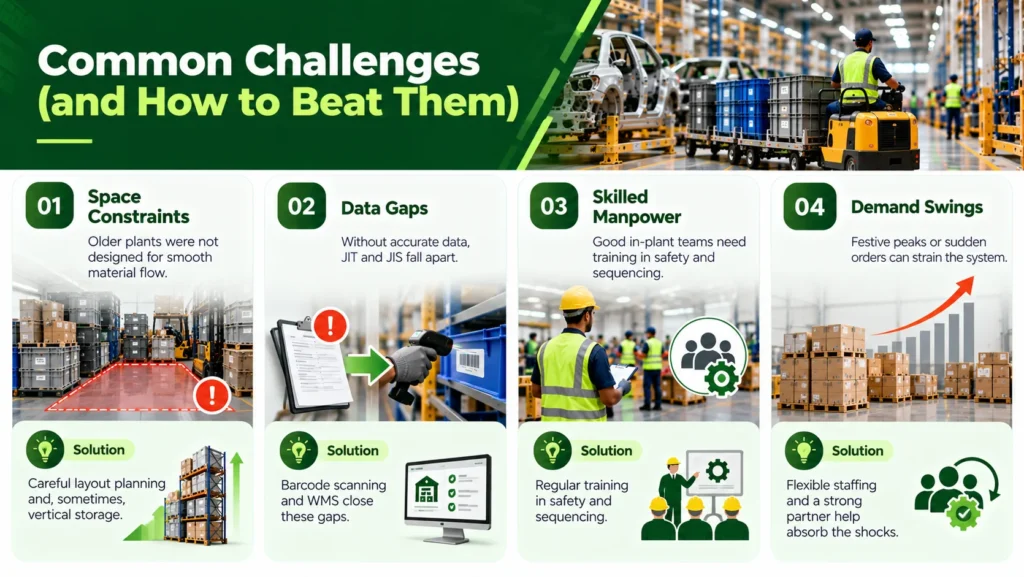
- Skilled manpower. Good in-plant teams need training in safety and sequencing. This is one reason outsourcing appeals to many.
- Demand swings. Festive peaks or sudden orders can strain the system. Flexible staffing and a strong partner help absorb the shocks.
None of these are deal-breakers. With the right processes and support, each one can be managed.
Conclusion: Small Moves Inside the Gate, Big Results Outside It
Let us bring it all together. In-plant logistics is the quiet engine that keeps a factory running. It covers everything from receiving raw materials to feeding the line to dispatching finished goods. Ideas like JIT and JIS keep inventory lean and lines moving, while kitting, WMS, and tuggers boost accuracy and speed.
For Indian manufacturers, the payoff is clear: less downtime, lower costs, better use of space, and higher quality. Whether you run it in-house or partner with a specialist, getting in-plant logistics right can lift your whole operation.
So here is the takeaway. If your plant struggles with line stoppages, cluttered floors, or high inventory costs, look inside the gate first. The answer is often there, waiting in the way parts move across your shop floor.
Ready to tighten the flow inside your plant? Talk to the Genex Logistics team about in-plant logistics, line feeding, and contract logistics solutions built for Indian manufacturers. Let us help you turn your shop floor into a smooth, cost-efficient operation.
Frequently Asked Questions
In-plant logistics is the management of how materials and parts move, get stored, and are handled inside a manufacturing plant. It covers the full internal journey, from receiving raw materials to feeding the assembly line to dispatching finished goods, all timed around the production schedule.
Warehousing is mainly about storing goods safely and shipping them when needed. In-plant logistics is about the timed flow of materials inside a production environment. It does not just store parts; it delivers them to the right workstation at the right moment so the line never stops.
Line feeding is the process of delivering parts to each workstation on the assembly line exactly when they are needed. It often uses tuggers pulling trolleys along fixed routes, dropping off full bins and collecting empty ones, so workers always have the components in front of them.
Just-in-Time (JIT) means parts arrive close to the moment they are needed, keeping inventory lean. Just-in-Sequence (JIS) goes further and delivers parts in the exact order they will be fitted on the line. JIS suits mixed-model lines, such as automotive plants building many variants.
Manufacturers outsource in-plant logistics to focus their people on core production rather than material handling. A specialist 3PL partner brings trained teams, WMS and scanning technology, and proven processes, which improves accuracy, cuts costs, and scales easily during peak demand.

Kapil Pathak is a Senior Digital Marketing Executive with over six years of experience specializing in the logistics and supply chain industry. His expertise spans digital strategy, search engine optimization (SEO), search engine marketing (SEM), and multi-channel campaign management. He has a proven track record of developing initiatives that increase brand visibility, generate qualified leads, and drive growth for D2C & B2B technology companies.