You have made the call. Your own warehouse is stretched, your team is firefighting dispatches, and outsourcing finally makes sense. Then a worry creeps in. What if orders stop going out while the stock is being moved?
It is a fair question. Most brands are not afraid of outsourcing itself. They are afraid of the switch.
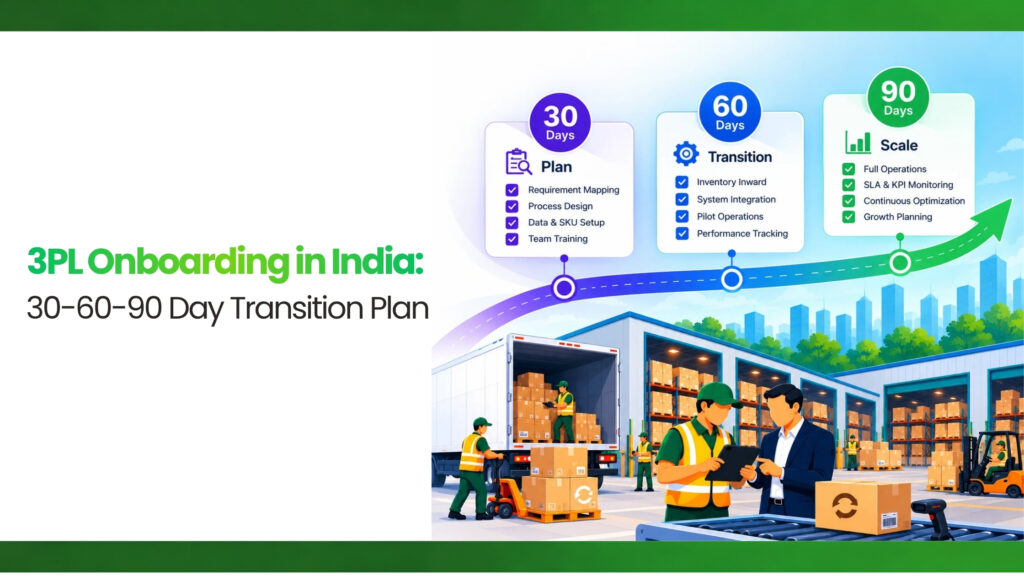
The good news is that a well-run move is not a leap. It is a series of small, checked steps. In this guide, we explain how a brand onboards with a 3PL in India, using the 30-60-90 day plan we follow at Genex Logistics. You will see what happens in each phase, what we need from you, where projects usually slip, and how to keep sales running throughout.
Whether you ship 200 orders a day or run a multi-city distribution network, the logic is the same. Plan first, test small, then scale.
What Does 3PL Onboarding Actually Involve?
3PL onboarding is the process of setting up a new logistics partnership so that your goods, data and orders flow smoothly. It covers far more than moving boxes.
Think of it like moving into a new house. The furniture is only one part of the job. You also need to switch on the electricity, set up the locks and agree on the house rules. Skip any of those and the first night is uncomfortable.
Five workstreams run side by side during a warehouse transition:
- Commercial: rate card, contract, SLAs and KPIs.
- Data: SKU master, barcodes, units of measure and opening stock.
- Systems: WMS setup, ERP and marketplace integration, carrier mapping.
- Physical: stock transfer, receiving, putaway and packaging.
- People and governance: training, escalation paths and review meetings.
If one workstream lags, the whole project waits. A perfect stock transfer is useless if orders never reach the warehouse system.
So why 30-60-90? Because it gives every workstream a clear window and ends with a measured review instead of a hopeful “we think we’re live.” Timelines do vary, and we explain what speeds things up or slows them down later in this article.
Still comparing options? Our guide on how to choose a 3PL logistics partner in India and our breakdown of 3PL vs 4PL vs in-house logistics will help you decide before you plan the transition.
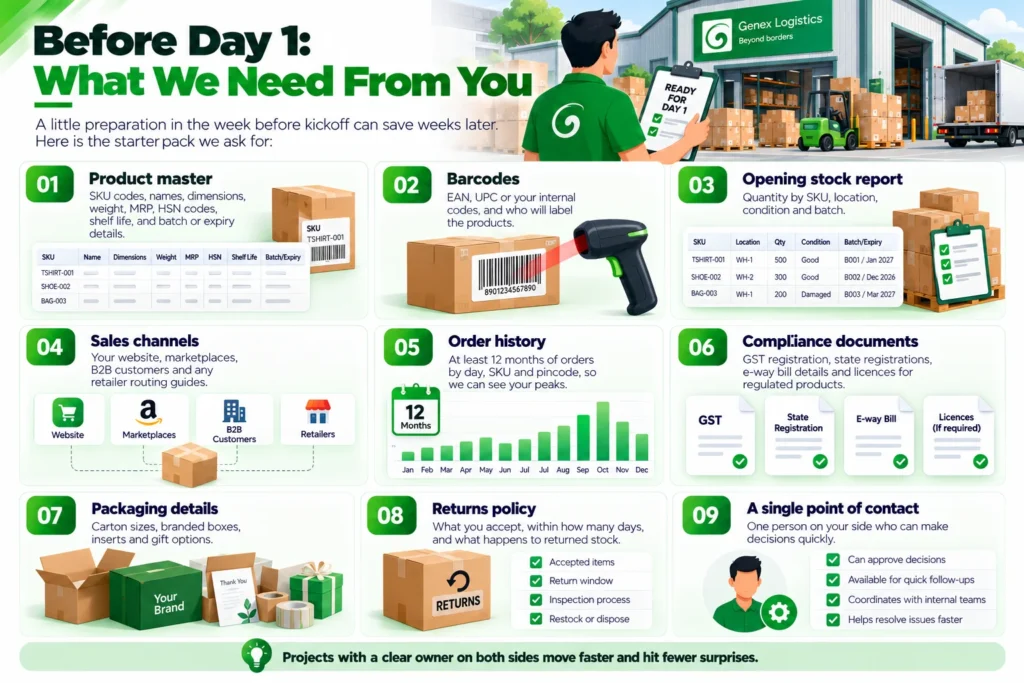
Before Day 1: What We Need From You
Here is something many brands do not expect. The biggest cause of delay is rarely the warehouse. It is missing information.
A little preparation in the week before kickoff can save weeks later. Here is the starter pack we ask for:
- Product master: SKU codes, names, dimensions, weight, MRP, HSN codes, shelf life, and batch or expiry details.
- Barcodes: EAN, UPC or your internal codes, and who will label the products.
- Opening stock report: quantity by SKU, location, condition and batch.
- Sales channels: your website, marketplaces, B2B customers and any retailer routing guides.
- Order history: at least 12 months of orders by day, SKU and pincode, so we can see your peaks.
- Compliance documents: GST registration, state registrations, e-way bill details and licences for regulated products.
- Packaging details: carton sizes, branded boxes, inserts and gift options.
- Returns policy: what you accept, within how many days, and what happens to returned stock.
- A single point of contact: one person on your side who can make decisions quickly.
That last item matters more than it looks. Projects with a clear owner on both sides move faster and hit fewer surprises.
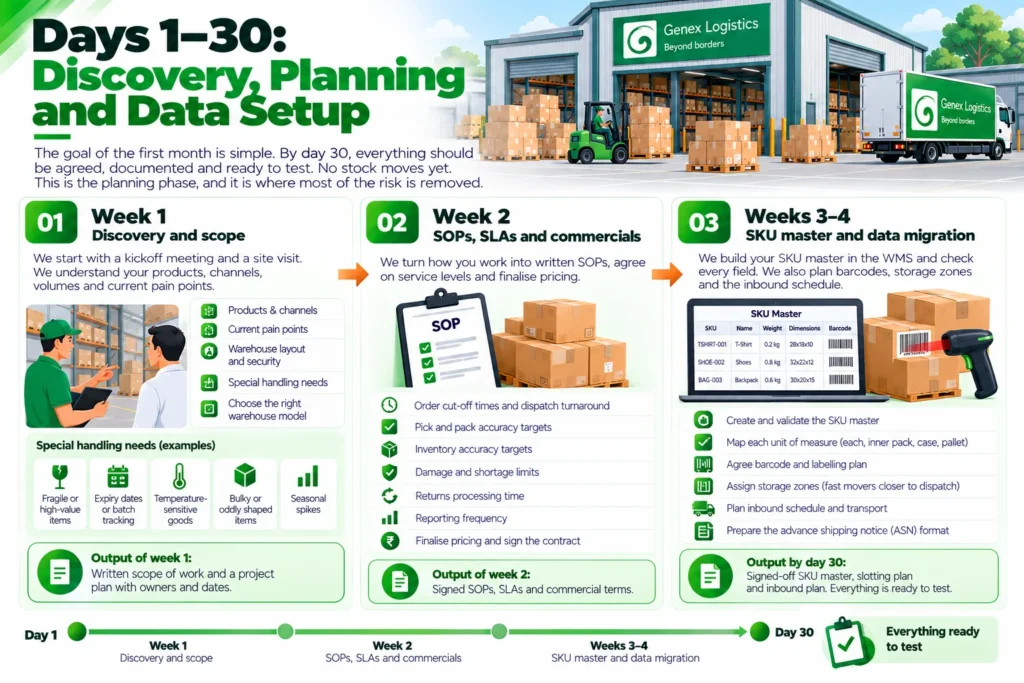
Days 1-30: Discovery, Planning and Data Setup
The goal of the first month is simple. By day 30, everything should be agreed, documented and ready to test. No stock moves yet. This is the planning phase, and it is where most of the risk is removed.
Week 1: Discovery and scope
We start with a kickoff meeting and a site visit. You walk through your products, channels, volumes and current pain points. We show you exactly where your stock will sit and how it will be secured.
During this week we also look for special handling needs:
- Fragile or high-value items
- Products with expiry dates or batch tracking
- Temperature-sensitive goods
- Bulky or oddly shaped items
- Seasonal spikes
This is also when you decide on the warehouse model. If you are weighing the trade-offs, read our comparison of shared vs dedicated warehousing in India.
Output of week 1: a written scope of work and a project plan with owners and dates.
Week 2: SOPs, SLAs and commercials
Next, we turn how you work into written standard operating procedures. These cover receiving, putaway, picking, packing, dispatch and returns.
Then we agree on service levels. A good SLA is specific. “Orders placed before 2 pm ship the same day” is clear. “Fast dispatch” is not.
Typical items we define together:
- Order cut-off times and dispatch turnaround
- Pick and pack accuracy targets
- Inventory accuracy targets
- Damage and shortage limits
- Returns processing time
- Reporting frequency
For a deeper look, see our article on 3PL SLAs and KPIs in a logistics contract.
Pricing is finalised in the same week. If you want to understand what drives charges for storage, handling and transport, our guide to warehousing cost in India explains the main components. Once both sides are comfortable, the contract is signed.
Weeks 3-4: SKU master and data migration
This is the least glamorous part of onboarding. It is also the most important.
We build your SKU master inside the warehouse management system and check every field. Why so much care? Because data errors behave like a wrong address on a parcel. They travel a long way before anyone notices.
A common example is the unit of measure. You may buy in cases of 12 but sell single pieces. If the system does not know that one case equals twelve units, your stock count will be wrong from the first day.
In these two weeks we:
- Create and validate the SKU master
- Map each unit of measure: each, inner pack, case and pallet
- Agree the barcode and labelling plan
- Assign storage zones, with fast-moving SKUs placed closest to the dispatch area
- Plan the inbound schedule, including transport and appointment slots
- Prepare the advance shipping notice (ASN) format for incoming stock
Output by day 30: a signed-off SKU master, SOPs, SLAs, a slotting plan and an inbound schedule. You should know exactly what will happen next, and when.
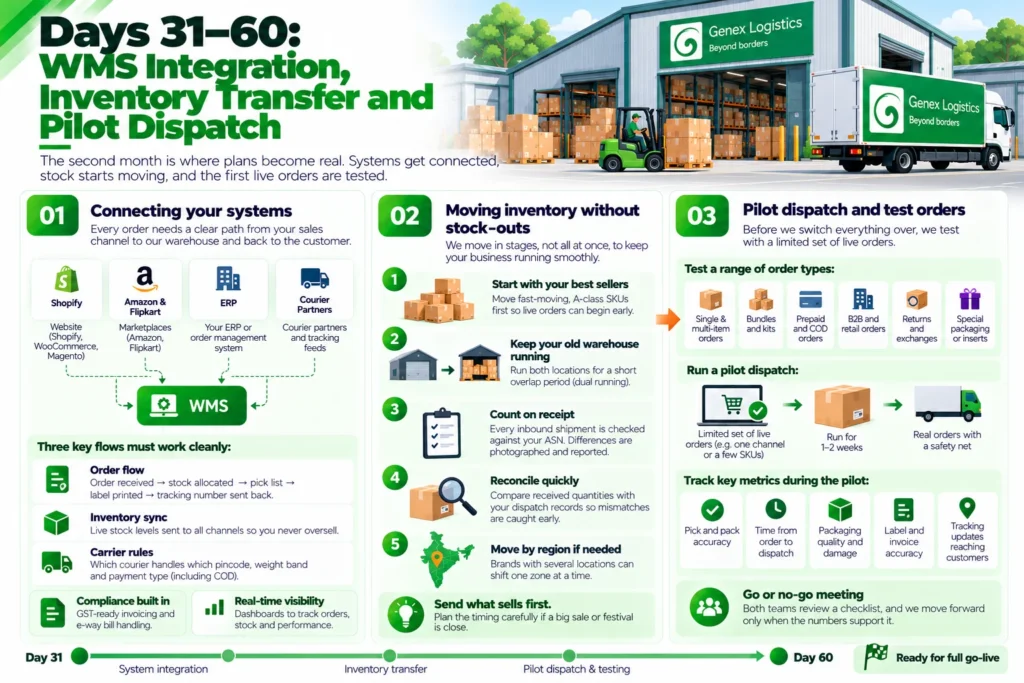
Days 31-60: WMS Integration, Inventory Transfer and Pilot Dispatch
The second month is where plans become real. Systems get connected, stock starts moving, and the first live orders are tested.
Connecting your systems
Every order needs a clear path from your sales channel to our warehouse and back to the customer. Think of it as a relay race. If one runner drops the baton, the race is over.
We connect the following, depending on your setup:
- Your website platform, such as Shopify, WooCommerce or Magento
- Marketplaces such as Amazon and Flipkart
- Your ERP or order management system
- Courier partners and tracking feeds
Integration can be done through APIs, EDI or structured file uploads for simpler setups. The right choice depends on your volume and tools.
Three flows must work cleanly before go-live:
- Order flow: order received, stock allocated, pick list created, label printed and tracking number sent back.
- Inventory sync: live stock levels sent back to every channel so you never oversell.
- Carrier rules: which courier handles which pincode, weight band and payment type, including cash on delivery.
Compliance gets built in here as well. That means GST-ready invoicing and e-way bill handling for movements that need them. Check the portal for the current value limits and rules that apply to your goods.
This step also lets you see your business through dashboards. Real-time visibility is one of the biggest day-to-day benefits of outsourcing, and we cover the wider trend in our piece on digitization in the 3PL space.
Moving inventory without stock-outs
The biggest fear in any warehouse migration is running out of stock while goods are in transit. The fix is to move in stages, not all at once.
Here is how we usually handle it:
- Start with your best sellers. Move fast-moving, A-class SKUs first so live orders can begin early.
- Keep your old warehouse running for a short overlap period. This is called dual running, and it protects sales.
- Count on receipt. Every inbound shipment is checked against your ASN. Differences are photographed and reported straight away.
- Reconcile quickly. We compare our received quantities with your dispatch records so mismatches are caught early.
- Move by region if needed. Brands with several locations can shift one zone at a time.
The rule of thumb is simple: send what sells first.
Timing matters too. If a big sale or festival is close, be careful about when you move stock. Our guide on festive season warehousing readiness explains how to plan for Diwali and Q4 volumes.
Pilot dispatch and test orders
Before we switch everything over, we test. Think of it as a dress rehearsal before opening night.
First come the test orders. We run a range of cases:
- Single-item and multi-item orders
- Bundles and kits
- Prepaid and cash on delivery orders
- B2B and retail replenishment orders
- Returns and exchanges
- Orders with special packaging or inserts
Then comes the pilot dispatch. A limited set of live orders, for example one channel or a handful of SKUs, runs through the new setup for one to two weeks. This is real life with a safety net.
During the pilot we track:
- Pick and pack accuracy
- Time from order to dispatch
- Packaging quality and damage
- Label and invoice accuracy
- Tracking updates reaching customers
Pilots almost always reveal small surprises. A label prints too small. A bundle is mapped wrongly. A pincode is missing from a carrier rule. Finding these in week seven is cheap. Finding them in week eleven, with thousands of orders waiting, is not.
The phase ends with a go or no-go meeting. Both teams review a checklist, and we move forward only when the numbers support it.
Days 61-90: Go-Live, Hypercare and Stabilization
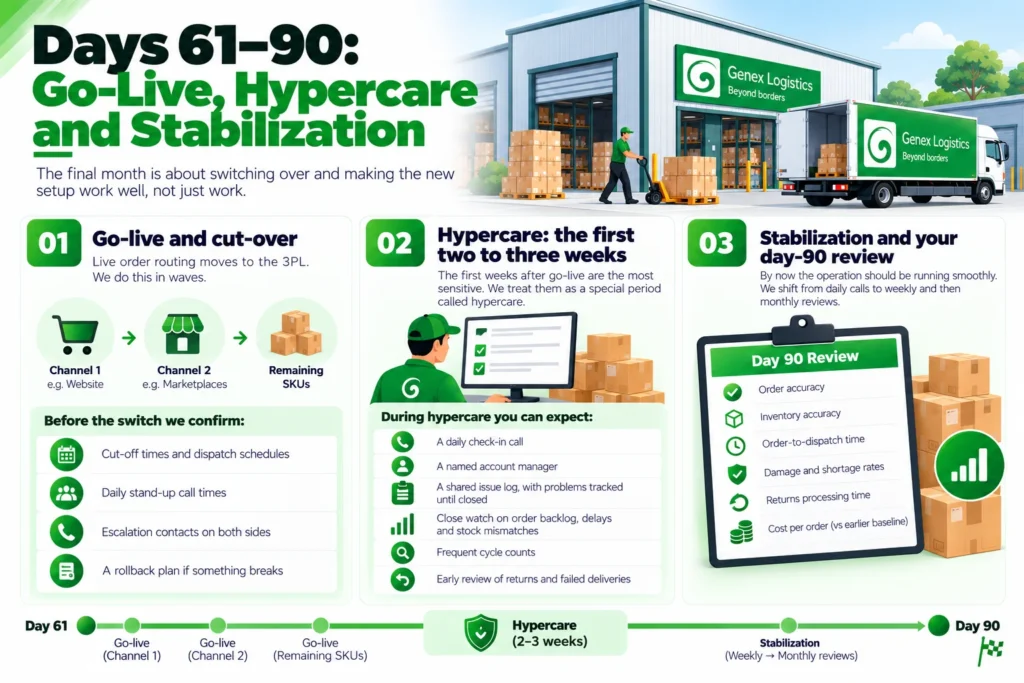
The final month is about switching over and then making the new setup work well, not just work.
Go-live and cut-over
Go-live is the moment live order routing moves to the 3PL. We usually do this in waves. For instance, one channel goes first, then the next, then the remaining SKUs.
Before the switch we confirm:
- Cut-off times and dispatch schedules
- Daily stand-up call times
- Escalation contacts on both sides
- A rollback plan if something breaks
That last point deserves attention. A rollback plan is like a spare tyre. You hope you never need it, but you drive more calmly knowing it is there.
Hypercare: the first two to three weeks
The first weeks after go-live are the most sensitive. We treat them as a special period called hypercare.
During hypercare you can expect:
- A daily check-in call
- A named account manager
- A shared issue log, with problems tracked until closed
- Close watch on order backlog, delayed dispatches and stock mismatches
- Frequent cycle counts to confirm that system stock matches physical stock
- Early review of returns and failed deliveries
The aim is to catch small problems while they are still small.
Stabilization and your day-90 review
By now the operation should be running smoothly. We shift from daily calls to weekly and then monthly reviews.
The day-90 review looks at hard numbers:
- Order accuracy
- Inventory accuracy
- Order-to-dispatch time
- Damage and shortage rates
- Returns processing time
- Cost per order against your earlier baseline
This is also the moment to ask what can be better. You might improve slotting, change packaging, add a second warehouse location or tighten your returns process.
Good data makes these conversations easy. India’s push for digital logistics, including the National Logistics Policy and the Unified Logistics Interface Platform, is also making system-to-system data sharing more common across the sector.
At a Glance: The 30-60-90 Day Plan
| Phase | Days | Main focus | What you walk away with |
|---|---|---|---|
| Plan | 1-30 | Discovery, SOPs, SLAs, SKU master | Signed contract, clean data, clear plan |
| Build and test | 31-60 | WMS integration, inventory transfer, pilot | Connected systems, stock in place, tested orders |
| Launch and stabilize | 61-90 | Go-live, hypercare, review | Live operations and a measured day-90 report |
How Long Does 3PL Onboarding Really Take in India?
Honest answer: it depends. Industry guides quote anything from a couple of weeks to several months. The difference comes down to your setup, not just the provider.
Things that usually speed up onboarding:
- Clean, complete SKU data from day one
- One or two sales channels
- Standard, ready-made integrations
- A single warehouse location
- Products without special compliance needs
Things that usually slow it down:
- Several channels plus an ERP that needs custom work
- Thousands of SKUs or frequent new launches
- Retailer compliance rules and B2B routing guides
- Batch, expiry or serial number tracking
- Multi-city rollouts
- Data that needs cleaning before it can be loaded
So treat 90 days as a framework, not a stopwatch. A simple setup may be ready sooner. A complex one may need extra time. What matters is that every phase has clear exit criteria.
One more tip on timing. Do not schedule go-live in the weeks just before a major sale or festival. A calmer window gives you room to fix small issues. For many brands, the weeks after Diwali and the start of the new calendar year work well.
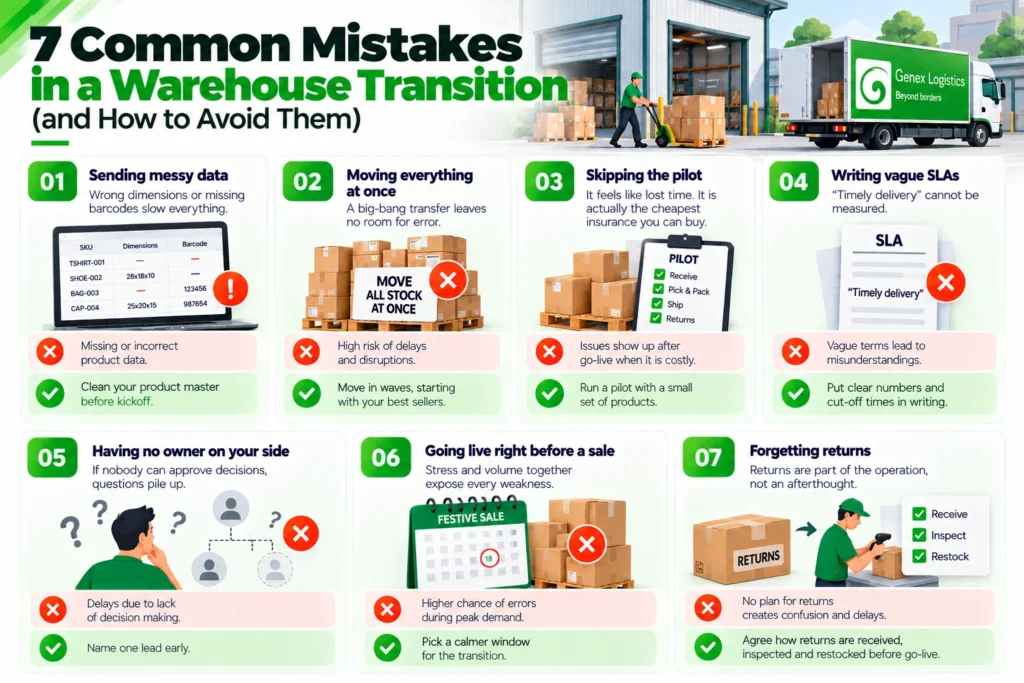
7 Common Mistakes in a Warehouse Transition (and How to Avoid Them)
1. Sending messy data. Wrong dimensions or missing barcodes slow everything. Clean your product master before kickoff.
2. Moving everything at once. A big-bang transfer leaves no room for error. Move in waves, starting with your best sellers.
3. Skipping the pilot. It feels like lost time. It is actually the cheapest insurance you can buy.
4. Writing vague SLAs. “Timely delivery” cannot be measured. Put numbers and cut-off times in writing.
5. Having no owner on your side. If nobody can approve decisions, questions pile up. Name one lead early.
6. Going live right before a sale. Stress and volume together expose every weakness. Pick a calmer window.
7. Forgetting returns. Returns are part of the operation, not an afterthought. Agree how they are received, inspected and restocked before go-live.
Switching From Another 3PL? What Changes
Moving from one 3PL to another follows the same 30-60-90 logic, with a few extra steps.
- Check your notice period and handover terms in the existing contract.
- Request data exports early: inventory records, order history and open orders.
- Run a parallel period where both warehouses can ship while stock moves.
- Do a joint stock count at the outgoing site, so everyone agrees on opening numbers.
- Confirm who is responsible for stock in transit and for any damage claims.
The biggest risk is the gap between the two operations. A clear overlap plan closes that gap.
Conclusion: A Smooth Switch Is Mostly Preparation
Outsourcing your warehousing and distribution does not have to mean weeks of chaos. A structured plan turns a scary change into a series of manageable steps.
Here is the short version:
- Days 1-30: discover, document and clean your data.
- Days 31-60: connect systems, move stock in stages and pilot with real orders.
- Days 61-90: go live in waves, support closely and review the numbers.
- Throughout: keep one owner on each side, agree measurable SLAs and avoid peak-season go-lives.
Ready to see what this would look like for your brand? Share your SKU list, order volumes and sales channels with the Genex Logistics team. We will map a 30-60-90 day transition plan for your business and arrange a warehouse visit so you can see the operation first-hand. Contact us today to request a quote or schedule a site visit.
Frequently Asked Questions
It depends on your SKU count, number of sales channels, integration needs and the type of products. A simple, single-location setup with clean data can go live sooner. A complex rollout with ERP integration, batch tracking or several cities takes longer. We use a 30-60-90 day framework so each phase has clear goals, and we adjust the plan to your situation.
You will need your product master with dimensions, weights and barcodes, an opening stock report, 12 months of order data, details of your sales channels, GST and other compliance documents, packaging requirements and your returns policy. Naming one point of contact on your side also helps a great deal.
Move in stages. Send your fastest-selling SKUs first, keep your old warehouse active for a short overlap and check every inbound shipment against an ASN. Reconcile quantities right away and run frequent cycle counts during the first weeks. This protects sales while the transfer is in progress.
The main risks are stock mismatches, delayed orders, data errors and unclear responsibility during the handover. You can reduce them by exporting your data early, doing a joint stock count, running both operations in parallel for a period and agreeing in writing who owns stock in transit. A pilot before full go-live adds another safety layer.
It is a good time when your in-house operation is limiting growth. Common signs include rising rent and labour costs, frequent dispatch delays, difficulty handling peak volumes and the need to reach new regions. Avoid starting right before a major sale. A calmer period gives you room to test and fix issues. Our guide on 3PL vs in-house logistics can help you compare the options.

Kapil Pathak is a Senior Digital Marketing Executive with over six years of experience specializing in the logistics and supply chain industry. His expertise spans digital strategy, search engine optimization (SEO), search engine marketing (SEM), and multi-channel campaign management. He has a proven track record of developing initiatives that increase brand visibility, generate qualified leads, and drive growth for D2C & B2B technology companies.