The festive sale is over. Orders flew out, the numbers looked great, and the team finally slept. Then, about two weeks later, the boxes start coming back.
Wrong size. Damaged in transit. Customer not home. Changed my mind. Suddenly your warehouse has a second job it never planned for, and nobody quite owns it.
Sound familiar? That is reverse logistics, and in India it is no longer a side process. With cash on delivery, easy return policies and quick commerce raising customer expectations, returns now shape your margins almost as much as sales do.
In this guide, we will walk through:
- What reverse logistics means and how it differs from forward logistics
- The main types of returns, with Indian examples
- The reverse logistics process, step by step
- What RTO in ecommerce is and how to reduce it
- Where reverse logistics costs hide
- How to prepare for the post-festive returns surge
- When it makes sense to hand returns to a 3PL
Let’s start with the basics.
What Is Reverse Logistics? Meaning and Definition
In simple terms, reverse logistics is the movement of goods from the customer back toward the seller, brand or a recovery point. It covers everything that happens after a product leaves its “final” destination and needs to come back.
A widely cited academic framework by researchers at Erasmus University defines it as planning, implementing and controlling the flow of goods from usage or distribution points back to recovery or proper disposal (de Brito and Dekker, A Framework for Reverse Logistics). In plain words, it is the return journey, plus every decision about what happens to the product next.
That second part matters. Bringing a box back is only half the job. The real value comes from deciding, quickly and correctly, whether the item gets restocked, repaired, resold elsewhere or recycled.
Reverse logistics in supply chain management
Think of your supply chain as a two-way road. Forward logistics is the busy lane heading to customers. Reverse logistics is the lane coming back, often with less traffic, poorer signage and no clear owner.
In supply chain management, reverse logistics links customer service, warehousing, inventory and finance. A slow returns lane means stock sits idle, refunds get delayed and customers lose trust. A well-run one turns returns into recovered inventory and repeat buyers.
Forward vs reverse logistics: the key differences
| Factor | Forward logistics | Reverse logistics |
|---|---|---|
| Direction | Warehouse to customer | Customer back to warehouse or recovery point |
| Volume | Predictable, planned in advance | Unpredictable, spikes after sales |
| Product condition | New, uniform | Mixed: new, used, damaged, incomplete |
| Packaging | Standard and labelled | Often missing or damaged |
| Main goal | Speed and cost per order | Recovery value and turnaround time |
| Decision points | Few | Many (inspect, grade, decide disposition) |
In short, forward logistics is a planned flow. Reverse logistics is a series of judgment calls, which is exactly why it needs a defined process.
Types of Reverse Logistics (With Indian Examples)
Not every return is the same. A shirt that didn’t fit and a router that stopped working need very different handling. Here are the main types you will see in Indian supply chains.
1. Customer returns
This is the most familiar type. A buyer orders a kurta in size M, it fits like an L, and they raise a return request. The courier then does a reverse pickup from the customer’s address.
Fashion, footwear and electronics see the highest volumes here. Most of these items are new or nearly new, so fast inspection and restocking protect your margin.
2. Return to origin (RTO)
RTO happens when a shipment never reaches the customer and travels back to the seller. Common reasons include a refused COD order, a wrong address or a customer who is unreachable.
RTO is a uniquely large problem in Indian ecommerce, so we will cover it in its own section below.
3. Return to vendor (RTV)
Here, a retailer or distributor sends goods back to the supplier or brand. Think of a modern trade chain returning slow-moving or near-expiry stock, or a distributor sending back a defective batch.
RTV is mostly B2B. It needs clean paperwork, debit notes and GST-compliant documentation for every movement.
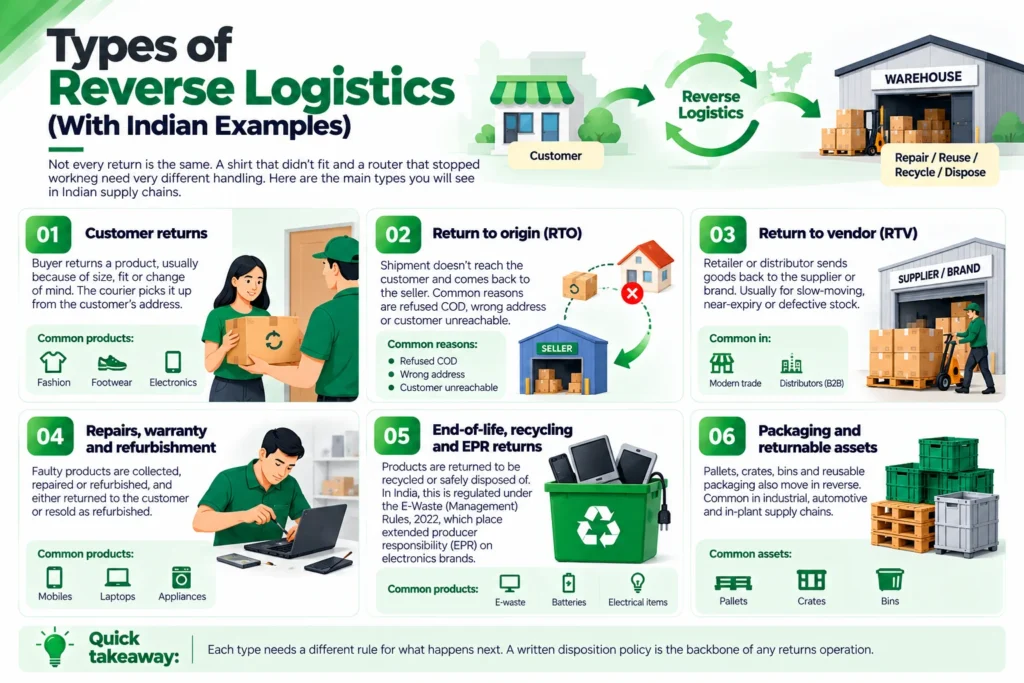
4. Repairs, warranty and refurbishment
A consumer durable brand collects faulty units, repairs or refurbishes them, and either returns them to the customer or resells them as refurbished. Mobile phones, laptops and appliances often follow this route.
5. End-of-life, recycling and EPR returns
Some products come back to be recycled or safely disposed of. In India, this is increasingly regulated. For example, the E-Waste (Management) Rules, 2022 place extended producer responsibility (EPR) on producers of electronics (Tamil Nadu Pollution Control Board). That means brands need a reliable reverse flow for collecting and channelling e-waste to registered recyclers.
6. Packaging and returnable assets
Pallets, crates, bins and reusable packaging also move in reverse. In-plant and automotive supply chains rely heavily on this loop. Lose track of them, and you end up buying the same crates again and again.
Quick takeaway: Each type needs a different rule for what happens next. That is why a written disposition policy is the backbone of any returns operation.
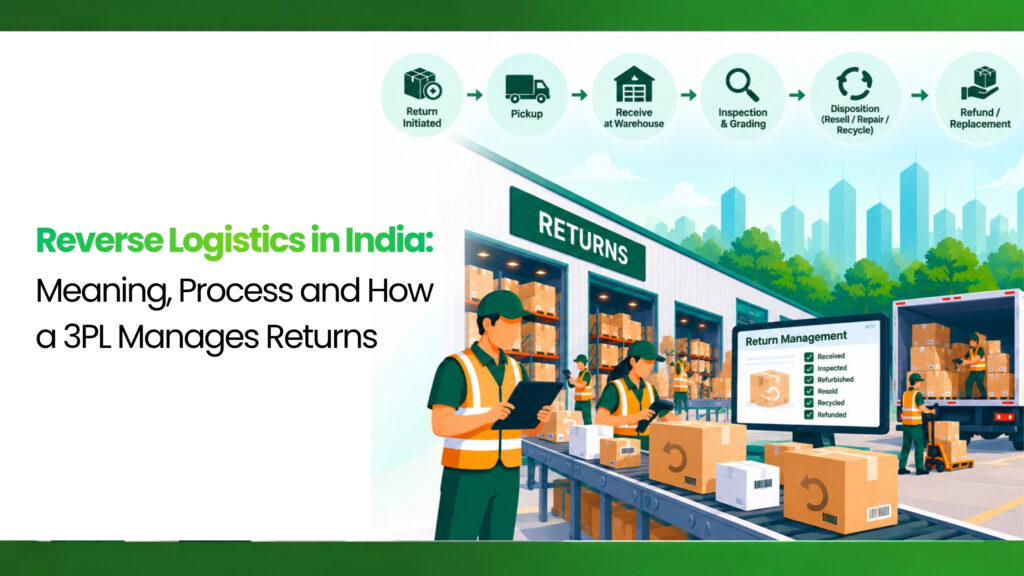
The Reverse Logistics Process: Step by Step
So what actually happens between “return requested” and “refund processed”? Here is the typical returns processing flow inside a well-run Indian warehouse.
Step 1: Return request and authorisation
It all starts with a return request. The customer or channel partner raises it, and the system checks it against your return policy.
Good practice here is simple: capture the reason code, photos where possible and the order ID. Clean data at this stage saves hours later.
Step 2: Reverse pickup or RTO receipt
Next, the item travels back. For customer returns, a courier partner does the reverse pickup. For RTO, the undelivered parcel simply makes its way back through the courier network.
Either way, the warehouse should know what is coming. An advance notice of expected returns helps the team plan dock space and manpower.
Step 3: Receiving and identification
Once the parcel arrives, the team scans it and matches it to the original order. This sounds easy until labels are missing, boxes are swapped or a customer returns a different product altogether.
That is why a dedicated returns dock, separate from inbound supplier receipts, makes such a difference.
Step 4: Inspection and quality check
Now comes the most important step. Trained staff check the product against a clear checklist:
- Are tags, seals and accessories intact?
- Is there visible damage or signs of use?
- Does the serial number or IMEI match the order?
- Is the original packaging usable?
For high-value items, many brands photograph each return at this stage. It protects you in disputes with customers and courier partners.
Step 5: Grading and disposition
After inspection, each item gets a grade and a destination. A simple model looks like this:
| Grade | Condition | Typical disposition |
|---|---|---|
| A | As new, all tags and packaging | Restock as fresh inventory |
| B | Minor packaging damage | Repack, then restock or sell at a small discount |
| C | Used or cosmetic damage | Refurbish, outlet or B2B liquidation |
| D | Defective | Return to vendor or repair |
| E | Beyond repair | Recycle or dispose of responsibly |
The faster you reach this decision, the more value you recover. Fashion loses value with every passing week, and electronics lose it even faster.
Step 6: Restock, refund and reporting
Finally, restocked items go back into sellable inventory, and the refund or credit note is triggered. The data from every return feeds into reports on return reasons, SKU-level return rates and recovery value.
Here, a warehouse management system does the heavy lifting. Barcode scanning, real-time stock updates and reason-code reports turn returns from guesswork into a measurable process. We explored this shift in our post on the impact of digitization in the 3PL space.
RTO in Ecommerce: Why It Hurts and How to Reduce It
If customer returns are a headache, RTO is a migraine. Why? Because you pay for shipping both ways and earn nothing in return.
What does return to origin mean?
Return to origin (RTO) means a shipment could not be delivered and is sent back to the seller’s warehouse. The customer never opened it, never paid for it and, in many cases, never really intended to buy it.
In India, RTO is closely tied to cash on delivery. A COD buyer has nothing at stake, so a change of mind costs them nothing. The seller, on the other hand, absorbs forward freight, return freight, packaging and the time that stock spent stuck in transit.
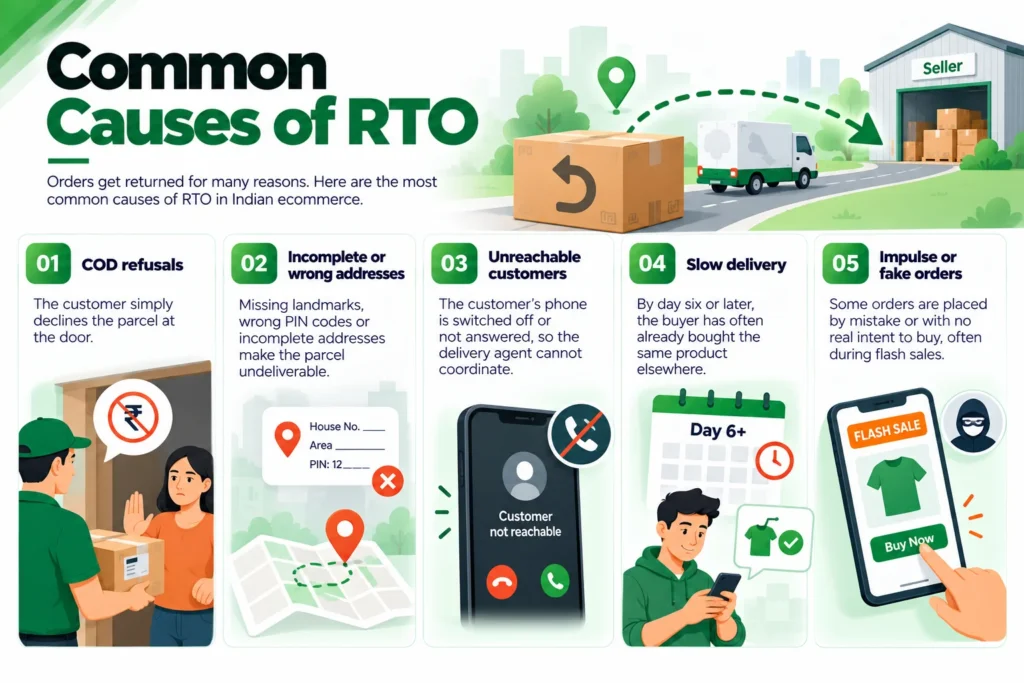
Common causes of RTO
- COD refusals: the customer simply declines the parcel at the door
- Incomplete or wrong addresses: missing landmarks, wrong PIN codes
- Unreachable customers: phone switched off or not answered
- Slow delivery: by day six, the buyer has already bought it elsewhere
- Impulse or fake orders: especially during flash sales
How to reduce RTO in ecommerce
The good news is that RTO responds well to small, consistent fixes. Here is what works in practice:
- Verify COD orders. A quick WhatsApp or IVR confirmation filters out many non-serious buyers before dispatch.
- Nudge prepaid payments. A small prepaid discount or a COD fee shifts behaviour without hurting conversion much.
- Validate addresses at checkout. Check PIN codes and prompt for landmarks.
- Ship faster. Holding stock closer to demand, through regional warehouses, shortens the window in which buyers change their mind.
- Flag risky PIN codes and repeat refusers. Your own RTO history is the best predictor.
- Process RTO stock quickly. Even when an RTO happens, the parcel is usually unopened. Inspect, restock and sell it again within 24 to 48 hours.
That last point is where your warehouse partner matters most. RTO parcels that sit in a corner for two weeks are dead stock. Parcels that are back on the shelf in a day are recovered revenue.
Pro tip: Track RTO rate by courier partner, PIN code and payment mode. You cannot fix what you cannot see, and the pattern is often surprisingly concentrated.
Where Reverse Logistics Costs Really Hide
Most teams track return shipping charges. Far fewer track the full reverse logistics cost. Yet the hidden parts often add up to more than the freight.
Here is what a single return can cost you:
- Freight both ways: forward shipping is already spent, and the return leg is extra
- Handling labour: receiving, inspecting, grading and repacking each unit
- Packaging: new polybags, tags, boxes and labels
- Storage: space taken up by returns waiting to be processed
- Value erosion: seasonal and trend-driven stock loses value every week it sits idle
- Write-offs: items that cannot be resold at all
- Customer service: calls, tickets and refund follow-ups
Notice how many of these are time-driven. The longer a return waits, the more storage it uses and the less it is worth. In other words, turnaround time is the biggest cost lever you control.
If you are budgeting a new warehouse setup, factor returns space and manpower in from day one. Our breakdown of warehousing cost in India explains how space, labour and value-added services are usually priced.
Planning for the Post-Festive Returns Surge
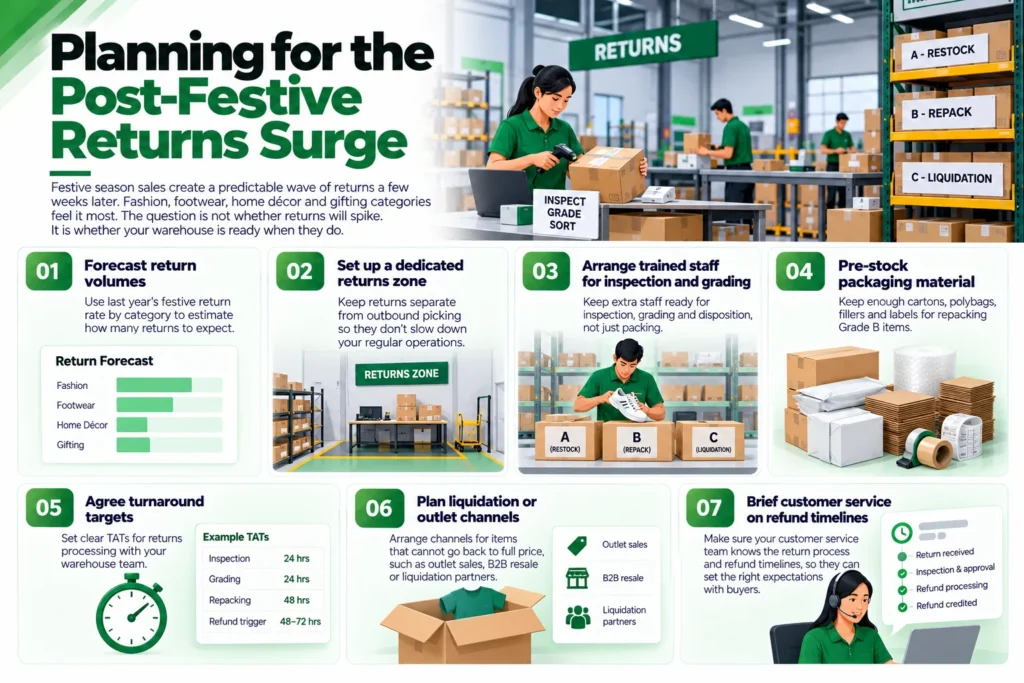
Now, back to where we started. Festive season sales create a predictable wave of returns a few weeks later. Fashion, footwear, home décor and gifting categories feel it most.
The question is not whether returns will spike. It is whether your warehouse is ready when they do. A practical readiness checklist:
- Forecast return volumes using last year’s festive return rate by category
- Set up a dedicated returns zone, separate from outbound picking
- Arrange extra trained staff for inspection and grading, not just packing
- Pre-stock packaging material for repacking Grade B items
- Agree turnaround targets for returns processing with your warehouse team
- Plan liquidation or outlet channels for items that cannot go back to full price
- Brief customer service on refund timelines
If you have already prepared your outbound operations using our festive season warehousing readiness guide, think of this as the second half of that plan.
In-House vs 3PL Reverse Logistics: Which Makes Sense?
So, should you run returns yourself or hand them to a third-party logistics partner? It depends on your volumes, your categories and how much management time you can spare.
| Factor | In-house returns | 3PL reverse logistics |
|---|---|---|
| Setup cost | Space, staff, systems all on you | Shared or existing infrastructure |
| Handling spikes | Hard to scale up and down | Flexible manpower and space |
| Process maturity | Built from scratch | Tested SOPs for inspection and grading |
| Technology | Separate investment in WMS and scanning | Usually included |
| Control | Full, but needs constant attention | Governed through SLAs and reports |
| Best for | Very low volumes or highly specialised products | Growing brands, seasonal peaks, multi-channel sellers |
For most growing brands, a 3PL makes sense once returns become a regular, measurable flow. You get the process and the people without building them yourself. For a wider view of the options, see our comparison of 3PL vs 4PL vs in-house logistics.
What to look for in a 3PL for returns
Not every warehouse partner handles reverse flows well. Before you sign, ask:
- Do they run a separate returns dock and process?
- What is their committed returns turnaround time, and is it in the contract?
- Can they grade, repack, relabel and kit returned items on site?
- Do you get SKU-level reports on return reasons and recovery?
- How do they handle RTV documentation and GST compliance?
Write the answers into your contract. Our guide to 3PL SLAs and KPIs covers which returns metrics to include, and the 3PL partner selection checklist helps you compare providers side by side.
For a real-world example, see how Genex supported a leading apparel and fashion retailer, a category where returns are part of everyday operations.
Conclusion: Treat Returns as a Second Supply Chain
Returns are not going away. If anything, Indian shoppers expect easier returns every year. The brands that win are the ones that treat reverse logistics as a proper process, not an afterthought.
To recap:
- Reverse logistics is the flow of goods back from customers to the seller or a recovery point, plus every decision about what happens next.
- The main types are customer returns, RTO, return to vendor, repairs, recycling and returnable packaging.
- A clear process of receiving, inspection, grading and disposition protects the value of every return.
- RTO in ecommerce can be reduced through COD verification, prepaid nudges, address checks and faster delivery.
- Turnaround time is the biggest cost lever, especially after the festive season.
- A 3PL gives you tested processes and flexible capacity without building it all yourself.
The festive returns wave is already on its way. Is your warehouse ready for it?
Talk to Genex Logistics. Our team can help you design a returns process, set clear turnaround SLAs and handle reverse flows alongside your forward operations. Get in touch with Genex to discuss your returns requirements.
Frequently Asked Questions
Reverse logistics is the process of moving goods from the customer back to the seller, brand or a recovery point. It includes returns, repairs, refurbishment, recycling and the decision on what to do with each returned item.
Forward logistics moves products from the warehouse to the customer in a planned, predictable flow. Reverse logistics brings them back, often in mixed condition and unpredictable volumes, so it needs inspection and grading at every step.
RTO, or return to origin, means a parcel could not be delivered and was sent back to the seller. It is common with cash on delivery orders, wrong addresses and unreachable customers.
Verify COD orders before dispatch, encourage prepaid payments, validate addresses at checkout and ship faster from warehouses closer to your customers. Also, track RTO by PIN code and courier to find patterns.
The typical reverse logistics process steps are return request, reverse pickup or RTO receipt, receiving, inspection, grading and disposition, and finally restocking, refund and reporting.

Kapil Pathak is a Senior Digital Marketing Executive with over six years of experience specializing in the logistics and supply chain industry. His expertise spans digital strategy, search engine optimization (SEO), search engine marketing (SEM), and multi-channel campaign management. He has a proven track record of developing initiatives that increase brand visibility, generate qualified leads, and drive growth for D2C & B2B technology companies.