Picture a typical Tuesday for a growing Indian brand. A Blinkit purchase order lands at 9 a.m. with a delivery slot for tomorrow. By noon, 400 Amazon and Myntra orders are waiting to ship. Then a Reliance Retail PO arrives for 60 cartons, with its own label rules. Meanwhile, your website keeps taking orders all day.
Same stock. Four very different customers. One warehouse.
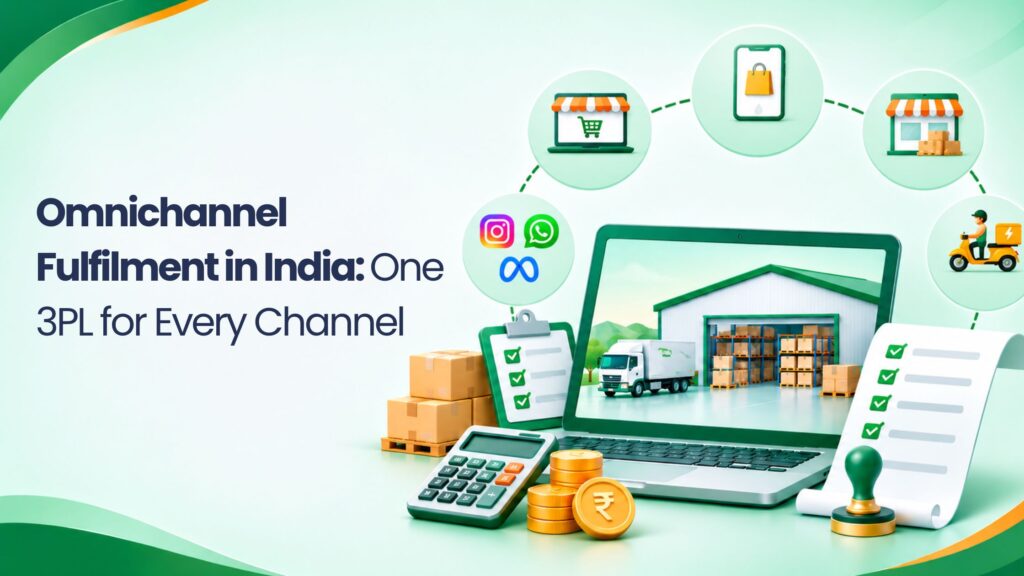
That is the real face of omnichannel fulfilment in India. Brands no longer sell in one place. They sell on marketplaces, quick commerce apps, modern trade shelves, general trade networks and their own D2C site, often all in the same week.
So how does a single 3PL warehouse keep every channel happy without splitting stock into five silos? That is what this guide covers. You will learn:
- What omnichannel fulfilment actually means for Indian brands
- How the rules differ for marketplaces, quick commerce, modern trade and D2C
- How one warehouse runs B2B and B2C picking side by side
- How inventory sync and channel-wise allocation stop overselling
- The compliance basics: POs, ASNs, appointment slots, GRNs and GST
- What to look for when you choose an omnichannel 3PL partner
Let’s start with the basics.
What Is Omnichannel Fulfilment in India?
Omnichannel fulfilment means serving every sales channel from one shared pool of inventory, managed by one system. A unit on the shelf is not “Amazon stock” or “DMart stock”. It is simply stock, and the system decides where it goes based on live orders and rules you set.
In India, that pool has to feed two very different kinds of orders:
- B2C orders: single units or small baskets going to a shopper’s door. Think marketplace orders, D2C website orders and some quick commerce flows.
- B2B orders: bulk, PO-based shipments going to another business. Think modern trade chains, GT distributors, quick commerce mother warehouses and marketplace fulfilment centres.
Multichannel vs omnichannel: what’s the difference?
The two terms get mixed up a lot, so here is a simple way to tell them apart.
In a multichannel setup, each channel gets its own slice of stock. You might keep 500 units for Amazon, 300 for Flipkart and 200 for your website. When Amazon runs out, those 300 Flipkart units just sit there.
In an omnichannel setup, all 1,000 units sit in one pool. Each channel sees what it is allowed to see, and stock moves to wherever demand shows up first.
Think of it like a family kitchen. Multichannel is giving every child a separate lunchbox in the morning. Omnichannel is one well-stocked fridge with a few house rules. Less food goes to waste, and nobody goes hungry while someone else’s box is still full.
Why Indian brands are moving to one warehouse
The push is practical, not trendy. Running separate warehouses for B2B and B2C means:
- Double rent, double teams and double software
- More safety stock, because each site needs its own buffer
- Stockouts on one channel while another channel sits on extra units
- Slower reaction when a channel suddenly takes off, like quick commerce during the festive season
A single omnichannel warehouse fixes much of this. However, it only works if the floor, the people and the WMS are designed for very different order types. That is where most of the hard work lies.
Four Channels, Four Rulebooks
Every channel buys from you differently. Before you design a single pick path, it helps to see those differences side by side.
| Channel | Typical order | What the buyer cares about most |
|---|---|---|
| Marketplaces (Amazon, Flipkart, Myntra, Nykaa, Meesho) | Single-unit B2C orders, plus bulk stock transfers to their FCs | Dispatch SLA, correct label, low cancellations |
| Quick commerce (Blinkit, Zepto, Swiggy Instamart) | Frequent, smaller B2B POs to mother warehouses | Fill rate, delivery slot, shelf life, ASN |
| Modern trade and GT (Reliance Retail, DMart, Spencer’s, distributors) | Large PO-based case-pack dispatches | Delivery window, labelling, correct invoice, GRN match |
| D2C website | Single-unit B2C orders | Speed, packaging, unboxing, easy returns |
Marketplaces: speed and SLA discipline
On marketplaces, you either ship each order yourself or send bulk stock into the platform’s warehouse. Many brands do both.
In a seller-fulfilled model, such as Myntra’s PPMP, the warehouse picks, packs and hands over orders within a fixed SLA. Miss it, and cancellations and seller ratings take the hit. For stock transfers, you book an inbound appointment at the marketplace fulfilment centre and send properly prepped, labelled cartons.
Quick commerce: high frequency, zero excuses
Quick commerce works more like B2B than B2C. Platforms send you a purchase order (PO) for their mother warehouse or feeder hub, usually every day or two. You must deliver the right quantity, in the right slot, with enough shelf life left.
Two numbers rule this channel:
- Fill rate: the share of the PO you actually supply. Ship 780 units against a PO of 1,000, and your fill rate is 78%.
- Slot adherence: whether your truck reaches the dock in the booked appointment window.
Low scores can mean fewer POs and weaker visibility on the app. Space is also tight in peak season. In 2026, Blinkit told sellers its warehouses were operating at full capacity during the festive rush and paused inbound for new products. If you want the deeper picture, read our guide to quick commerce warehousing for 3PLs in India.
Modern trade and general trade: paperwork is part of the product
Modern trade (MT) chains like Reliance Retail, DMart and Spencer’s buy through POs with strict terms. Each chain has its own packaging, labelling and delivery rules. Many run appointment-based docks, so a truck that arrives late may simply be turned away.
General trade (GT) is less formal but just as demanding in its own way. Distributors and super stockists want full cases, accurate invoices and dependable dispatch dates. The order sizes are big, so one error can mean a lot of returned stock.
D2C: your brand in a box
Your own website is where the customer sees your brand most clearly. Speed matters, but so do clean packaging, inserts, gift notes and a smooth return process.
D2C also tends to have the most unpredictable demand. A single influencer post can triple orders overnight. Your warehouse needs to absorb that spike without starving your B2B channels.
How One 3PL Warehouse Handles B2B and B2C Fulfilment Together
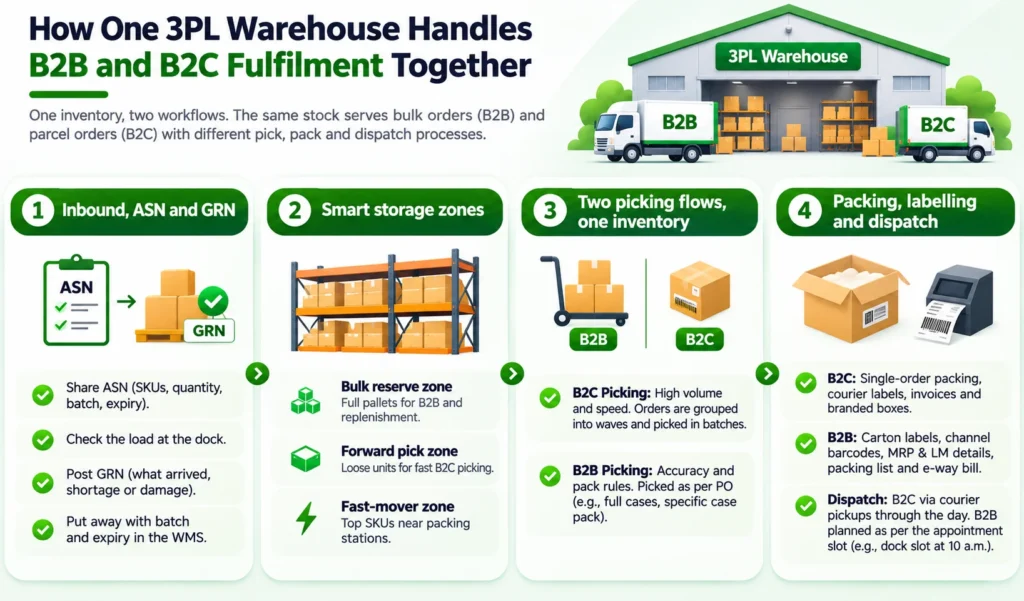
Here is the core idea. Stock is shared, but workflows are not. The warehouse keeps one inventory pool, then runs separate pick, pack and dispatch flows for bulk orders and parcel orders.
Let’s walk through a day on the floor.
Step 1: Inbound, ASN and GRN
It all starts when stock arrives from your factory or supplier.
- Your team shares an advance shipping notice (ASN) before the truck leaves. It lists SKUs, quantities, batches and expiry dates.
- The warehouse checks the load against the ASN at the dock.
- It then posts a goods receipt note (GRN) confirming what actually arrived, including any shortages or damage.
- Stock is put away into bins, with batch and expiry captured in the WMS.
Why does this matter for omnichannel? Because quick commerce and MT buyers often reject stock with short shelf life. If expiry is not captured at inbound, you find out at their dock, not yours.
Step 2: Smart storage zones
A good omnichannel layout usually splits the floor by how stock moves, not by channel:
- Bulk reserve zone: full pallets and master cartons for B2B and replenishment
- Forward pick zone: loose units in shelving for fast B2C picking
- Fast-mover zone: top SKUs placed closest to packing stations
- Staging lanes: space near the docks for B2B loads waiting for their slot
The forward pick zone is refilled from bulk reserve through the day. As a result, the B2C team never has to hunt through pallets, and the B2B team never has to pick loose units one by one.
Step 3: Two picking flows, one inventory
This is where B2B and B2C really part ways.
B2C picking is about volume and speed. Hundreds of small orders are grouped into waves and picked in batches, then sorted at packing. A picker might collect items for 30 orders in one trip.
B2B picking is about accuracy and pack rules. A Reliance Retail PO may ask for full cases only. A quick commerce PO may need a specific case pack or inner pack. Pickers work order by order, often pulling whole cartons from reserve.
Some SKUs need a bulk break. For example, a master carton of 48 units may be opened so 12 units can move into the forward pick zone for B2C orders. The WMS has to track that change in units, or your stock count drifts.
Step 4: Packing, labelling and dispatch
Packing also splits in two:
- B2C: single-order packing, courier labels, invoices, branded boxes and inserts for D2C
- B2B: carton labels, channel-specific barcodes, MRP and Legal Metrology details, packing lists and e-way bills
Dispatch is planned differently too. B2C parcels go out in courier pickups through the day. B2B loads are planned backwards from the appointment slot. If the Zepto dock slot is 10 a.m. tomorrow, the pick, pack and truck times are set to hit it.
Should your brand share this kind of facility with other brands, or run its own space? We compare both options in our guide to shared vs dedicated warehousing in India.
Inventory Sync and Channel-Wise Allocation
Shared stock is only an advantage if every channel sees the right number at the right time. Otherwise, you oversell on one channel and disappoint a big buyer on another.
What multi-channel inventory sync really means
Inventory sync is the flow of live stock numbers from your WMS to every place you sell. When a unit is picked for a Flipkart order, your D2C site, Amazon and Meesho should all see one less unit within minutes.
Sync breaks down in a few common ways:
- Slow updates: stock refreshes every few hours, so two channels sell the same last unit
- Wrong SKU mapping: the same product has different codes on Blinkit, Amazon and your ERP, and nobody linked them
- Hidden reservations: B2B POs are being picked, but the units still show as free on B2C channels
Each of these leads to cancellations, penalties or an angry buyer. The fix is not more spreadsheets. It is one system of record, with every channel reading from it.
Pooled, allocated or hybrid?
There are three ways to share stock across channels:
| Model | How it works | Best for |
|---|---|---|
| Pooled | Every channel draws from the full pool | Self-shipped channels with fast sync |
| Allocated | Each channel gets a fixed quantity | Channels where a missed PO is very costly |
| Hybrid | A minimum per channel, plus a shared buffer | Most Indian brands, most of the time |
Most brands end up with the hybrid model. For example, you might protect 1,200 units for a Reliance Retail PO due Friday, keep a floor of 300 units for quick commerce, and let marketplaces and D2C share the rest.
Setting allocation rules that actually help
Good allocation rules answer three questions before the rush, not during it:
- Which channel wins when stock is short? A large MT PO with a fixed delivery date may come ahead of a D2C order that can wait a day.
- How much buffer does each channel need? Faster channels with slower sync need a bigger cushion.
- When do rules change? Big sale events like Big Billion Days, EORS or Diwali usually need different limits.
In short, allocation turns a fight between channels into a plan. Planning a peak? Our festive season warehousing readiness guide walks through the prep in detail.
Marketplace, Modern Trade and Quick Commerce Compliance
B2C mistakes cost you one order. B2B mistakes can cost you a whole truck. That is why compliance deserves its own playbook.
The PO-to-GRN journey
Most B2B buyers in India follow a similar path:
- PO received: the buyer shares SKUs, quantities, prices, delivery location and a deadline.
- PO checked: the warehouse confirms stock, MRP, EAN and case pack before accepting.
- Appointment booked: a dock slot is secured at the buyer’s warehouse.
- Pick, pack and label: as per the buyer’s rules.
- ASN sent: before the truck leaves, so the buyer can plan receiving.
- Delivery and GRN: the buyer checks the load and posts a GRN.
- Reconciliation: you match the GRN against what you shipped and raise disputes on any gaps.
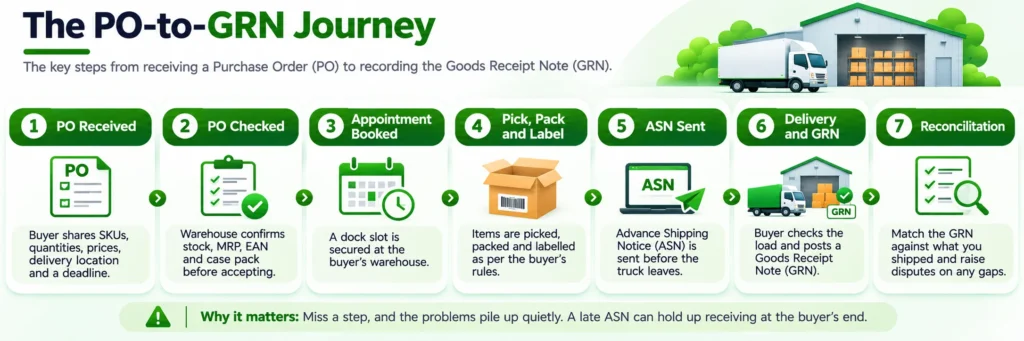
Miss a step, and the problems pile up quietly. A late ASN can hold up receiving. A GRN mismatch can delay payment for weeks.
Why POs and shipments get rejected
If your loads keep coming back, check these first:
- Short shelf life: many buyers set a minimum remaining shelf life
- Wrong or missing labels: barcodes that don’t scan, missing MRP or net quantity
- Case pack errors: loose units where full cases were ordered
- Missed slots: the truck arrives outside the booked window
- Short or excess supply: quantities that don’t match the PO or ASN
- Invoice errors: wrong GSTIN, prices or PO number on the invoice
Notice something? Almost every rejection starts inside the warehouse, long before the truck reaches the buyer.
Labelling and Legal Metrology basics
Packaged goods sold in India must carry key declarations under the Legal Metrology (Packaged Commodities) Rules. These include MRP, net quantity, manufacturer details and date of packing. On top of that, each MT chain and platform may want its own carton label, barcode placement or packing list.
A good 3PL keeps these rules as channel-wise SOPs. Packers see the right instructions for each order, instead of relying on memory.
GST: APOB and e-way bills for 3PL dispatch
Two GST points matter when your stock sits in a 3PL warehouse.
First, the warehouse usually needs to be added to your GST registration as an Additional Place of Business (APOB). Marketplaces and buyers often check this before they accept stock or invoices from that location. We explain the steps in our guide to GST registration for a 3PL warehouse.
Second, B2B dispatches above ₹50,000 need an e-way bill. In 2026, GSTN also made the Ship-To GSTIN field mandatory for bill-to/ship-to movements, where you invoice one party but deliver to another location. Tally’s guide to the Ship-To GSTIN rule covers the scenarios. For a brand shipping to MT distribution centres or quick commerce hubs, getting this right avoids blocked e-way bills and stuck trucks.
The WMS Layer That Holds It All Together
You can have a great team and a well-planned floor. Still, without the right warehouse management system (WMS), omnichannel fulfilment falls apart under pressure.
Think of the WMS as the air traffic controller. It does not fly the planes, but it decides who lands where and when, so nobody collides.
Features an omnichannel WMS needs
Here is what to look for:
- One inventory record across every channel, warehouse and bin
- Real-time inventory sync with marketplaces, quick commerce portals, D2C platforms and your ERP
- Channel-wise allocation and reservation, so B2B POs lock their stock the moment they are accepted
- Separate B2B and B2C pick flows, such as wave or batch picking for parcels and order-wise picking for POs
- Batch, expiry and FEFO rules, so short-dated stock goes to channels that accept it
- UoM and bulk break handling for cases, inner packs and single units
- Channel-specific labels and documents, including carton labels, invoices and packing lists
- ASN generation and GRN reconciliation to close the loop with B2B buyers
- Dock and appointment planning that works backwards from the slot
- Dashboards for fill rate, on-time dispatch, order accuracy and inventory accuracy
Why a 3PL’s own WMS matters
Many brands already run an OMS or ERP. That is useful, but it is not enough on its own.
The OMS tells the warehouse what to ship. The WMS controls how it gets picked, packed and loaded. When a 3PL runs its own WMS that plugs into your OMS, you get floor-level control plus brand-level visibility. You can see every PO, every wave and every exception without calling the warehouse.
The numbers on those dashboards should also match the ones in your contract. For a list of the metrics worth writing down, see our guide to 3PL SLAs and KPIs in a logistics contract.
How to Choose an Omnichannel 3PL Partner in India
Many 3PLs say they do “B2B and B2C”. Fewer can show you both running smoothly from one inventory pool. So how do you tell the difference?
Ask these questions during your evaluation:
- Can you show me B2B and B2C running on the same floor today? A site visit beats a slide deck every time.
- Which channels do you already serve? Look for live experience with marketplaces, quick commerce platforms and at least one MT chain.
- How do you handle appointment slots and ASNs? Ask who books slots, who sends ASNs and how missed slots are tracked.
- What fill rate and PO rejection rate do your clients see? Ask for real numbers, not adjectives.
- How fast does your WMS sync stock with my channels? Minutes, not hours.
- How do you set channel-wise allocation? Can you reserve stock for a PO and protect a buffer for each channel?
- Do you manage batch, expiry and MRP-wise stock? This is essential for FMCG, beauty, food and pharma-adjacent brands.
- How are GST details handled? Check APOB support, e-invoicing and e-way bill generation.
- What happens in peak season? Ask about extra manpower, extended shifts and dock capacity.
- How is pricing structured? Storage, inbound, pick-pack per order, B2B handling and value-added services should all be clear.
Red flags to watch for
- Separate stock “for B2B” and “for B2C” with no live link between them
- Manual spreadsheets for POs and appointments
- No clear owner for GRN disputes
- Vague answers on SLAs or penalties
Want a deeper checklist? Our 15-point guide to choosing a 3PL logistics partner in India covers it step by step. Once you pick a partner, this 30-60-90 day 3PL onboarding plan helps you move stock and channels without disruption.
Conclusion: One Warehouse, Every Channel, Fewer Headaches
Selling across marketplaces, quick commerce, modern trade and D2C is now normal for Indian brands. Running a separate operation for each one is not. It costs more, ties up stock and makes every peak season harder than it needs to be.
To recap, omnichannel fulfilment in India works when you get five things right:
- One shared inventory pool, with live sync to every channel
- Separate B2B and B2C workflows on the same floor, from storage zones to pick flows
- Clear allocation rules that decide which channel wins when stock is tight
- Tight compliance on POs, ASNs, appointment slots, labels, GRNs and GST
- A WMS and a 3PL team that make all of the above repeatable, every single day
Get these right, and something useful happens. Your buyers stop chasing you, rejections drop, and your team can finally focus on growth instead of firefighting.
Ready to run every channel from one warehouse? Talk to the Genex Logistics team about your channels, volumes and growth plans. We’ll show you how a single omnichannel setup could work for your brand.
Frequently Asked Questions
B2C fulfilment ships single units or small orders straight to shoppers, usually by courier. B2B fulfilment ships bulk, PO-based orders to businesses such as modern trade chains, distributors and quick commerce warehouses. B2B needs case packs, appointment slots, ASNs and stricter paperwork.
Yes, as long as it is set up for both. The warehouse keeps one shared inventory pool but runs separate storage zones, pick flows, packing stations and dispatch plans. A WMS with channel-wise allocation keeps the two from competing for the same units.
An ASN (advance shipping notice) tells the receiver what is coming before the truck arrives: SKUs, quantities, batches and expiry dates. A GRN (goods receipt note) records what the receiver actually accepted. Comparing the two shows any shortage, excess or damage.
The WMS holds one live stock record. Each time stock is received, reserved, picked or returned, it pushes updated numbers to every connected channel. Channel-wise allocation rules then decide how much each channel can see, which helps prevent overselling.
The most common reasons are short shelf life, missing or wrong labels, MRP errors, case pack mistakes, missed appointment slots and quantities that don’t match the PO. Most of these can be prevented with clear channel-wise SOPs and checks inside the warehouse before dispatch.

Kapil Pathak is a Senior Digital Marketing Executive with over six years of experience specializing in the logistics and supply chain industry. His expertise spans digital strategy, search engine optimization (SEO), search engine marketing (SEM), and multi-channel campaign management. He has a proven track record of developing initiatives that increase brand visibility, generate qualified leads, and drive growth for D2C & B2B technology companies.